The United States Chose Not to Renew the USMCA. What Happens Next?

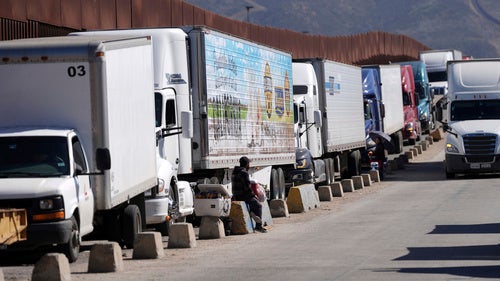
The trilateral trade deal with Mexico and Canada remains in place for now, but the decision raises questions about North America’s economic future.
The United States announced Wednesday it would not agree to renew the United States-Mexico-Canada Agreement (USMCA), raising questions about North America’s economic ties moving forward.
For now, the trilateral trade deal—enacted during the first Trump administration as a replacement for the North American Free Trade Agreement (NAFTA)—remains in place.
“We're not in a sudden-death scenario,” said Council Distinguished Nonresident Fellow Julián Ventura, who previously served as Mexico’s deputy foreign secretary. “The challenge for Canada, Mexico, and key stakeholders in the three countries is to reduce the level of uncertainty as much as possible.”
With discussions between the three nations set to continue, Ventura spoke with the Council’s Libby Berry about the next phase of negotiations, the potential roadblocks ahead, and why North American connectivity matters.
This interview has been edited for length and clarity.
Representatives from the United States, Mexico, and Canada met yesterday for the first joint review of the USMCA, during which the United States announced it would not renew the trilateral trade agreement. What has been the immediate impact of this decision, and what happens next?
In practical terms, what happened yesterday has no immediate impact. The USMCA, which underpins almost $2 trillion in trilateral annual trade, remains in force with ongoing consultations among the three North American partners.
The virtual meeting of the three trade ministers was held in accordance with Article 34.7 of the agreement, which mandates a joint review of its operation on its sixth birthday. Given the US position not to opt for this renewal, the USMCA stays in place for the next 10 years with annual reviews starting in 2027.
It's very important to keep in mind that the treaty itself allows for a 16-year extension if the parties agree to do so at any time before the 10-year expiry date. So, we're not in a sudden-death scenario. Massive USMCA-compliant trade, which amounts to almost $800 billion and is equivalent to about 85 percent of Canadian and Mexican exports, continues with tariff-free access as the three countries continue to work through their differences.
Is this an ideal situation? No, if you consider that maximum certainty in a turbulent economic environment is at a premium and the most desirable objective. The challenge for Canada, Mexico, and key stakeholders in the three countries is to reduce the level of uncertainty as much as possible and ensure that North America's competitive position is better in relative terms than other parts of the world for trade and investment.
US Trade Representative Jamieson Greer said in a statement that Washington would continue to engage with Mexico and Canada “to address the Agreement’s shortcomings. What do you think he is referring to, and what sticking points might emerge in future reviews?
Even before we start thinking about the next reviews, remember that the current one is still ongoing. Mexico and the United States will hold their third round of formal meetings on July 20 in Mexico City, and Canada is moving toward more focused engagement with its Washington counterparts. What is being discussed? The United States has tabled a long list of issues, including what it perceives as unfair Canadian and Mexican trade and investment policies and concerns about the need to address persistent trade deficits with both its partners. This is a big issue for US President Donald Trump.
On the USMCA-specific items that are being discussed, we haven't seen a great deal in terms of details, although from media reports we know that the United States is proposing significant changes to the rules of origin in the automotive sector. Canada and Mexico have their own concerns as well, particularly ones related to significant US tariffs in place on steel, aluminum, copper, and certain auto components.
Beyond yesterday’s meeting, there have been no trilateral trade talks and discussions have followed bilateral tracks. Could we see a shift away from a trilateral agreement to separate bilateral deals between the North American countries?
I see it as an extremely unlikely possibility. Untangling the interconnected nature of our trade would be daunting and would require congressional approval, which is something that the United States has and will continue to try to avoid. The changes that they're trying to factor in are more likely to be reflected in annexes or side letters to the existing agreement. The essence of the USMCA is trilateral in nature. That doesn't mean that the three countries need to be at the table when each and every issue is being discussed. My expectation is that more structured Canada-US dialogues are not too far down the road and that there will be trilateral discussions such as the one held yesterday.
The key challenge is to avoid surprises. Canada and Mexico have been pretty effective in keeping in close touch, exchanging information on their separate interactions with Washington. On the Mexico-Canada front, both countries have committed to an action plan to increase bilateral trade and investment. Mexican President Claudia Sheinbaum attended last year's G7 summit hosted by Canada, and Canadian Prime Minister Mark Carney made an official visit to Mexico. And even without the USMCA, Canada and Mexico are already bound in a free trade framework because they are both parties to the Comprehensive and Progressive Agreement for Trans-Pacific Partnership (CPTPP).
Canada in particular has sought to diversify its economy away from the United States and closer to Europe and China. How might these new partnerships affect North American trade ties moving forward?
The turbulence around USMCA has certainly injected considerable momentum to both Canada and Mexico's diversification strategies. They are both huge export-driven economies, G20 members with a big network of trade agreements. As I mentioned, they're both part of the Trans-Pacific Partnership, and both have strategic trade agreements with the European Union (EU). Mexico recently modernized its long-standing 25-year-old global agreement with the EU. And both Canada and Mexico, like the United States, have significant relationships with China.
It's in our respective national interests to have an open, rules-based North American economic space.
Diversification is a wise move, but as the prime minister of Canada has stated, the intention is not to substitute but rather to complement the North American dimension. Geography matters. Over 80 percent of Mexico's exports go to the United States, 70 percent or so in Canada's case. This is a market that can never be replaced. Millions of jobs and investment decisions depend upon the North American market, and that's why it's in our respective national interests to have an open, rules-based North American economic space.
Recent polling by the Chicago Council on Global Affairs, Buendia y Marquez, and Nanos Research found that American, Canadian, and Mexican publics think the USMCA has been beneficial to their economies and want it to continue in some form. Could public opinion influence the next phase of negotiations?
One would think that these very positive public perceptions in the three countries will impact policy decisions. In this instance, we're seeing more alignment between these perceptions and policy positions in the Canadian and Mexican cases, including on how their respective political leaders are navigating recurrent US pressures on various fronts. This seems to be less apparent in the case of the United States, in which Trump's very critical rhetoric against the agreement seems to be more out of sync with public sentiment. This might change going forward, particularly as we approach November's midterm elections, where congressional seats in trade-sensitive states are in play.
In any case, it's important to keep in mind that there's an implicit recognition of the importance of USMCA and its broader impact by the US administration, reflected in the consistent carve-outs of USMCA-compliant trade from various initiatives. My sense is that political and economic realities will eventually kick in and help smooth the USMCA pathway.
The USMCA review took place as the three countries jointly host the World Cup. Overall, where do North American relations stand in this moment?
North American relations are more resilient and constructive than one would assume. The intensity and depth of our societal, economic, cultural connectivity, and day-to-day interaction is often difficult to fathom, but it's there and it's huge. We might be out of sync on several key issues, but if we think of relations in their broadest sense, they're quite good.
As we look forward to how the USMCA unfolds, it's very important not to lose sight of the big picture. We're each other's best, most reliable partners. We're indispensable to each other if we want to compete in the global economy. Each country, including the United States, cannot do it on its own. We need to raise our collective level of ambition and think strategically about what we need to do together to seize opportunities and to tackle some very significant challenges.
The Chicago Council on Global Affairs is an independent, nonpartisan organization and does not take institutional positions. The views and opinions expressed in this commentary are solely those of the author.

Related Content
 Global Economy
Majorities in USMCA publics believe the 2020 trilateral free trade agreement has been beneficial to their economies, but Mexicans and Canadians are reticent about how much their governments should acquiesce to US demands.
 Global Economy
North America has a chance to come out on top of global trade, investment, and competitiveness in a rapidly shifting geopolitical environment.
 US Foreign Policy
The United States-Mexico-Canada Agreement is up for review in 2026. In its pursuit of a strong economy, the United States would be smart to renew its trade partnership with its North American neighbors.
 Global Economy
As the United States-Mexico-Canada Agreement heads toward its first review in 2026, Julián Ventura shares what’s at stake for the region’s economies.