The USMCA Review: What to Keep in Mind and What to Watch for on North American Trade

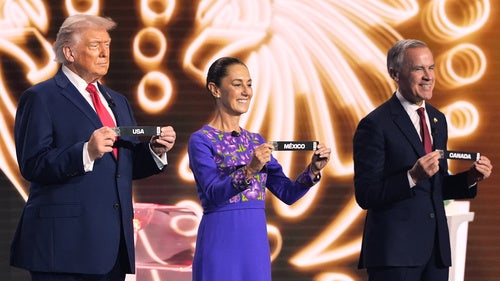
North America has a chance to come out on top of global trade, investment, and competitiveness in a rapidly shifting geopolitical environment.
On the Ides of March and amid global turmoil, it’s easy to be pessimistic. But when it comes to North American trade, there is plenty of room for optimism.
No other trade relationship has a greater impact on the US economy, jobs, competitiveness, and growth than the one the United States has with Mexico and Canada. The trilateral trade deal strengthens the United States’ global economic position, attracts investment, and enhances its economic security.
This week, the United States and Mexico begin bilateral discussions in preparation for the mandated July 1 joint review of the United States–Mexico–Canada Agreement (USMCA).
Here is what to keep in mind and what to watch for as the discussions unfold:
What happens in North America matters globally.
When US President Donald Trump threatened to pull out of the 1994 North American Free Trade Agreement (NAFTA) in his first term, everyone from US trading partners to company boardrooms watched to see if Canada and Mexico could prove it was possible to constructively negotiate with the new occupant of the White House. The 2020 USMCA showed the world that a trade deal was possible, triggering significant foreign investment in the three North American partners and contributing to the nearshoring phenomenon.
Today, the USMCA is just about the only traditional, comprehensive, binding trade agreement the United States complies with—keeping 85 percent of intraregional trade tariff-free. In 2025, according to the US Census Bureau , that amounted to about $785 billion in Canadian and Mexican exports to the United States—more than the combined total exports from Germany, Japan, South Korea, India, Italy, France, and the United Kingdom.
Not all trade agreements are created equal.
Unlike the USMCA, many of the various framework agreements negotiated by Washington are highly discretionary in their implementation and contain difficult-to-enforce, private sector-driven investment commitments.
Recent agreements between other key global players also differ from the USMCA in terms of ambition and scale. In a smart and strategic move, the European Union and India closed a nearly 20-year-long negotiation by temporarily removing tough-to-tackle contentious market access and geographical indication issues to facilitate trade that amounts to less than half of Mexico’s trade with Texas.
The USMCA has been successful, but there is room for improvement.
As recognized by US Trade Representative Jamieson Greer in his report to Congress , US exports of goods and services to Canada and Mexico have increased by 56 percent since 2020 . Despite trade uncertainty, intraregional capital investment flows have also reached record highs, and Mexico and Canada—in that order—are now the United States’ top trading partners and most important customers for the large majority of US exports.
While Greer warned that there will be no “rubberstamp” extension of the agreement if specific bilateral and trilateral “shortcomings” are not satisfactorily addressed, the fact that the preparatory dialogue is beginning should be seen as a positive sign of what is expected to be vigorous US engagement toward July’s formal review. Canadian trade minister Dominic LeBlanc visited Washington earlier this month, and bilateral talks between Canada and Mexico are scheduled for May,
The review process involves more than governments.
The three partners will come to the table having conducted extensive stakeholder dialogues on the agreement with individual companies, business associations, and labor unions. While many have flagged significant concerns, shortcomings, and suggestions for improvement, there remains broad support for extending the deal. Still, their views will inform the countries’ respective negotiating strategies, and ongoing outreach and consultations are expected.
Talks will be bilateral and trilateral.
Onlookers should expect a hybrid process that includes bilateral and trilateral talks. Over the past few months, Mexico has taken a “clear the decks” approach with Washington to address a long list of US concerns, including seasonal produce exports, energy policies, customs regulations, labor law enforcement and foreign investment screening, while also ramping up domestic actions and bilateral cooperation on immigration and fentanyl. Canada has opted instead to hold off on engagement with the United States until USMCA consultations begin on various bilateral issues identified by Washington—including concerns about market access for US dairy products.
Many specific issues, by their very nature, will need to be addressed with all three countries at the table, including those related to the critical minerals marketplace sought by Washington and possible adjustments to the agreement’s calculation of rules of origin, which Greer has indicated the United States wants to extend to include non-automotive industrial goods.
While some have warned of potential pitfalls for Canada and Mexico posed by a “divide and conquer” negotiation dynamic, the hybrid approach makes sense and should not cause undue concern as it can be offset by close communication and constant information sharing between Ottawa and Mexico City.
The China dimension.
China-related issues are expected to be at the forefront of the USMCA talks, as all three North American partners have substantial political and economic relationships with Beijing, considering all are facing a set of similar challenges derived from China’s trade and investment strategies. The United States, Mexico, and Canada are all considerably reliant on Chinese components for their respective manufacturing sectors. Notably, over 70 percent of Mexican imports and over 45 percent of Canadian and US imports from China are capital and intermediate goods.
Beyond trade, China is also an essential cooperation partner on a wide range of global challenges, including the effort to effectively reduce the flow of the chemical precursors used to make fentanyl. Moving toward sensible North American policy alignment while acknowledging differences in each country’s relationship with China is a smart move that will require a nuanced and gradual approach. Canada and Mexico will need to keep a close eye on the North American dimension of any trade-related outcomes from Trump’s anticipated visit to Beijing.
Trump’s words carry weight, but they should not drive policy decisions.
Since unveiling his America First Trade Policy , the US president’s stream of statements and posts have presented tough navigational challenges for US allies and partners. Mexican President Claudia Sheinbaum has been careful in her response, avoiding verbal back-and-forth in favor of intensive and direct government-to-government engagement. This approach has paid off and put Mexico in a better relative position compared to other partners. Lessons learned over the last months should stay top of mind during the review.
The White House may set the rules, but Congress and the courts will play a role.
The recent Supreme Court ruling striking down Trump’s International Emergency Economic Powers Act (IEEPA) tariffs significantly altered the global tariff jigsaw puzzle by triggering a new 15 percent global tariff that does not apply to Mexico and Canada, as well as a slate of Section 301 investigations focused on structural excess capacity that includes Mexico.
With the US midterm elections approaching, greater legislative branch assertiveness is expected, particularly from trade-sensitive states and congressional districts. This means there could be room for smart, targeted Canadian and Mexican engagement with key players and potential advocates.
Diversification is important, but the core should be protected.
Diversification should be a long-term strategic goal for every country. Mexico and the European Union are set to modernize their 25-year-old Global Agreement, and Canadian Prime Minister Mark Carney has just concluded a diversification roadshow. Both Mexico and Canada have a large network of free trade agreements, including the Comprehensive and Progressive Agreement for Trans-Pacific Partnership (CPTPP).
Almost 60 percent of Canadian exports are primary products. This commodity-based export mix gives Canada greater short- and medium-term bandwidth for redirection to other global markets. This is not the case for Mexico, however. Its high North American content manufactured goods account for almost 92 percent of its exports and consequently make it difficult to redirect to alternative markets.
Still, as Canada and Mexico seek to expand or stake out new markets, realism and the national interest should prevail. Both nations’ overwhelming strategic imperative should be to inject as much certainty and stability as possible into their North American economic space. With over 80 percent of Mexican exports and over 70 percent of Canadian exports destined for the United States— and millions of jobs and investment decisions at stake—reality demands it.
Much attention will be paid to the specific modalities of the potential USMCA renewal in the coming weeks. Possible outcomes include a 16-year extension, yearly reviews over the next decade, or two bilateral agreements, the latter of which could require congressional approval. Each scenario entails different levels of uncertainty. Yes, the shape of the outcome is important, but beyond its specific design, the ultimate goal for both Canada and Mexico should be to maintain as much tariff-free access, eliminate or reduce as much as possible sectorial and other ancillary tariffs, and ensure supply chain viability through continued access to vital inputs and sensible rules of origin.
The road ahead will not be free of unexpected twists and turns. There is no tried-and-true playbook to guide the process, and no scenario is ever perfect. Regardless of outcomes, uncertainty will remain the name of the game, at least for the foreseeable future. But if Mexico, Canada, and the United States play their cards right and follow a realistic, strategic, and forward-looking approach, North America has a chance to come out on top of global trade, investment, and competitiveness in a rapidly shifting geopolitical environment.
The Chicago Council on Global Affairs is an independent, nonpartisan organization and does not take institutional positions. The views and opinions expressed in this commentary are solely those of the author.
Related Content