Trump's Shifting Objectives in Iran and How the War Could End

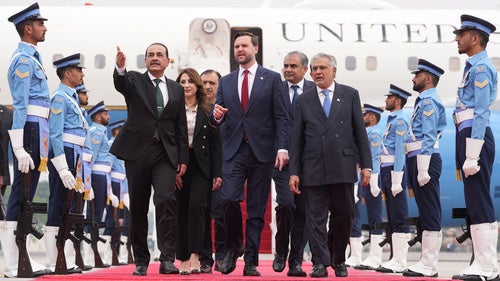
With distrust deepening and the Iranian regime still in place, can the United States and Iran reach a deal?
Since joining Israel in the February 28 attack on Iran, US President Donald Trump has given several reasons for the United States’ continued military engagement in the region. His mixed messages on US goals have complicated the pursuit of a resolution to the military conflict, which continues to be deeply unpopular among Americans. On Wednesday, Trump said that there was “no time frame” for ending the war, stressing that his administration wants a “good deal for the American people.” But what does a “good deal” look like today?
Council Senior Fellow and Vice President of Research for Security and Defense Ariane Tabatabai spoke with the Council’s Christina Colón about how much progress the Trump administration has made toward achieving its objectives, the current state of the Iranian regime, and how the war with Iran is likely to end.
This interview has been edited for length and clarity.
The Trump administration has outlined several goals for the Iran war. What are the current objectives? And how do they compare with those shared at the beginning of the conflict?
The administration’s stated objectives have shifted throughout the course of the conflict, and they even shifted prior to the conflict starting.
Back in January, as large-scale protests going on in Iran, the regime killed thousands of people to reassert control over Iranian cities. President Trump said that he might intervene to help protect protesters. A bit later, Trump talked about using force as a lever to get Iran to the negotiating table to conclude a deal on its nuclear program. But negotiations were ongoing when the president made the decision to join Israel in large-scale combat operations.
In the days following the conflict, the administration framed the war as a response to an imminent threat from Iran. More recently though, the administration has settled on a set of objectives largely around degrading and destroying key Iranian capabilities: further degrading Iran's nuclear program; scaling back its missile, drone, and naval capabilities; ensuring that Iran will not be able to continue using its proxies to threaten US forces and partners; and protecting US partners in the region. Though here, too, there are some discrepancies in the administration’s statements, with the drone program appearing among these objectives in some statements and not in others.
Why have those objectives become the administration’s focus? What unique threats are associated with each one?
The nuclear program really is the big-ticket item when it comes to what the United States has considered the Iran issue set. If Iran were to weaponize its nuclear program, it would immediately complicate every problem the United States has with Iran, not to mention the general threat it would pose to the nonproliferation regime, the international order, and regional security.
Multiple administrations going back to the George W. Bush administration have tried to tackle the problem of Iran's nuclear program, and they've all done it a little differently. In 2015, President Barack Obama reached a signature deal called the Joint Comprehensive Plan of Action (JCPOA)—or the Iran nuclear deal—which imposed verifiable limits on Iran's nuclear program in exchange for some sanctions relief. President Trump, in his first term, withdrew from that deal. And then he started building out what his administration referred to as the ‘maximum pressure campaign,’ which was really anchored by sanctions and export control actions.
The Biden administration came in and tried to rejoin the JCPOA, hoping to build on it to address other areas of concern like support for terrorism and the missile program. It failed to do so. And so, it used a mix of diplomacy, sanctions, and export controls to try to impose limits on Iran's nuclear program again. Then President Trump came back into office and he kind of continued that initially—a little bit of diplomacy, a little bit of sanctions—but what really changed—and what is now a big departure from decades of US policy—is that he's turned to force to try to scale back the Iranian nuclear program.
Over the summer, we had what the administration dubbed ‘Operation Midnight Hammer,’ where it targeted key Iranian nuclear facilities to try to scale that program back. And now we're in the middle of ‘Operation Epic Fury,’ which is also trying to continue to degrade Iran's nuclear capabilities. The US intelligence community had assessed for years that Iran had not made the decision to acquire a nuclear weapon. Iran did once have a clandestine nuclear weapons program, which it stopped in 2003 (though it carried forward elements of it until 2007).
Iran's missile program is another core problem at the center of Iran policy. Iran has of course used its missiles and supplied them to its proxies throughout the region to deter, harass, and attack US forces and US partners in the region. In fact, a tension at the center of the JCPOA was that it did not include limits on Iran's missile program, which critics found to be very problematic since that program could be used potentially to deliver nuclear weapons if Iran ever were able to acquire them.
The nuclear program really is the big-ticket item when it comes to what the United States has considered the Iran issue set. If Iran were to weaponize its nuclear program, it would immediately complicate every problem the United States has with Iran.
More recently, unmanned aerial vehicles (UAVs) or drones have become another important problem in the Iran issue set. Not only has Iran been using UAVs itself to target US forces and US partners, but it's also been supplying them to its proxies throughout the region, as well as supplying them to Russia to use in its war against Ukraine. Now, Russia is resupplying Iran with essentially the same drones, which it has upgraded during its war in Ukraine.
Next is the naval capabilities. Iran doesn't have a blue-water navy. And it's not a particularly sophisticated navy. So, it's been interesting to see that the administration has elevated Iran’s naval capabilities as a problem in a way it wasn't by previous administrations. Iran mostly relies on asymmetric capabilities, which we're seeing in the Strait of Hormuz right now. Iran has been able to use fast boats and mining for example—which are not a particularly expensive or a complicated thing to use—to really hold that entire choke point at risk and impose a cost on its adversaries.
The proxies serve as a force multiplier for all the capabilities I've described, as they allow Iran to project power beyond its borders and expand its strategic depth. They have been a core problem we've had with the regime for 47 years now. As Iran has a weak conventional military, it uses these forces throughout the region to attack, harass, and deter adversaries, including the United States and its partners in the region.
Since the Hamas attack on October 7, 2023, Israel has been gradually degrading these proxy capabilities, starting with Hamas and Lebanese Hezbollah, which has served as the main hub to Iran’s proxy network. One interesting counterfactual is what would this conflict look like if Iran had its full capabilities as was the case prior to 2023 when it comes to its proxies? I imagine that the cost of this conflict would be a lot higher for the United States and its partners.
How much progress has the United States made toward achieving each of these goals?
Operationally, the United States has been able to degrade and scale back a lot of these capabilities. But when we start to zoom out and look at what it’s doing strategically, it becomes a little more complicated.
The United States has significantly degraded Iran's nuclear program. There is no doubt about it. Between ‘Operation Midnight Hammer’ over the summer and the ongoing conflict, key facilities and equipment have been damaged and destroyed. But Iran maintains two very important things: One is that it still has a stockpile of highly enriched uranium. Open-source estimates are that Iran could produce about 10 to 12 nuclear weapons with the stockpile it currently has in the country.
The second is Iran’s knowledge base. As I mentioned, Iran had a nuclear weapons program until 2003, and it has had a nuclear energy program for decades now, going back to before the revolution. It has all these scientists, technicians, and engineers who have been working on maintain that knowledge that could enable Iran to acquire a nuclear weapon if it decides to do so.
The concern that I and many of my colleagues in the analytical community have is that this war may have made it more likely that Iran will seek to acquire a nuclear weapon. There is now a much more radical iteration of the regime in place than a few months ago—one that is more closely aligned with the Revolutionary Guards. And through this conflict and Operation Midnight Hammer, Washington has essentially indicated to Iran that its current deterrence posture is not sufficient. If you look at the slate of countries that President Trump has either intervened in or has threatened to intervene in, they're all non-nuclear weapon states (Venezuela and Cuba, for example). And so, I'm concerned that after this conflict, Iran will be more determined than ever to acquire a nuclear weapon.
When it comes to missiles and UAVs, there are some different estimates as to how much the United States has degraded these capabilities. I think we’ve made significant progress, but again, open-source reporting indicates that Iran retains some of its arsenal and the means of production and can certainly reconstitute the capabilities that the United States is degrading right now. The question to me is how fast can it rebuild those capabilities? And I suspect that the regime will prioritize rebuilding its missile and UAV capabilities after a conflict because the program has really paid off the most for it in this conflict.
Naval capabilities are another area where they're probably going to try to reconstitute what they can, and potentially with improvements. If you watch the events in the Strait of Hormuz, Iran has been able to raise the cost of the conflict for the United States in a way that we had sort of predicted in the analytical community, but it's certainly been much more sophisticated even than we had anticipated.
Iran does not need very big, sophisticated, expensive platforms. What it needs is those asymmetric capabilities. And it can pretty much rebuild those on the cheap.
Iran is probably going to deprioritize its proxies because they haven't really paid off for it. Lebanese Hezbollah hasn't been as involved in the conflict. The Houthis, Hamas, the Iraqi Shia militias—all of these groups have had their own calculations, their own interests. They have been a lot less involved than we would have imagined a few years ago.
US President Donald Trump has also frequently stated his desire to see the Iranian regime overthrown. What is the current state of the Iranian system?
The main thing to know is that the system remains in place. Its architecture continues to exist in the same way that it did a few months ago, and the regime's grip on power remains essentially intact. Over the course of decades, the regime has built an architecture outside of a few key figures to be able to sustain itself in the face of potential conflict with outside adversaries and in the face of intense pressure domestically. That includes decision-making bodies and security forces.
But while the power centers remain in place, a lot of the personalities who used to be part of that system have been killed by the United States and Israel. We are now seeing a cohort of new military, civilian, and clerical leaders come to power or assume new positions. Some are less experienced; some are a bit more experienced. But overall, if you look at them side-by-side with their predecessors, many are much more hardline than the people that they're replacing—most of whom were far from progressive icons, to say the least.
What impact has the war had on the US position in the world? What costs and tradeoffs have come with the administration’s decision to engage in a military conflict in the Middle East?
The most important and the most obvious is the loss of human life. Thirteen US service members have been killed, and hundreds have been injured in this conflict. Thousands of civilians have been killed in Iran and in Lebanon.
And the conflict is now taking place at a regional level with implications for the populations of countries from Israel to Iraq and the Persian Gulf. Then there is the economic cost: Tourism and energy sectors are being hit throughout the Gulf, and freedom of navigation remains disrupted in the Strait of Hormuz, with second- and third-order effects from energy to fertilizer supplies. But I want to zero in a little bit on the military side of things, because I think that is not discussed as much beyond the defense community. Just this week, we had reports indicating that the United States can't really supply or continue delivering certain weapons to European allies. It is having to move assets from the Indo-Pacific to the Middle East. These are just some of the immediate things that are happening, but there's going to be consequences in the longer term as well.
There's going to be a readiness impact going forward for the US military. It is burning through ammunition. It is burning through interceptors. These are all things that it’s going to need in other conflicts and other scenarios.
There's going to be a readiness impact going forward for the US military. It is burning through ammunition. It is burning through interceptors. These are all things that it’s going to need in other conflicts and other scenarios, whether in a few months or in a few years, and it's going to take time for the United States to rebuild and restock. There are billions of dollars that it’s going to have to spend to rebuild facilities throughout the region that are being targeted by Iranian and proxy drones and missiles. So, there are second and third-order effects that are going to keep unraveling militarily in the years to come.
Finally, there is a cost for US alliances and US standing in the world. The United States have tensions with NATO and other allies that are not just due to the war in Iran but exacerbated by it. And these tensions are going to have implications for pretty much everything the United States does in the world, from Europe to the Indo-Pacific. And they're not going to end as soon as this war ends.
How could the war end? And what comes after—for Iran, the United States, and the world?
There are three main scenarios that I foresee: We get a deal, the war escalates further, or the war drags on until somebody finally gives up. And we could, of course, have some sort of combination of the three. We could have escalation followed by a deal, for example, which is a very likely scenario.
Let’s start with a deal. The fact that the vice president of the United States is leading a delegation to negotiate with Iran is not a small thing. This is a regime the United States hasn’t had diplomatic ties with over the past almost five decades. While there have been high-level negotiations led by the secretary of state, for example during the Obama administration, this is still a significant development.
At the same time, progress has been patchy. We've seen threats by the president to erase the Iranian civilization while at the same time talking about negotiating a deal. He’s threatened a blockade while discussing a ceasefire. So, the policy remains confused and the messaging confusing, which doesn't lend itself particularly well when you're trying to negotiate with an adversary in the middle of a war, which is already complex enough.
Things will take time. The JCPOA was just focused on the nuclear program, and it still took several years to negotiate. So we shouldn't expect a quick settlement here. Again, these are two countries that deeply distrust each other. They're already fighting a war, and now they're going to have to come and conclude a series of deals or a deal on some thorny issues.
The second scenario is escalation. Already, an estimated 3,000 civilians are dead in Iran, and a lot of infrastructure damaged. If the US president follows through on his threats to escalate the conflict further—going after bridges, power plants, and other critical infrastructure more broadly—it could be devastating. We would see thousands more die in this conflict. And, in an even worse scenario, the United States could decide to put boots on the ground. That would mean a lot of consequences and many casualties on both sides.
Lastly, there is a scenario in which everybody just kind of carries on and then eventually moves on to other objectives and says, “mission accomplished.” I think this is a possibility as well because we've seen President Trump do that elsewhere. We're just a few months ahead of the midterms and this is a deeply unpopular war in the United States, so there is a possibility he says, “We've done what we had to do. Let's move on to the next thing.”
In terms of what happens next, I'm pessimistic about the future of Iran, at least in the immediate future after the conflict. We're going to be dealing with a more hardline regime. We're likely going to be dealing with a regime that is going to seek a nuclear weapon, and I hope that my prediction doesn't actually come true. But I think we're going to be dealing with a regime that is going to be much more problematic even than the one that we had before.
The Chicago Council on Global Affairs is an independent, nonpartisan organization and does not take institutional positions. The views and opinions expressed in this commentary are solely those of the author.

Related Content
 Global Politics
A European-led international mission and the Gulf Cooperation Council are trying to determine who will guarantee openness and stability in the strait once the Iran war ends—and how.
 Public Opinion
Recent polls show Democrats and Independents oppose US policy toward the conflict, while Republicans back the Trump administration's approach.
 Global Politics
Thinking about Pakistan as a South Asian power misses the fact that it has regional connections to the Middle East—and global power connections it can leverage.
 US Foreign Policy
Matt Duss unpacks what the widening conflict with Iran could mean for the future of US foreign policy.