Why Pakistan is Mediating Between the United States and Iran

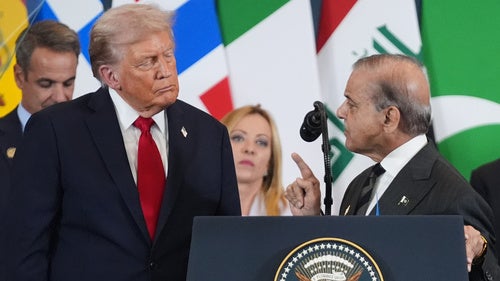
Thinking about Pakistan as a South Asian power misses the fact that it has regional connections to the Middle East—and global power connections it can leverage.
As the Trump administration pushes to bring its war with Iran to an end, Pakistan has emerged as a key mediator, passing messages between Tehran and Washington and hosting regional powers seeking to deescalate the conflict.
While Pakistan borders Iran to the west, its effort to broker peace talks has come as a surprise given its global position, domestic challenges, and volatile relationship with US President Donald Trump in his first term. Can the nation manage this moment of high-stakes diplomacy?
Council Senior Nonresident Fellow Paul Staniland spoke with the Council’s Christina Colón about why Islamabad became the primary intermediary, how its role in the conflict is impacting US-India relations, and what is at stake for Pakistan should negotiations go awry.
This interview has been edited for length and clarity.
Turkey, Pakistan, and Egypt have all been actively mediating between the United States and Iran, yet Pakistan has emerged as the key mediator. How did Pakistan become the primary broker between Washington and Tehran?
It actually goes back a little bit before this most recent crisis. Pakistan has really reached out to the Trump administration and Donald Trump personally, as well as his family members, to try to build influence in Washington. Under the first Trump administration, Pakistan was kind of a sideshow. Trump even tweeted negative things about it. But it has shown itself to be more useful in the second Trump administration. So, there's a preexisting basis for US-Pakistan cooperation under this administration.
Pakistan also has strong relations with Iran, with which it shares a very long land border. It also recently signed a defense pact with Saudi Arabia—which is obviously part of this crisis—and it has strong connections with China, which is affected by the energy crisis that's emerged. So, Pakistan is trying to use these different connections to place itself in a mediator role in ways that I think signal a greater level of geopolitical clout and influence than we might have expected a couple of years ago.
Pakistan has been referred to as an “unexpected” mediator. Why has its involvement in negotiations come as a surprise?
I think Pakistan has really fallen behind India in terms of the general South Asian competition for power and influence. India has grown much faster, has a much larger economy, and Pakistan, in the eyes of some, has been relegated to a secondary state in South Asia. However, it does have very important linkages to the Middle East—Saudi Arabia, Iran, the Gulf states—as well as to global powers like the United States and China.
Thinking about Pakistan as a South Asian power misses the fact that it has both regional connections to the Middle East, but also these kinds of global power connections that it's been able to leverage very effectively.
Let's talk about India. Pakistan is deepening ties with the United States at a time when the US-India relationship is experiencing real friction. Does a warmer US-Pakistan relationship complicate the broader picture in South Asia?
It has complicated things to a certain extent. There have been two major irritants in the US-India relationship in the second Trump administration. One has been unrelated to Pakistan, which is US-India negotiations over a trade deal that would be acceptable to both sides. The second source of irritation has been the Pakistanis’ cultivation of Trump. They've nominated him for a Nobel Peace Prize. They're involved in his “Board of Peace.” And I think India worries that Pakistan has been more effective at kind of playing the Trump administration and getting in its good graces. This creates, in some ways, some real challenges for India. In other ways, it doesn't. It doesn't change the fact that India has been on a long, sustained growth trajectory. It doesn't change the relative balance of power between the two countries.
On the other hand, I do think it raises questions about Washington's reliability—and in some ways answers them. Washington is not a reliable strategic partner for India in the same way that people may have thought three or five or 15 years ago. That doesn't mean US-India relations are doomed or going to kind of decay, but that there's probably a lower ceiling on the relationship than some in both Washington and New Delhi would have thought until fairly recently.
Why is Pakistan eager to gain the favor of Washington?
Because Pakistan is relatively weaker in South Asia, it looks for outside powers. China has been and continues to be the most consistent strategic partner of Pakistan, but the Pakistanis have also tried not to rely too heavily on China, so they've looked at two other sources. One is the United States, which has a very up-and-down relationship with Pakistan going back to the mid-1950s. Currently, the relationship is on an upswing. There's no guarantee that upswing will continue, though.
Pakistan is looking to create a diversified portfolio of relationships that will let it punch above its weight—and also allow it to hedge against or balance against Indian influence and power within South Asia.
The other is the Gulf states and the Middle East in general. Pakistan is looking to create a diversified portfolio of relationships that will let it punch above its weight—and also allow it to hedge against or balance against Indian influence and power within South Asia.
Pakistan is currently involved in several active conflicts, including military operations against Afghanistan, a longstanding dispute with India, and an internal insurgency. How is it navigating its role as a mediator amid these domestic and regional challenges?
Right now, they're somewhat disconnected. The mediation role really doesn't have much to do, at least not very directly, with the Pakistan-Afghanistan conflict—which has flared back up in recent days—or insurgency in the Pakistani province of Balochistan or the Pakistan-India conflict. Those are all underlying strategic challenges that Pakistan faces. And there are also economic problems that have been triggered by—and really exacerbated by—the energy and fertilizer crises coming out of the current war.
I think Pakistan is attempting to use its various different relationships to kind of give itself greater geopolitical clout. At the same time, that doesn't change the fact that it has an active conflict on one border, a conflict that could flare up at any moment on the India border, and pretty substantial internal security concerns. So, on the one hand, this is an important moment for Pakistan. But it doesn't transform anything structurally that Pakistan is currently facing.
What would a successful outcome look like for Pakistan? And what's most likely to get in the way?
A successful outcome would be Pakistan being able to facilitate some kind of resolution to this war. What that looks like exactly, I'm not going to hazard a guess. Both the United States and Iran appear to have passed messages. The Pakistanis have convened a meeting with other regional powers in Islamabad. The foreign minister flew to Beijing. So, it sounds like they're trying to help craft some kind of deal. If there is a ceasefire or some kind of resolution, that would be a success. But the reasons for that to fail are many and largely outside of Pakistani control.
It’s not clear what the Trump administration's goals are or what it views as an acceptable endgame. I think it's fair to say the messaging out of Washington has been extremely confusing and contradictory. It's also not clear what either the Iranians or the Gulf states would accept. But I think Pakistan is trying to navigate and figure out what the different constraints are on all these sides, and hopefully it can play a role in facilitating some kind of conflict resolution. Being able to do that would let it frame itself as a regional stabilizer and as a valuable intermediary between conflictual, divided parties and give it a sense of influence and power within the broader Middle East and South Asia that could be useful in the future.
What does Pakistan stand to gain—and potentially lose—by serving as a meditator?
I think the downsides are not specific to Pakistan. An escalated economic crisis is very bad for Pakistan, but it's bad for the rest of Asia as well. Asia has really been hit by the economic ripple effects of this conflict. It’s possible that Trump could blame the Pakistanis in some way if this deal doesn't happen. But I think that the downside risks are not very high.
There is one specific risk Pakistan faces that a lot of other states don't: It has a defense pact with Saudi Arabia. It doesn't want to be in a situation where the war escalates, and it's forced to be called to Saudi Arabia's aid against its neighbor—and important potential business partner—Iran.
In terms of advantages, I think you could imagine Pakistan being able to get better deals from certain countries or leaders, either as a kind of thank you for its role or in recognition of its greater clout or influence in the international system. I think in a lot of ways though what it's trying to do is limit the damage to itself economically and politically. So, it's not necessarily looking for special favors that it could call in in the future, but those may be kind of valuable side effects as well.
More broadly, I think Pakistan does look to this as an opportunity to escape being locked in this rivalry with India as the kind of primary way in which people understand Pakistan's international role. This is a chance to allow it to say it plays other valuable roles within the international system.
What else is important to understand about Pakistan’s role in this moment?
One thing that's important is how Trump administration-specific this kind of moment is with Pakistan. Under the Biden administration, ties with Pakistan were fairly peripheral and secondary, and even hostile at times. The Pakistani strategy right now has been catered very carefully and successfully toward Trump and his inner circle.
After 2028, it's not clear if the United States and Pakistan will continue to have good relations or is if this is kind of an artifact of a particular moment around the Trump administration. The US-Pakistan relationship has seen enormous ups and downs over the decades, so there is a lot of uncertainty about the future.
The Chicago Council on Global Affairs is an independent, nonpartisan organization and does not take institutional positions. The views and opinions expressed in this commentary are solely those of the author.

Related Content
 Food Security & Sustainability
Catherine Bertini and Michael Werz explain how the Iran war could ripple from energy markets into global food systems, driving prices higher and worsening global food security.
 Global Politics
The Iran war is presenting the greatest test yet of the limits of America's power in an increasingly multipolar world.
 Global Politics
Washington’s Iran policy should be grounded in human rights, liberalism, democracy, regional stability, national security, and economic opportunity—and treated as both a strategic and a moral issue.
 US Foreign Policy
Matt Duss unpacks what the widening conflict with Iran could mean for the future of US foreign policy.