What Regime Change Could Mean for Iran

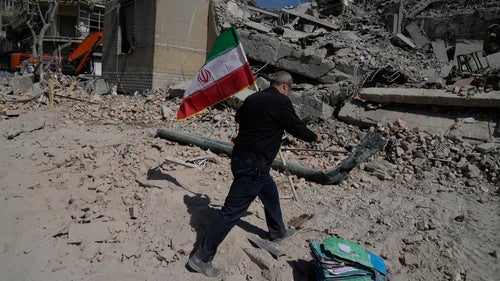
Washington’s Iran policy should be grounded in human rights, liberalism, democracy, regional stability, national security, and economic opportunity—and treated as both a strategic and a moral issue.
In Washington, Iran policy has become a party reflex. A decision by one administration is rejected by another administration—even when the facts on the ground point in the same direction. The instinct is understandable. The enduring trauma of the 2003 invasion of Iraq looms large in every debate. But Iran is not a talking point, and this moment is not about party loyalty. It is about whether the United States is willing to confront a regime that has treated violence, aggression, and hostage politics as its core identity for nearly five decades.
Since coming to power in 1979, the Islamic Republic has defined itself as anti-American and anti-Zionist, building an ideology of exporting the Islamic revolution beyond rhetoric. Tehran learned it could undermine the international liberal order without engaging in a direct conventional war by investing in proxy networks, missiles, and drones—using them as tools for negotiation and escalation. At home, Iran developed a secretive nuclear program and used repression as a means of governance.
Iran’s history demonstrates why the weakening of the regime’s coercive center matters so much in this moment. With Ayatollah Ali Khamenei dead, the Islamic Republic enters a succession moment that could quickly become a legitimacy crisis. If the regime’s grip fractures and competing factions within the security state begin to fight over control, the strategic landscape will shift. A regime built on coercion is most vulnerable when its chain of command is disrupted, rival power centers stop coordinating, and the aura of inevitability that kept elites loyal begins to fade.
Today, there are humanitarian, security, and economic cases for pursuing regime change in Iran. The Islamic Republic has become increasingly repressive since it overthrew the Pahlavi monarchy. Its use of repression is not accidental or sporadic; it is systematic and entrenched. For years, Iranians have endured cycles of mass arrests, torture, executions, and deadly crackdowns on protests. Between January 8 and 9, the regime killed thousands of its own citizens for taking to the streets and demanding change. This is not an authoritarian state that sometimes oversteps, but a modern security autocracy that uses fear as a core tool of governance. And a regime that normalizes mass violence should not be treated as a legitimate political authority.
For years, Iranians have endured cycles of mass arrests, torture, executions, and deadly crackdowns on protests.
Throughout the years, Iran has remained a persistent challenge to US national security—regardless of which party occupied the White House. Washington’s inability to manage the country is not a partisan assessment, but a reflection of the Islamic Republic’s strategic posture and methods of building power. For decades, the Islamic Republic has established a regional model that depends on ongoing tension and crises. It does not aim for a final resolution; instead, it seeks leverage. This leverage is derived from multiple fronts, proxies, and calibrated escalation, which keeps the region on the brink of wider conflict while forcing the United States and its allies into a constant cycle of crisis response.
The regime has worked to weaken US influence in the Middle East not only with rhetoric but through policy. It has armed and funded proxy groups such as Hezbollah in Lebanon, supported attacks on US military bases, and used missiles and drones in an attempt to expel the United States from the region. It has engaged in hostage-taking and coercive diplomacy to extract concessions and deter external pressure, and undermined US credibility among allies by casting the United States as an unreliable security partner. All of this has been done to eliminate US influence in the Middle East. The regime’s intent has never been to simply resist US policies, but to reshape the regional order—constraining US power, weakening US partners, and making Iran’s influence the prevailing reality.
Since the United States and Israel launched their coordinated attack on Iran, the Islamic Republic has attacked more than seven Arab countries in the region, including Oman and Qatar—longstanding allies of Iran’s ayatollahs that regularly tried to shield Iran from the United States’ rage. While a different Iranian regime would not solve every regional problem, it would remove the central engine of organized destabilization. A post-Islamic Republic government led by the interests of the Iranian people would focus on solving domestic problems instead of pursuing revolutionary expansion, and the region could move toward agreements that are unrealistic under the current leadership. Iran could join a new security architecture—rather than sabotage it—by normalizing relations with its neighbors, including Israel, and joining frameworks like the Abraham Accords.
Economically, Iran is a major country with significant market potential across sectors, including energy, infrastructure, aviation, technology, and consumer goods. Under the current regime, these opportunities have remained largely unrealized due to sanctions, mismanagement, corruption, and political unpredictability. Even after the 2015 nuclear deal, American companies were kept out of the country. A different Iran could reintegrate into global markets, which would open new trade and investment opportunities, reduce volatility in the Persian Gulf, and promote more predictable shipping with less disruption from proxy warfare.
While the humanitarian, security, and economic cases for military intervention have been frequently raised, there is a fourth reason that many analysts have understated: the geopolitical chain reaction. The Islamic Republic is part of an informal axis of authoritarian cooperation. Tehran’s networks connect to Moscow’s revisionism, Beijing’s anti-liberal worldview, Pyongyang’s proliferation model, and a broader coalition of nations that learn from each other’s coercive tactics. As such, a successful democratic transition in Iran would not only impact coordination between authoritarian regimes but also potentially strengthen global democracy by challenging the narrative that authoritarian repression is a viable long-term strategy.
Of course, none of this means the United States should act recklessly. Regime change should not and cannot be a slogan. The objectives of military action must be clear and limited, the risk of escalation must be planned for, and civilian harm must be minimized. Most importantly, any path toward regime change must prioritize Iranian agency. The United States can help in this process by creating conditions that make the regime’s coercive system less effective while expanding the opposition’s space for organization.
The fundamental question today is not whether Iran is a threat but whether American decision-makers will remain constrained by partisan perspectives in the face of a regime that is harming its citizens, destabilizing its neighbors, and challenging international norms. Washington’s Iran policy should be grounded in human rights, liberalism, democracy, regional stability, national security, and economic opportunity—and treated as both a strategic and a moral issue.
The Chicago Council on Global Affairs is an independent, nonpartisan organization and does not take institutional positions. The views and opinions expressed in this commentary are solely those of the author.
Related Content
 Global Politics