Are We Headed for a Bigger War with Iran?
 Play Podcast
About The Episode
US and Israeli strikes on Iran have triggered retaliation across the region, with drones, missiles, grounded flights, and rising oil prices. But what’s the actual goal? Is this a short, decisive campaign or the start of something bigger? And if the fighting stops, does the region return to normal or just settle into a tense pause before the next round? From Tel Aviv, former US Ambassador to Israel Daniel Shapiro breaks down what the US and Israel are trying to achieve, the risks involved, and why the outcome is far from clear.
This transcript has been edited for clarity.
Leslie Vinjamuri: If you've been trying to keep up with what's happening between the United States, Iran, and Israel, it can feel like every few hours, there's another headline. It's a lot, and it's moving fast. Now, President Trump is warning of even larger strikes ahead, and the fallout is rippling across the region, impacting US allies, and raising the stakes well beyond the United States, Israel, and Iran.
Maybe the real question isn't just what's happened, but where this is headed? Are we looking at a contained round of escalation, or are we at the edge of something much bigger?
Daniel Shapiro, former US Ambassador to Israel in the Obama administration and a Pentagon official under President Biden, joins us from Tel Aviv. He's here to help us think through exactly that.
I'm Leslie Vinjamuri, president and CEO of the Chicago Council on Global Affairs, and welcome to Deep Dish.
Dan, you were in Israel for other reasons, but now you are clearly caught there for a period of time. Maybe you could give us your initial reaction, what you anticipated, and how you capture the current state of affairs.
Daniel B. Shapiro: There have been two tracks that have led to this moment. One track is following what's been known as the 12 Day War back in June of last year, when Israel attacked Iranian nuclear facilities, primarily. Then the United States joined in the end. That nuclear threat was put on the back burner. But the Israelis became very focused on the ballistic missile threat because during that war, in response to the Israeli strikes, Iran fired hundreds of ballistic missiles at Israel.
Israel has excellent missile defense capabilities, but over the course of that 12-day war, an increasing number of those were able to get through the defenses, and there were strikes. I think 30 Israelis were killed in those strikes. Hundreds of homes were destroyed. Thousands of Israelis were injured and displaced. So it was quite meaningful, and it was really just a taste of what Iran's capability is. It has over 2,000 medium-range ballistic missiles that can reach Israel. It had ambitions to manufacture as many as 30 a month.
So the Israelis, even though the nuclear threat was addressed to some degree, were telling the Trump administration that they were going to have to go back and address that ballistic missile threat at some point in the coming months.
I believe it was at the meeting at Mar-a-Lago, just around New Year's, when Prime Minister Netanyahu presented this case to President Trump. The reports noted that President Trump said, "Yeah, I understand, and we'll figure out the timing, but you'll have our support when that time comes."
Then, in January, an X factor was introduced: the protests by the Iranian people against the regime. It's hard not to feel some solidarity with them. President Trump said, "Help is on the way. We have your back. Go out to the streets, take over your institutions. There'll be a real price to pay if the regime cracks down on these protests." But the regime did crack down on the protests and killed thousands.
President Trump had kind of drawn a red line, but didn't really respond in real time. It looked like, in January, he was about to make a strike, and I thought he was going to take a short, sharp strike, perhaps to kill the supreme leader, perhaps to hit some of the other security institutions that suppressed the protests to show that there was a price to be paid. So he backed up his call to support the protestors and threatened that there's more where that came from. It increased economic pressure to hold his line on zero enrichment as the nuclear negotiation standard.
LV: Are you suggesting that the fact that he didn't do that, and instead entered the negotiations that we saw in Geneva, President Trump was more or less sticking to the line that the negotiations were actually about enriching uranium and about the nuclear program only? Are you suggesting that the negotiations were sort of a false pretense?
You've talked about the protests. Is there any degree of commitment to Iran being able to deliver something in those negotiations that would've prevented the US from taking action?
DS: The question requires us to put ourselves inside Donald Trump's mind, and that's a place I never fully understand. I try not to speculate other than to say I think he has different impulses and they sometimes pull in different directions.
He'd sort of given an acknowledgement that the missiles had to be dealt with. Then he felt this moment and made a red line declaration that he would support the protestors. Then, when the moment didn't seem right to strike because maybe they weren't prepared, or Israel wasn't prepared, and they needed more assets in the region to do that, he got pulled back into these negotiations. Of course, he held very firm to the standard he'd had last year, which was that it had to be zero enrichment and Iran sending out all of its highly enriched uranium and total transparency of inspections of all their facilities.
There was never a chance Iran was gonna agree to those terms, in my judgment. But if Iran had agreed to those terms, it's quite possible that he would've taken that deal, and it would've been a deal that the regime would've been able to survive and live with, at least for now. The missile issue would probably have been dealt with later by the Israelis.
So in December, it was about missiles. In January, when the protests started, it was about changing the regime. Then, when the moment passed and the strike wasn't taken, it was about a nuclear deal. Pretty elusive, probably wasn't going to happen. But if it had happened, the regime would have survived, and the missile question would still be unresolved.
Secretary Rubio made some slightly strange comments about this on Tuesday. These things all merged together in the absence of a nuclear deal. Some people would say that he was using that as a cover to prepare for the strikes by getting all the assets in place. The Israelis were pushing to move on the missiles. He still had an open account for not having responded to the protests. And by Saturday, we were off to the races.
Even now, there is no clarity on the administration's actual strategic objective in this operation. The president didn't give a speech, he didn't give a clear briefing to Congress, and he has spoken to numerous journalists since the strikes started, giving different reasons for why he's doing it and what he's trying to achieve.
LV: Okay. I want to drill down on that, but before we do, let me ask you another question. Since you're in Tel Aviv, we've heard from, I think, it was Secretary Rubio saying the US decided to strike at this time because Israel was going to strike anyway. Then the US would be hurt, and therefore, the US wanted to get ahead of the game.
How do you interpret the relationship between Israel and the United States on these strikes? Aligned? Working in close concert? Very separate objectives? Will they remain aligned?
DS: The military and the intelligence cooperation is of an extraordinarily high degree of coordination. I served at the Pentagon in the Biden administration. I ran the Middle East department there. Post-October 7th, when Iran attacked Israel in April 2024, there was a whole coalition of air defense that the central command built together with the Israelis and numerous other regional partners to defend Israel from that attack.
Each time Israel and the US got further into joint operations, planning, and intelligence sharing to really maximize their ability to work together. Then, of course, in the June war last year against Iran, there was another round of very close coordination. So there's been a lot of planning done together.
When things got started on Saturday, it was very clear that there was a division of labor, but very coordinated. Israel went after regime leaders, Ayatollah Khamenei, the supreme leader, and a group of 40-some leaders who were all meeting together. It went after some of the ballistic missile targets. The US is going after naval vessels. It's going after other regime infrastructure. It's going after the IRGC and Basij. But they've clearly done this in an extremely coordinated way, at least at the front end of the campaign, which is to weaken the regime.
But the question is, will they remain coordinated on the objectives? It's fair to say Israel would like to continue to see this regime actually fall. This regime, of course, since its inception in 1979, been calling for the death of Israel, calling for Israel's destruction. It sponsored the terrorist organizations all around the region and it's sought nuclear weapons. It has this ballistic capability. Israel wants to see this regime fall. And that is what the president said he also wants to see,
LV: Let me stop you here and ask you to describe what that would mean? We know that decapitation, taking out the senior leadership, isn't enough. There's a succession plan, quite likely, that the regime is embedded across the entire country with infrastructural power. But "Israel would like to see regime change," what does that actually mean? Do you think that the US is aligned with that? It's one thing to say, yes, we want regime change, but to actually have a plan for what that means and what it would look like.
DS: I don't think there's a plan. I don't think anybody knows what it means. When you decapitate the leader of a regime, as you stated, which has durability, institutions, and redundancy built into it, with hundreds of thousands of people under arms, whose very survival probably depends on the system holding, it's very hard to know how you could engineer its failure. Certainly, with air power alone, without putting boots on the ground.
So if the notion is that, well, what should happen is that the people will rise up and take care of it, that's obviously desirable to see the Iranian people freed of this very repressive regime.
But how does that happen? The leaders of the Iranian opposition, the most talented of them, are either dead, in jail, or in exile. There's no clear, consolidated leadership. There could easily be, even if the regime did crumble, once defections occur within parts of the security apparatus, which is probably a requirement for it to happen.
If there's a two-stage collapse, there could be chaos and rivalries among ethnic groups, geographic divisions, and other social groups, without a clear focal point for alternative leadership to step in. I don't think anybody really knows the answer to the question. I don't think much planning has been done. Many organs of the US government that have the knowledge to conduct post-conflict transitions have been degraded, and much of their talent has been dismissed.
LV: To be fair, it was never done very well, even when the talent was there, because it's a very difficult thing to do.
DS: It's a very difficult thing to do. We have a terrible record of regime change, whether we do it actively, remotely, on the ground, or from the air. We can almost never control what happens in these societies. It's very unknown. There's a fair chance that although that was the stated objective at the beginning of this campaign, and going back to when the protests were being held in January that President Trump could reach a point—much sooner, maybe this week or later this week, it's just a speculation—that he would want to say, mission accomplished, we've had a victory. We've killed the supreme leader and a whole leadership cohort. We've set back the ballistic missile capability to some degree by hunting launchers and hitting some underground storage facilities.
We've re-hit some of the nuclear sites and reaffirmed that our mandate is zero enrichment and export all the enriched material. We wish the Iranian people well, but we'll just have to wait and see what happens. That's much more like the one-and-done style of military engagement that he favors. As seen with the strike against Qasem Soleimani in 2020, the strike against the Fordow underground facility in June of last year, and the Maduro extraction in Venezuela. Then he can claim victory, say he's produced the outcome he wanted, and wipe his hands of it.
LV: Except that this has now quickly expanded. Iran's response has been to strike blindly as much as it can with suicide drones across the Gulf region. Did you anticipate this response? How far do you see this spreading? Now we're talking about strikes on the US Embassy and Saudi Arabia. We've seen the attacks on civilian locations in the Emirates. Obviously, the local community is sheltering in place, and flights have been shut down. Is this what we expected to see, and do you see it continuing to escalate?
DS: It's what we should have expected. The notion that the regime would just crumble away, even if the top leadership was eliminated, was never realistic. If the regime feels it's really in a fight for its survival, there's no reason to hold anything back.
They've done things that seem illogical. But from their perspective, as a way of trying to pressure other countries—let's say in the Gulf, the UAE, Saudi Arabia, the other countries that have been attacked—or to hit the US bases there and use that as persuasion to get other countries to urge Washington to wrap it up, makes a certain amount of sense.
To send as many missiles as they can to Israel as they have been every day, they've got no reason to hold anything back. They have a real incentive to use everything they have. They may have a numerical advantage in ballistic missiles, drones, and some cruise missiles that they possess against the air defenses that the United States, Israel, and Gulf States possess. And they might be right that they can withstand the punishment that they're taking and continue to launch these aerial munitions.
At some point in a week or two weeks, or a little bit longer than that, the inventories of the defensive interceptor missiles will be depleted to the point that the other countries—maybe the United States as well, and maybe Israel—will be the ones wanting to shut down this conflict and not do it necessarily on the terms that they wanted.
It's crazy, in a way, that they've now attacked something like 11 or 12 different countries, including non-belligerent countries that had actually urged the United States not to enter the war. That was the Gulf position. They've attacked all of them. They've attacked Cyprus. It sounds crazy and out of control, but again, a desperate regime fighting for its very survival and thinking that if it can hold on long enough and spread enough mayhem around that it depletes all the air defenses against it—there is a logic to it.
At some point, the president might say, this is more than I wanted. Oil prices are going up. Air travel is shut down. Six American service members have been killed. Civilians have been killed in a number of other countries. And he can declare victory by saying we killed the supreme leader, we've weakened them, we've warned them, and they now know what we're capable of. Good luck to the Iranian people.
I do think the Israeli position would be, we should push this further, try to get the regime even weaker, and try to get more of those ballistic missiles dealt with before we call this a war.
LV: What is your reaction to this? Iran has a certain kind of asymmetric advantage at this moment.
DS: They do. Nobody has more disdain for this regime than I do. The day it's gone from this world is going to be better for the Iranian people, better for the region, and better for US interests. We know how much blood—American, Israeli, Lebanese, Iraqi, Syrian, and Iranian blood—there is on the hands of the leaders of this regime.
We should want it to disappear. I certainly shed no tears at all for the supreme leader, but when going into a war like this, it is important to have your strategic objectives lined up and really understand how you prioritize them and how you match ways and means.
There's no doubt Iran is overmatched militarily by the power of the US and Israeli militaries. They've done together some extraordinary damage to very valuable Iranian assets. Iran can absorb much of that pain at somewhat lower cost. When the president has said that the goal is regime change, not that we'll be on the ground doing it, but that the Iranian people will do it, that implies we may be in this fight for four, five, or six weeks. And of course, that could be longer depending on what happens or what losses we suffer.
But then other days he suggested that he can take a deal in two or three days. He can find a Delcy Rodríguez-style figure in the Iranian regime. I doubt such a person exists. Secretary Rubio's comments have focused a bit more on the ballistic missile threat that we spoke about earlier, which is a serious threat and kind of has to be addressed at some point. But then, some days, we hear the president tell a reporter that we could declare victory tomorrow. So it's confusing to the American people. I think it's confusing to Congress. I think it's confusing to a lot of our allies. What are we ultimately trying to achieve? What would we consider to be success? How do we rack and stack these priorities? What costs are we willing to endure?
Of course, there are opportunity costs elsewhere. We have two aircraft carriers in the Middle East right now. We have none in the Indo-Pacific. We don't have any in the Western Hemisphere, which is the president's other priority. We're running down munitions, both interceptors, defensive missiles, and offensive capabilities, that we might need in other theaters, at some point.
LV: Assuming that regime change is not delivered in this window, however long it goes on for, can you imagine a scenario under which the US and Israel, and the US partners in the Gulf region, return to a high level of stability? What conditions would have to be met for us to see a return to normal working life? A return of tourism? Flights going back and forth in the way that they did up until a few days ago? What does it take to get back to a position of relative stability with the current regime in Iran, or whoever turns out to be the next leader, still in place?
DS: If the president decides that there's been enough accomplishments that he's satisfied, even if the regime remains in place, it's going to be weaker. There'll be some degree of deterrence. The very scenario that the president hopes, and I also sort of hope, will happen, is that the Iranian people rise up.
In that situation, there could be a tense calm, and people will get back to traveling. Airlines will open again. Trade will sort of resume. But it will be tense. There will be the possibility of another round, whether it's by the Israelis' initiation to try to continue to degrade the ballistic missile capability, or the Iranian regime decides that it's going to continue this war in another way, even after a ceasefire or an end of hostilities. There's a whole range of ways this conflict can continue at a lower grade and for a longer time.
While that goes on, some degree of normal life in the region resumes, and that may be the most likely scenario. Again, if we're talking about a situation where the president doesn't want this to be a weeks- or even months-long conflict, and whether it's something we can't afford, he'll have a narrative of success. He'll end it, but the regime will be there. It'll be weakened, but it'll hold on. It will continue to be a source of hostility. We'll have to be prepared for future rounds while people try to get back to business.
Is that very satisfying? Not that satisfying.
LV: If stability is not only about reality, it's also about perceptions of stability, it's very difficult to imagine us going back to a situation where you couldn't imagine a drone suddenly hitting a major international airport in Dubai.
I want to ask you one final question, as we come to a close. You've said President Trump hopes, and you hope, that the Iranian people would rise up. Can you say a little bit more about that? We've talked about the extraordinary power that this regime has across Iran, across its institutions, its military, its defense, its intelligence, and across all of society.
They did rise up. They were on the streets. They were murdered. What does that even mean? The Iranian people rising up? What is a realistic path to transition that includes the Iranian people rising up?
DS: First of all, there's a lot more the United States can do to help support the Iranian people in non-kinetic ways. Even if the war ends and the regime remains in power, albeit in a weakened form, you can continue to increase pressure against the regime in various forms of sanctions, isolation, and public naming and shaming of the officials and the organs involved in the torture and the murder of so many of their own people.
You can do more to help people communicate. A lot of focus on Starlink and other ways to provide them with internet access and improve their communication. There's a lot of coordination that can be done with elements of the diaspora, at least the responsible elements of the Iranian diaspora.
There's plenty that can be done to help support the people's ambitions to be rid of this regime. But as for the internal process itself, I'm often guided by the wisdom of a former colleague from the Obama administration, Professor Michael McFall at Stanford University. He said that these things always seem impossible before they happen and inevitable after they happen. You don't know what that magic moment is, that tipping point when the people lose their fear. We've seen a fair bit of that, and there may be more to come.
Then the second piece is when the guys with the guns decide they no longer want to shoot at the people who have lost their fear. That erosion of cohesion within the regime in the security organs, and, of course, at certain political levels. And somebody emerging, in this case, it might be someone connected to the regime, like Rouhani, the former president who's considered more of a moderate.
But somebody might emerge and say, no, this is not what we want. This is not how we should treat our own people. And when that erosion of cohesion starts to spread, you don't know when it tips and when it's sufficient. But when those two things meet, the loss of fear and the loss of cohesion, you get this breakthrough.
Before it happens, it's impossible to see it because these regimes look very durable. This one has lasted 47 years afterward. You can look backwards and see all the cracks and all the reasons why. So, I really pray for the Iranian people's ability to find that moment. I admire the courage tremendously that so many of them have already shown in putting their lives on the line, and I mourn for those who've been killed.
I couldn't possibly say that we know when or how that happens, and of course, the sacrifice it calls on people to make is enormous. So in the meantime, keeping pressure on the regime and keeping faith with the Iranian people in various ways to show support are the right approaches. Then we have to hope that that moment comes much sooner than later.
LV: That was Daniel Shapiro, former US Ambassador to Israel. Thanks so much for listening to this episode of Deep Dish on Global Affairs. I'm your host, Leslie Vinjamuri. Talk to you next week.
Deep Dish is a production of the Chicago Council on Global Affairs. If you enjoyed today's episode, make sure to follow Deep Dish on Global Affairs wherever you get your podcasts. And if someone you know might find it interesting, send it their way.
As a reminder, the opinions you heard belonged to the people who expressed them, and not to the Chicago Council on Global Affairs. This episode is produced by Tria Raimundo and Jessica Brzeski, with support from Marty O'Connell and Lizzie Sokolich. Thank you for listening.


Related Content
 US Foreign Policy
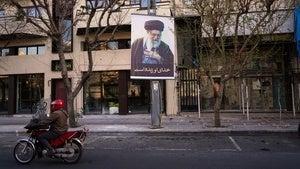
US President Donald Trump has called for regime change, the destruction of Iranian military capability, and the degradation of proxy groups. But an operation with multiple goals carries greater risk.
 US Foreign Policy
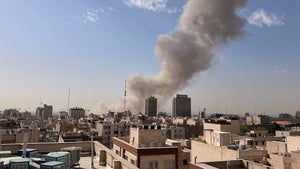
The United States and Israel attacked Iran, signaling a departure from nuclear negotiations.
 US Foreign Policy
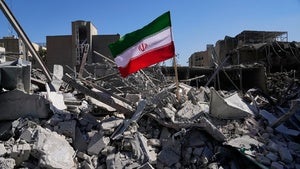
"US President Donald Trump and his administration are plainly unmoved by claims that they bear responsibility for the fates of nations where the United States has intervened," Council Senior Nonresident Fellow Suzanne Nossel writes.