Trump, Iran, and the Future of American Power
 Play Podcast
About The Episode
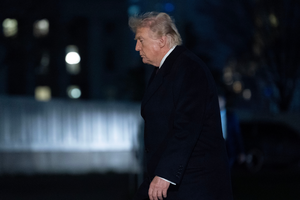
President Trump said he would stop wars, not start them. But as the conflict with Iran widens, that promise is under strain. Matt Duss of the Center for International Policy explores what this moment reveals about presidential war powers, the limits of military force, and what this war could mean for the next chapter of US foreign policy.
This transcript has been edited for clarity.
Donald Trump [Voiceover]: We had no wars. They said he will start a war. I'm not gonna start a war, I'm gonna stop wars.
Leslie Vinjamuri: President Trump campaigned on a promise: No new wars. Now, as the US has drawn deeper into the war with Iran, it's starting to feel like that promise has shifted. Congress is debating how much authority the president has to escalate, allies are watching closely, and President Trump is already signaling that Cuba could come next.
Donald Trump [Voiceover]: It may be a friendly takeover. It may not be a friendly takeover. It wouldn't matter.
LV: So what does this moment tell us about where US foreign policy goes from here?
Today I am sitting down with Matt Duss, one of America's leading progressives and former foreign policy advisor to presidential candidate Senator Bernie Sanders, to help make sense of what this conflict could mean for the next chapter of US foreign policy.
I'm Leslie Vinjamuri, president and CEO of the Chicago Council on Global Affairs, and welcome to Deep Dish.
Matt, we're talking today, the morning after, apparently, Israel assassinated Iran's top security advisor, Ali Larijani. We're two and a half weeks into the war with Iran, which has widened seemingly out of America's control. This is not really the foreign policy I think you've been advocating, as I understand it.
Matt Duss: No, that's true.
LV: I was looking at your Foreign Policy article from several months ago, and maybe we could start with this: you entered this debate many years ago. You've been trying to shape it intellectually unsuccessfully in terms of actual policy, but it's a tall bar and hard targets need to be recognized as such. What is it that America has been getting wrong for so long? Why is nobody listening? What is it that the US keeps getting wrong?
MD: I would maybe frame it not as, "What is America getting wrong?" But "What are American policy makers getting wrong?" It's important to note that American voters—at least when you poll them, and in many ways they've shown in the candidates they vote for, especially for president—are in favor of a much less militaristic and a much more restrained and pro-peace foreign policy than the Washington foreign policy establishment seems interested in and willing to give them.
In 2024 and even in 2016, but especially in 2024, Trump and Vance really leaned into a pro-peace, anti-war message in the last few weeks of the election. You can find video of Trump saying, "Oh no, we're not gonna have war. We're gonna have so much peace. It's going to be amazing."
This is actually not something that began with Trump. Since the end of the Cold War, in every election since 1992, except 2004, the more anti-war candidate has won. Certainly, Barack Obama won on the strength of opposition to the Iraq war. Even George W. Bush, back in 2000, ran on a "humbler foreign policy." Joe Biden himself ran in 2020 on a promise to end the forever wars, on a promise to rejoin the Iran nuclear agreement, a promise that, unfortunately, he did not keep.
So again, just to answer your question, I would say yes, Americans are interested in a different foreign policy. But we have a foreign policy establishment that remains wedded to this idea of American primacy, of American global military hegemony. It's an almost religious idea that if America is not everywhere, in everyone's business all the time, defining our interests as broadly as possible, then the world will fall into chaos.
You saw this expressed by this line that former Secretary of State Tony Blinken would repeat all the time. He'd say, "If America's not at the table, someone else is defining the global order, or even worse, no one is." In other words, if not for us, then chaos.
LV: Just to comment on the critique. It does seem plausible. It's true in the boardroom. Why wouldn't it be true in the world of geopolitics that if there's something at stake, and you've got a country that owns 25% of the global economy, a very large percentage of the military spend, that you would want to have a seat at the table? It's not indefensible, the idea that you'd be in the game, but the militarism is part of your broader critique.
Before we go down that path, let me get your positive vision of where America should go. You're one of the leading thinkers from what's been referred to as a school of progressivism, not only generally, but for America's foreign policy. People understand progressivism more for what it means at home than what it might mean abroad. How do you outline that?
MD: I can answer both of those things together. When we think about progressive foreign policy, it's correct to start by asking, "Well, if people are more familiar with a progressive domestic policy, what does that mean?" I think it means that we recognize that government should take care of its people.
We recognize our obligations to each other. We live in a community, and it is not every person for themself. Progressives, at least as I define a progressive foreign policy, don't mean to withdraw from the world. It means we need to emphasize different tools. Much less military, much more diplomacy, but also using America's influence. We still have an enormous influence. America's relative share of power has declined; there's no question about that. But we still have enormous power and influence, a set of networks and partnerships that are really unrivaled in the world.
What progressives advocate is using that convening power much more effectively to address shared challenges. There are so many of them, whether it's climate, irregular migration, pandemics, non-proliferation—a lot of things that we don't even talk about so much, but that we really need to get back to.
What we're seeing right now, not just in Iran but also in Gaza over the past few years, is the absolute shattering of a whole set of norms around war and the protection of civilians. You mentioned the assassination of Ali Larijani. The normalization of the assassination of leaders of states is not a good thing.
One doesn't have to be a fan of Larijani, and I am not; he oversaw the horrific crackdown on protestors just a few months ago. But one doesn't have to approve of that to understand that the norm against assassinating heads of state and leaders like this is an important one.
LV: Going back to your central thesis, which is extremely important, that America should use its convening power. That taking care of its people at home is sort of complemented in its foreign policy agenda. You have a really interesting section in the article where you talk about the provision of global public goods.
For the rest of the world, certainly for America's post-war European allies, but also for our allies in the Indo-Pacific, this was a big part of the United States' offering. It was not only the multilateral institutions, but also access to America's markets. It was the rules-based order, which for many people meant trade. It meant access to America's consumers. And it actually meant unequal access: they got access to our markets, but we didn't always get access to their markets in the same way.
That was the post-war thesis. There's also, from progressives, a big critique coming out of your thinking on foreign policy about that unevenness. So how do you square the circle? What is the concept behind this? America's supposed to provide global goods, but presumably not in the way that we used to. Not with a free hand.
MD: When I hear the words "rules-based order," it's one of those professions of faith that you hear in the high church of US foreign policy. And my response is the same response that I think Gandhi gave when he was asked about Western civilization. He said, I think it would be a great idea. I think a rules-based order would be a great idea. We should have one now. We've had a kind of rules-based order, as you mentioned, America protects the global commons and shipping. We support a trade system that opens up markets and gives access, often unevenly, to the United States.
Senator Sanders' criticism of China's entry into the WTO, which arose from a broader critique largely on the progressive left, that with this global trade system, this theological commitment to the idea of "free trade," the ultimate good that could be done was to remove barriers to trade. To free capital, to do what it will, and let the market essentially be God.
There were many of us who were critical of this long ago. My own entry into politics was through the alter-globalization movement in the late nineties, early two thousands. This is the movement that protested the World Bank, the IMF, and the WTO, and this is where Senator Sanders and others like him got their criticism. It's not to say we don't support trade. Trade is good, interaction is good. We live in a global community. We should engage with each other and trade as part of that.
But ultimately, who benefits? Who is designing the rules under which this "free trade" takes place? The criticism back then, which is now undeniable as true and interestingly even the Biden administration acknowledged, was essentially that these rules were designed to discipline states and free capital.
Essentially, to allow wealthy corporations to discipline democracy, to prevent democracy from setting up rules that would protect its own workers. And that is what has led to this massive de-industrialization in the United States. Offshoring of millions and millions of jobs that had allowed people to raise families, including my own.
This theory helped a lot of people get rich. But those benefits were overwhelmingly directed at a very small percentage of wealthy people who continued to enjoy enormously disproportionate influence over our politics.
What we really need to do is talk about how to reverse this. We need to allow democracy to discipline capital. We need to allow democracy to discipline the market. We're only at the beginning of this debate. So again, it's not to suggest that we need to withdraw from the world, not at all. That's a critique that we often saw back in the nineties: if you don't support free trade as we define it, you're just an isolationist. But again, I want to note that a lot of those people who were out in the streets at that time turned out to be correct.
LV: So, as you think through America's footprint in the provision of global public goods, it's a little bit hard because we're in the middle of a war that seems to be tearing everything apart. But what places should America target? Is it a reform agenda for the existing multilateral institutions? The WHO, the Paris Accords, the WTO—which, according to the current leader of that organization, Dr. Ngozi, 72% of world trade still flows according to WTO rules, so it's doing something.
Or are there different issues, different workarounds? What is the progressive forum policy advice that you're giving for where America should land in the next phase?
MD: I don't tend to think disestablishing major institutions is a great idea, as a general rule. I guess I'm sort of conservative in that way. A lot of work was done to set this network of multilateral organizations and institutions in the wake of World War II. Some of them have proven ineffective, and others have become quite corrupt. But there's a way to reform and strengthen a lot of these institutions. Probably not all of them, but the major ones. Maybe the UN, I don't know about the WTO, we'll have to see.
Starting with the idea that the United States needs to reinvest and re-accredit the very idea of multilateralism, the very idea of a positive-sum global engagement. What we've seen from Trump is a challenge to that very idea. That was the premise underlying the creation of these organizations: countries can benefit from engaging according to a set of rules, essentially giving up a bit of their own sovereignty by agreeing to be constrained by global norms and laws. In the short term, that might seem like a disadvantage, but in the long term, it benefits everyone.
Of course, the United States always engaged in this somewhat hypocritically; there was always a double standard. We saw this double standard displayed extremely glaringly in the way that the United States dealt with the war in Ukraine versus the war on Gaza. But at least there was a premise that countries benefit from adhering to a set of rules.
Trump has really put that in the grave, or even if it was already in the grave, he's kind of trampling the dirt down. He's just saying that powerful countries like Russia, China, the United States, and Israel get to do what they want, and other countries just have to deal with it. A very old concept of how international relations should work, and it might seem satisfying for people who are married to this horrible, toxic idea of strength and performative masculinity. But for those of us who understand a bit more about history know that this does not lead to safety and stability. This leads to conflict. This leads to poverty.
LV: Let me ask you about the use of force. For better or for worse, it's where we've been for several months now. We wake up in the middle of our winter holidays to the news that the leader of Venezuela has been captured and taken to Brooklyn. We're now several weeks into the war with Iran.
As a set of principles, progressive foreign policy for use of military force, where do you begin? Do you begin with Congress? Do you begin with the people? Do you begin with the UN Security Council? Should there be rules to govern the use of force? Or is it that, as President Trump would say, some things need to be highly secretive? If you're going to be decisive and get rid of the sitting leader of a state like Iran, you can't deliberate. You can't play by the rules. You've got to go in, execute, and be sharp and fast.
MD: There are situations in which the president has to move quickly. In emergencies, if there's clear, imminent evidence of a threat, such that seeking the required constitutional authorization from Congress would take too long, there are provisions for that. The Constitution enables the president to take action when necessary, without consulting Congress.
But the president is then required to come to Congress and explain him or herself, and that's something Trump has simply not done here. He hasn't even bothered. He has produced no evidence. Multiple members of Congress who have attended these classified briefings have come out of them and reaffirmed this repeatedly. They have produced zero evidence that there was an imminent threat here to the United States, and frankly, there was no evidence that there was an imminent threat to Israel either. But importantly, in terms of the US president's actions, there's certainly no imminent threat, so the president could not take the time to come to Congress and make his case and seek authorization.
Of course, if there was action that needed to be secret, there are mechanisms for that, too. The president can come and speak in a classified setting, but they didn't bother to do that at all. So, again, in terms of progressives and the use of force, yes, I would certainly recognize that there are cases when it is appropriate. One needs to make absolutely sure that non-military, non-violent means have been exhausted, and there's absolutely no way that those options were exhausted in the case of Iran.
LV: Say you're advising on China, which is meant to be one of our top foreign policy priorities, although it certainly doesn't feel that way. What is the prescription for dealing with China? What was the prescription for dealing with Iran in this context?
MD: Both great questions. I would step back a little. And I will get to those, I'm not dodging it. But I do want to note that part of the problem in our politics right now, not just foreign policy but our politics in general, is that our political consensus has completely come apart. We have lost a shared sense of what the American project is.
LV: And you mean the American people? Or the American leadership?
MD: Both. Americans are deeply divided. Many of them see the other side not just as people they disagree with, but as enemies. That's a real problem. People see politics now as a zero-sum proposition. The idea that if the other side wins, they will destroy us, or at least take it out on us. And there are many reasons for this.
Part of it is that we have a political system that has been so completely gerrymandered. Unfortunately, it does reward obstruction from either side. It doesn't reward bipartisanship, and I don't mean bipartisanship in the lame Washington everybody-needs-to-be-a-centrist way. But we do have real political differences in the way the country should be arranged and what policies we should pursue.
There are probably more answers we could arrive at that are not necessarily finding the least offensive bit in the center, but are genuinely populist. We are in a populist moment. There is already a left-right populist coalition being built that could be durable. That's my own view.
LV: So it's about leadership to build that cross-partisan whole of society consensus, but for what?
MD: That's a good question. I think it is leadership, but it's also reforming our political system. We have a system of elections that is essentially legalized bribery. We are a complete outlier in the democratic world in the extent to which wealth is allowed to influence our politics.
Even before the Citizens United decisions, the idea that corporations have all the rights of people is just an insane concept. The Citizens United decision made it even worse by allowing all this dark money to flow into campaigns. Unrigging our politics, the cause of anti-corruption, and campaign finance reform, while it might not seem the most obvious answer on how to make better foreign policy, I think it absolutely is a very key step.
LV: These are critical issues, no doubt. You've gone to the source, but while they're bubbling, the person in the White House has to deal with China. So, as they're trying to unlock something that feels broken and almost impossible to fix, but we can't give up. What do you do about China?
MD: Right. So with China, we need to recognize that the US and China need to find a way to coexist. That should be obvious. Unfortunately, it does not seem obvious to some people in Washington who have wedded themselves to this idea of strategic competition. They think the coming century will be one in which the US and China are locked in competition, if not outright conflict.
I think that's a bad choice. In the same way that a lot of people back in the nineties insisted that this neoliberal trade policy, "free trade," is just the way of the world. As Tony Blair infamously said, "Arguing about this is like arguing about the weather. It's just something we need to get used to. This is reality." He was wrong.
You see a lot of people arguing this now in terms of strategic competition with China, saying this is just how it's going to be. We need to accept this reality of global affairs and prepare for it. But I think that's wrong too. Strategic competition is a choice. Is there going to be competition between the US? Sure. Is there going to be cooperation? There won't be unless we try. But defining the relationship between the US and China as primarily competitive is a very bad choice.
I know that is seen very, very negatively inside China, certainly by the Chinese government. We should acknowledge that the Chinese government does and has done a lot of things that I don't like, that are unfair, and that are certainly repressive to their own people. We should find ways to make clear that we disagree, and push back where we can and where we need to.
LV: The Biden administration, to be fair, had this idea that you cooperate as well as compete. It wasn't just competition.
MD: I agree with that. I would say about the Biden administration, interestingly, Biden's rhetoric told a better story than the actual policy. If you look at the efforts to clamp down on their semiconductor technology, the so-called small-yard high fence, whether they intended it or not, my understanding is that China interpreted that as an effort to suppress their economic growth. And of course they're going to oppose something like that. This is what I mean. We cannot pit American workers against China's workers. That goes back to this zero-sum concept; even though Trump has sharpened it, we did see, unfortunately, elements of that in the Biden administration's policy.
Biden himself, when he talked about this, was a little more casual, which is the approach. Like, listen, the US remains enormously powerful, and this idea that China is going to just overtake us and dominate the world isn't realistic. Yes, China has influence. It's going to continue to have influence, and frankly, it's expanding its influence while we do dumb things like launch unnecessary wars in Iran or occupy Afghanistan for 20 years.
We've been wasting so much time, energy, and resources on these stupid wars that China has actually been using that to its advantage. So again, I don't want to feed into the conflict competition frame, but let's just acknowledge that these wars have not been helpful to us.
LV: Is the vision of a progressive foreign policy, such as you understand it, that you've got to invest in these global public goods, rethink what that means, don't throw out the old institutions, don't enter wars that aren't necessary, and use all your other tools? But what about deterrence? Where does hard power sit for you?
MD: Deterrence is important. Deterrence is about making your enemy think that if they do this thing, it will not be worth it. The cost you will pay will outweigh any potential benefit. Sometimes that's hard because deterrence is not something you create just by building up a lot of weapons. It is about engendering the belief, on the other side, that you will use it.
Taiwan is an interesting case and a very important one, particularly for progressives. I tend to come down on the idea that this ambiguity, while very unsatisfying, is actually the best course right now. A very important question progressives bring to foreign policy is, "What is the path of least harm?" I've been to Taiwan. I've had the opportunity to go a few times. I have huge admiration for what the people of Taiwan have built in their democracy. It's a really robust democracy. Even a lot of pro-independence Taiwanese colleagues recognize that there's really no path for Taiwanese independence right now. So they would like to maintain the status quo, and I think that is a pretty good idea. Now, there are people who argue that by saying we should defend Taiwan if China invades, there are others who should say we should just hang back and pretend it's less important to us.
I can see both of those situations leading to conflict sooner rather than later. So I do think this ambiguity, while it seems somewhat confusing and of course it is designed to be confusing in a way, is kind of working right now.
LV: So America is being strategically ambiguous about whether it would come to the defense of Taiwan or whether it would cede to the Chinese when they try to take over.
MD: Right. Understanding that it's obviously a major issue in Taiwanese politics and a major issue in China's politics. We need to acknowledge that, and that should help us think about what the path of least harm is here.
LV: So here we are, in the middle of this war. It feels like it's sort of changed the world at the moment. The Strait of Hormuz is blocked. Donald Trump has called on America's NATO allies to help out, and for the most part, they're saying no. Israel continues its strikes. Iran continues its strikes. There doesn't seem to be any clear resolution in sight. I understand the critique that we shouldn't have gotten here. We should have used negotiation, and Iran didn't present an imminent threat.
But now we're here. And whoever comes next, whether they're progressive or not, is going to inherit this situation. What is the advice going forward? How does America get out of this situation in a way that leaves Americans both more secure and more prosperous?
MD: My advice would be for everyone to oppose this war. For Democrats to continue to oppose it, to refuse to support any supplemental funding for this illegal and unnecessary war. The next democratic president should investigate and potentially prosecute members of the Trump administration who launched a war of aggression.
There is a complete lack of accountability in American politics. This is part of the crisis we face; it's one of elite impunity. This is a much bigger problem than just the Trump administration. I support the same thing for the Biden administration's policy on Gaza. I want to see these things declassified.
The American public has a right to know what they knew and when they knew it, and how these decisions were taken. This is part of Trump's appeal. When Trump stands up there and says the system is rigged, that gets traction because people understand the system is rigged. Now, of course, it's rigged on behalf of people like Donald Trump and his wealthy friends, but it's also rigged on behalf of powerful and influential people who work in Washington and who work in government. So if you're asking me how to deal with Iran, yes, I think we should end the war immediately.
It will be years before any Iranian government will be willing to sit down and talk directly to the United States, but there are intermediaries. We can work through Oman and other countries. Unfortunately, Trump, and also Biden, but mainly Trump, has really discredited America's word on the global stage.
It's going to take a long time to reestablish our credibility in diplomacy, but I think we have to start immediately. I hope, if a Democrat wins the White House in 2028, it's an enormous opportunity but also an enormous necessity for that person to take a very different approach. Not just with foreign policy, but also with how we deal with former officials who have been engaged in some of these abuses.
LV: Thank you, Matt Duss, for joining us. It's been really great to talk with you about what a progressive foreign policy would look like for America in this next period.
MD: It was a pleasure. Thanks so much for having me.
LV Tracking: That was Matt Duss, Executive Vice President at the Center for International Policy. I'm your host, Leslie Vinjamuri. Talk to you next week.
Deep Dish is a production of the Chicago Council on Global Affairs. If you enjoyed today's episode, make sure to follow Deep Dish on Global Affairs wherever you get your podcasts. And if someone you know might find it interesting, send it their way.
As a reminder, the opinions you heard belonged to the people who expressed them, and not to the Chicago Council on Global Affairs. This episode is produced by Tria Raimundo and Jessica Brzeski, with support from Marty O'Connell and Lizzie Sokolich. Thank you for listening.


Related Content
 US Foreign Policy
The US-led postwar international order is being tested in the waters of the Strait of Hormuz and in the shrewd calculations of governments from New Delhi to Helsinki.
 Public Opinion
Just three in 10 Americans see the division of foreign policy powers between Congress and the president as “about right.”
 US Foreign Policy
From Venezuela to Greenland, the US has dominated global headlines one year into Trump’s second term. But what comes next, and how is the world reacting? Join Emma Ashford and Ryan Hass as we discuss these topics among others.