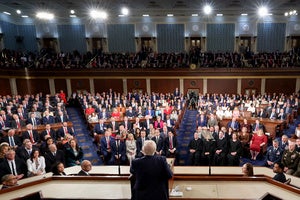
Just three in 10 Americans see the division of foreign policy powers between Congress and the president as “about right.”
Since returning to the Oval Office, US President Donald Trump has pursued an aggressive, “America First” foreign policy agenda, often sidestepping Congress to deploy military force and apply coercive pressure abroad. Following the US capture of Venezuelan President Nicolás Maduro, bipartisan coalitions in Congress renewed a push to limit Trump’s power under the War Powers Act—enacted after the Vietnam War to limit the US president’s authority over the armed forces. While a resolution on Venezuela ultimately failed to pass, lawmakers recently introduced additional resolutions to prevent Trump from using military force on Iran without congressional approval.
Recent decades have seen a steady erosion of congressional authority over foreign policy, and results from the 2025 Chicago Council Survey, fielded July 18-30 before the US operation in Venezuela, suggest a growing number of Americans are taking notice.
Congress Seen as Playing Too Weak a Role in Shaping US Foreign Policy
Data from the July 2025 poll find 52 percent of Americans think Congress plays too weak of a role in determining US foreign policy as compared to the president (52%), while a third say the role it plays is about right (30%). Less than two in 10 say Congress plays too strong a role (15%).
However, there are stark partisan divisions in Americans’ assessments of congressional power. Democrats (72%)—and to a lesser extent, Independents (56%)—think Congress is playing too weak of a role, while Republicans think the division of power is about right (52%).
Between 1980 and 2002, no more than a third of Americans considered Congress weak and increases in threat sentiment among a particular partisan group generally coincided with the opposite party holding executive power. Now, however, a narrow majority of Americans believe Congress is playing too weak of a role (52%), with drastic increases among Democrats and Independents since the Council last asked this question in 2002. This upward trend likely reflects growing concerns over the health of American democracy and weakening public trust in democratic institutions.
Yet the rise in perception that Congress is playing too weak of a role among Democrats far outpaced that among other partisans, suggesting that even though Americans broadly agree that congressional power has weakened, the issue has become deeply partisan.
Americans Say Public Interests and International Law Should Be Prioritized in US Foreign Policy Decisions
Data from the 2025 Chicago Council Survey also suggest that Americans want the interests of the American people to be taken into account by US leaders making foreign policy decisions.
Across the board, Americans are most likely to think US leaders should take public interests into the greatest consideration (75%) when making foreign policy decisions. Half of Americans (48%)—and especially Democrats (61%)—also think American leaders should take international law into a great deal of account. Four in 10 Americans think the interests of allies and partners should be taken into a great deal of consideration when making foreign policy decisions (41%), followed by US business interests (35%).
Among partisans, nearly half of Republicans see the importance of taking business interests into account when making foreign policy decisions (46%), compared to three in 10 Democrats and Independents (30% and 32%, respectively).
Just a third of Americans think the resolutions of the United Nations should be taken into account in foreign policy decision-making (33%), with a stark partisan divide. On this, nearly half of Democrats believe UN resolutions should be taken into a great deal of consideration (47%), while just two in 10 Republicans (and three in 10 Independents) agree.
Finally, only a quarter of Americans across political divides believe US leaders should take their own financial interests into account when making US foreign policy decisions (24% overall). By contrast, majorities say leaders should not consider their own financial interests when making foreign policies, consistent with broader public concerns about government corruption. Of a list of possible threats to the vital interests of the United States, Americans are most likely to say US government corruption poses a critical threat.
Conclusion
The data show that Americans want their voices to matter in foreign policy decisions but also view Congress as too weak to represent their interests or check executive power. The failed war powers resolutions illustrate just how difficult reining an increasingly powerful executive has become today. With the Trump administration pushing to seize control of Greenland, threatening Latin American leaders, and now openly musing about military strikes on Iran, the administration’s attempt to consolidate military powers in the executive shows no sign of slowing down.
This analysis is primarily based on data from the 2025 Chicago Council Survey of the American public on foreign policy, a project of the Lester Crown Center on US Foreign Policy.
The 2025 Chicago Council Survey was conducted July 18–30, 2025, by Ipsos using its large-scale, nationwide, online research panel (KnowledgePanel) in English and Spanish among a weighted national sample of 2,148 adults 18 or older living in all 50 US states and the District of Columbia. The margin of sampling error for the full sample is ±2.2 percentage points, including a design effect of 1.07.
Partisan identification is based on how respondents answered a standard partisan self-identification question: “Generally speaking, do you think of yourself as a Republican, a Democrat, an Independent, or what?”
The 2025 Chicago Council Survey is made possible by the generous support of the Crown family and the Korea Foundation.
The data for the total sample were weighted to adjust for gender by age, race/ethnicity, education, Census region, metropolitan status, and household income using demographic benchmarks from the 2024 March Supplement of the Current Population Survey (CPS). The specific categories used were:
- Gender (Male, Female) by Age (18–29, 30–44, 45–59 and 60+)
- Race/Hispanic Ethnicity (White Non-Hispanic, Black Non-Hispanic, Other Non-Hispanic, Hispanic, 2+ Races Non-Hispanic)
- Education (Less than High School, High School, Some College, Bachelor or Higher)
- Census Region (Northeast, Midwest, South, West)
- Metropolitan status (Metro, non-Metro)
- Household Income (Under $25,000, $25,000–$49,999, $50,000–$74,999, $75,000–$99,999, $100,000–$149,999, $150,000+)


Related Content
 Public Opinion
Majorities also oppose using US troops to overthrow governments in Cuba or Colombia, occupy Venezuela, and gain access to the natural resources of other countries.
 Public Opinion
The US capture of Venezuela’s Maduro echoed intents outlined by Trump in the 2025 National Security Strategy. While the action might have appealed to his Republican base, the strategy’s principles are mostly out of step with US public opinion on America’s engagement in the world.
 Public Opinion
Many hesitate to give their opinions on the conflict, but attitudes seem to fall along partisan lines on whether the United States made the right move.
 US Foreign Policy
Results and analysis of the Council's 2025 annual survey of American views on foreign policy.