In Venezuela, Trump Puts His National Security Strategy in Action. What Do Americans Think?
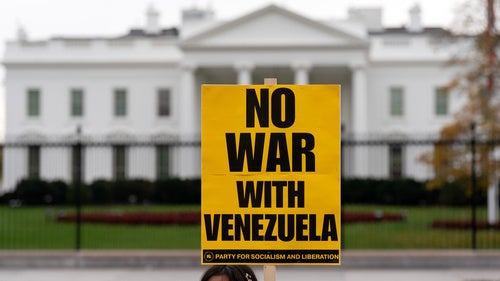
The US capture of Venezuela’s Maduro echoed intents outlined by Trump in the 2025 National Security Strategy. While the action might have appealed to his Republican base, the strategy’s principles are mostly out of step with US public opinion on America’s engagement in the world.
While the attack on Venezuela and capture of President Nicolás Maduro was not explicitly outlined in the Trump administration’s National Security Strategy (NSS), the action was foreshadowed by many of the playbook's principles.
For 50 years, the Chicago Council on Global Affairs has been polling Americans about their attitudes toward foreign policy issues. Using these data, we mapped where American public opinion aligns with the strategy’s foreign policy arguments—and where it diverges.
Latin America
The Trump administration's NSS places a priority on the Western Hemisphere and outlines the administration’s desire to bolster America’s influence, “control migration, stop drug flows, and strengthen stability and security on land and sea.” In seizing Maduro and his wife from their home in Caracas, US President Donald Trump put this doctrine into action. US Secretary of State Marco Rubio reiterated the intent, saying that the United States was “not going to allow the Western Hemisphere to be a base of operation for adversaries, competitors, and rivals of the United States.”
According to Council polling, Americans do not necessarily see the Western Hemisphere as a priority. When asked in 2024, only a handful of Americans felt that Latin America was the most important region for US economic growth (11%) or US military security (5%). Instead, the public was much more likely to name Europe (30%) and Asia (41%) as key countries for US economic growth and pointed to Europe (42%), the Middle East (24%), and Asia (22%) as most important for US military security.
Notably, Americans across partisan affiliations appear to reject the idea of a spheres-of-influence approach to US foreign policy. Recent polling finds just 14 percent of Americans say the United States should let China dominate Asia in exchange for allowing the United States to dominate North and South America. By contrast, at least eight in 10 Americans across the political divide say the United States has too many interests in Asia to let any one country dominate the region. And even more—nine out of 10 across the political spectrum—oppose allowing Russia to dominate Europe so the United States can call the shots in the Western Hemisphere.
Europe
After the US attack on Venezuela, Europe is no longer dismissing Trump’s talk of acquiring Greenland. “Utilizing the US military is always an option at the commander-in-chief's disposal,” the White House said about the endeavor. But Council polling finds Americans across partisan groups largely oppose using US troops to invade Greenland and make it part of the United States, with only 7 percent in favor.
Greenland isn’t Trump’s only target, however. The NSS is particularly harsh toward Europe on several counts—including a callout of European officials’ “unrealistic expectations” for the war in Ukraine. The American public, however, appears to align with Europe’s support for Ukraine and would prefer that the United States do more to support the country. Six in 10 Americans favor sending US arms and military supplies (62%) and providing economic assistance (61%) to Kyiv. This includes a substantial increase in Republican support for sending aid, with half now in favor of sending US arms.
The strategy also criticizes Europe for allowing “civilizational erasure” due to migration, leading to a “loss of national identities and self-confidence.” While immigration was certainly an important factor in the 2024 US presidential election, most Americans do not actually see multiculturalism as a bad thing. In fact, 52 percent of Americans say increasing the number of people of many different races, nationalities, and ethnic groups makes the United States a better place to live, and 28 percent say it makes no difference. It would seem then that Americans would be just as comfortable with—or at least apathetic toward—multiculturalism in other parts of the world. And while the strategy positions multiculturalism as a threat to global alliances such as NATO, solid majorities among most major racial groups in the United States consider maintaining alliances an effective tool in achieving US foreign policy goals, which could indicate that these concerns are unfounded.
China
China is at the front and center of the strategy’s Asia section, which is the longest regional section in the NSS. In it, the administration runs through the importance of Asia, the failures of past US-China policy, and the role of technology and the economy.
Some of the priorities laid out—such as avoiding a conflict with China and maintaining US technological superiority—are also seen by the American public as important goals for US-China relations. Yet Council polling over the past year shows a recalibration of attitudes toward China. Although 66 percent of Republicans still consider Beijing’s rise a critical threat to the United States, less than half of Democrats and Independents agree. In fact, a narrow majority of Americans (53%) say the United States should undertake friendly cooperation and engagement with China—up from 40 percent in 2024.
American views on trade with China are also shifting, with Americans now divided over whether US-China trade weakens (48%) or strengthens (47%) US national security. This is a change from 2024, when most Americans believed it weakened US security.
The Trump administration seems to see Chinese exports to the United States as a problem in and of itself, even if those exports are not coming from China but instead from Chinese companies producing goods elsewhere—which the NSS refers to as an effort by China to “export to the United States through other proxy countries.” How the United States plans to “rebalance” trade with China, however, is left unsaid. Thus far, the approach has been heavy on tariffs, which have been steadily losing support among the American public. Just four in 10 Americans overall (38%) back higher tariffs on Chinese goods—down from 55 percent a year ago—and a majority of Americans (54%) now oppose higher tariffs. Further, just a third of Americans (34%) support significant reductions in US-China trade, down 23 percentage points since 2021 when 57 percent supported broad trade cuts.
When it comes to Taiwan, the NSS states that “the United States does not support any unilateral change to the status quo in the Taiwan Strait.” This matches with public attitudes in the United States and Taiwan, with majorities on both sides of the Pacific favoring maintaining the status quo.
Immigration
While immigration continues to be one of the top concerns among Republicans, opposition has softened over the past year. Council surveys show all partisan groups have relaxed their opposition to legal immigration in the space of a year, with record or near-record numbers of Americans supporting increasing (28%) or maintaining current levels (49%) of legal immigration. Meanwhile, opposition to legal immigration is at an all-time low (21%), with just 36 percent of Americans seeing large numbers of immigrants and refugees arriving in the country as a critical threat, down from 50 percent last year.
Two-thirds of Americans (65%) say immigrants currently working in the United States illegally should be able to apply for US citizenship, either immediately (43%) or after a penalty and waiting period (22%). And only a minority overall favor forcing undocumented workers to leave their jobs and the country altogether (23%), which is relatively unchanged from 2024’s figure (20%).
US Sovereignty
The words “sovereign” and “sovereignty” appear about 15 times throughout the NSS, with the administration proclaiming the “United States will put our own interests first and, in our relations with other nations, encourage them to prioritize their own interests as well.”
But data show that most Americans do not believe in a strategy of “America Alone,” instead expressing a desire for US leaders to consider the interests of its allies alongside its own. Far more Americans today think the United States should mainly make important foreign policy decisions with major allies (60%) rather than on its own (21%). This indicates a strong preference for nourishing relations with allies, especially as nine in 10 Americans consider maintaining US alliances (91%) to be an effective way to achieve US foreign policy goals. In fact, in 2025, maintaining alliances edged out military power as a “very” effective tool for achieving US foreign policy goals.
While the NSS decries “trade imbalances, predatory economic practices, and other impositions” by US allies, American views of alliances are quite positive. The 2025 Chicago Council Survey saw the highest levels yet in American views of US security alliances in Asia (72%), Europe (68%), and the Middle East (67%) as being beneficial to the United States alone or the United States and its allies.
In sum, Council polling reveals a significant misalignment with the NSS, particularly on US engagement with other countries. While the strategy calls for an “America First” approach to foreign policy, Council polling shows the majority of Americans would prefer to work with allies and other countries to solve global problems, and they have a strong desire for the United States to choose engagement with—over retreat from or aggression toward—the rest of the world.
The Chicago Council on Global Affairs is an independent, nonpartisan organization and does not take institutional positions. The views and opinions expressed in this commentary are solely those of the author.


Related Content
 US Foreign Policy
Results and analysis of the Council's 2025 annual survey of American views on foreign policy.
 US Foreign Policy
Solid majorities of Democrats and Independents think the United States should consult with allies before making major foreign policy decisions, but only four in 10 Republicans agree.
 Migration
While majorities of Democrats and Independents support a path to citizenship for immigrants living and working in the United States illegally, only four in 10 Republicans agree.
 US Foreign Policy
While Republicans remain focused on limiting China's rise, a majority of Americans now favor a policy of cooperation and engagement with Beijing.