Behind China's Measured Response to the Middle East Conflict

The Iran war is presenting the greatest test yet of the limits of America's power in an increasingly multipolar world.
The threat of an unprecedented global energy crisis appears now to be driving US policy toward the Iran war as the Strait of Hormuz—through which one-fifth of the world’s oil and liquified natural gas supply passes—remains closed to the United States and its European allies. As US partners, allies, and other major powers face pressure to pick a side, the escalating conflict is presenting the greatest test yet of the limits of America's power in an increasingly multipolar world.
Fractures appeared earlier this week when European allies refused to send their warships to the Strait of Hormuz, though the United Kingdom is now allowing the United States to use its bases to bomb Iran’s missile sites. Others have pursued alternative approaches. In a sign that its strategy of multi-alignment is working, India has secured safe passage for its ships through the Strait, through which about half of its crude oil and roughly 85 percent of its liquified petroleum gas imports pass.
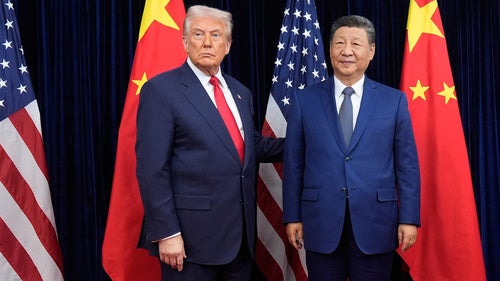
Notably, even China has now come under pressure to send military support for the US effort in the Middle East. A highly anticipated summit between US President Donald Trump and Chinese President Xi Jinping was postponed this week, with Trump saying the ongoing war required he remain in Washington. Questions about the planned meeting in Beijing began to arise on Monday, following Trump’s threat to delay the summit should China refuse to help the United States reopen the Strait of Hormuz. The Chinese Foreign Ministry responded to the request by reiterating its call “on parties to immediately stop military operations.”
To discuss China’s strategy in closer detail, I spoke with Professor Rana Mitter, a member of the study group on US250 Mapping the Global Future jointly convened by the Council on Foreign Relations, Princeton University’s Reimagining World Order Initiative, Georgetown University’s Lloyd George Study Group on World Order, and the Chicago Council on Global Affairs. Mitter is a renowned scholar on China and the ST Lee Chair in US-Asia Relations at the Harvard Kennedy School. Together, we discussed the factors behind China’s response to the Middle East conflict, where the US-China relationship stands, and why a delayed summit may ultimately be to Xi’s advantage.
Leslie Vinjamuri: Earlier this week, President Trump threatened to delay his summit with President Xi unless China sent warships to help reopen the Strait of Hormuz—and then requested that delay after China refused. Where does that leave the US-China relationship? Is this a genuine rupture, or is it a negotiating tactic?
Rana Mitter: I think this may be the first time that a US president has made a formal request to China to actually send a military presence to an area where it's not currently present. But in some sense, this isn't the first time that something like this has happened. In the first year or so of the Ukraine crisis, Donald Trump put out a Truth Social post in which he talked about a variety of things that should be done, and he used the words, ‘China can help.’ So, there may be a wider thinking here that, as the world order changes, that the Trump presidency—I use that phrase rather than ‘administration’ because I suspect there are many different views—may be seeking to actually indicate that it does see a role for China in terms of global governance. If that were the case, that will be a very significant change in the way in which China is viewed in terms of US policy. And it's fascinating that it was China that actually declined to take it up.
Let’s say what that means for the US-China relationship more broadly. It seems to me that China right now is very keen to get into negotiations with the US side in general and with the president in particular. I think that they feel that there are a variety of areas—Taiwan is one, technology is probably another, and tariffs another—where they will find it extremely useful to be able to sit down with the Americans and talk to them. One of the indications that we have that the Chinese are keen to have the meeting was China’s Minister of Foreign Affairs Wang Yi's statement when the Iran war started. He said this was a war that should never have happened. It was not an outright condemnation of the United States or Israel, or indeed of Iran. It was a more generalized statement of regret.
Vinjamuri: China's entire foreign policy identity is built on the Five Principles of Peaceful Coexistence. And yet from Iran's perspective, here they are—a country that signed a Comprehensive Strategic Partnership with China—getting struck repeatedly, and Beijing is essentially acting as a neutral party. At what point does that posture stop looking like principle and start looking like abandonment? And does that distinction matter to President Xi?
Mitter: One of the things that makes current Chinese behavior fascinating is an event that happened about three years ago, and that was the reconciliation between Iran and Saudi Arabia that was widely touted as having been facilitated by the Chinese. It's notable that whatever else that particular agreement may or may not have meant, it's clearly shattered to pieces now. Although there's no official statement about this, it's widely suspected that the Saudi government seems to have been tacitly very supportive of the US-Israeli attacks on Iran.
So where is China in all of this? At the granular level, I'm not sure that the Chinese side actually thinks there's much they can do. The war started when the United States and Israel decided that they wanted to attack the nuclear facilities and, more broadly, the infrastructure of Iran. This wasn't something where, as far as we know, they consulted Beijing. And therefore, Beijing will not feel that it's its responsibility to seek to mediate, nor is it being asked to at the moment.
Then, it has to take account of the fact that it is simultaneously very reliant on energy supplies from both of the main actors—Saudi and Iran—and also keen to remain on good relations with them both. This may sound a little odd considering that, in its own backyard, China can often be highly coercive and highly confrontational. The Philippines would be a good example of that in terms of the use of gray-zone military tactics. Australia would be good example of that in terms of the use of economic coercion. But further afield, in the Middle East for instance, China is much less eager to get involved with taking sides. It seems to me that outside its own backyard, China doesn't really relish the role of becoming a global peacemaker, and that means there's one important part of global powerbroking it's abdicating before it's even chosen to mount the throne.
If China really doesn't choose to mediate in this particular conflict, it's probably a sign overall that China has looked over the precipice of what it means to really be a power that has global responsibilities and global obligations—as indeed the United States has done for 75 or 80 years—and decided that's not for it. That doesn't mean at all that China is uninterested in having global influence; it certainly does when it comes to geoeconomics, norms, finance, standards, international institutions, and the list could go on. But in terms of becoming a global mediator, its partnerships are just that. They are partnerships. Certainly, they've found it useful to do joint naval exercises with Iran. But that was not the beginning of a new NATO. It was essentially a way for partners to test their technology and test their ability to coordinate with each other. It did not involve anything like an assurance that China would come to the assistance of Iran if it were in trouble. Nor is there much public sign that the Iranians are particularly asking the Chinese to get involved.
What does perhaps seem to be going on is that India and China in particular are trying to communicate with what's left of the Iranian leadership to allow shipping that is designated for travel to China or India to be exempted from the closure of the Strait of Hormuz. But that is a trade-oriented element of the current negotiations that's very specific to making sure that China's energy suppliers remain uninterrupted. It’s not a statement of geopolitical commitment.
Vinjamuri: China once considered Iran to be a crucial part of their Belt and Road Initiative. How does this shape Beijing’s position with respect to this war?
Mitter: I think the prospect of Iran being in the Belt and Road Initiative will certainly give Beijing pause for thought about how this might affect those wider plans. But if you look at the details of the Belt and Road Initiative, it’s more of a net—full of holes—and less of a network. In other words, this is a system in which various things are brought together using the overall branding of the Belt and Road Initiative—and the term ‘Global Development Initiative’ is slowly but surely beginning to eclipse the Belt and Road Initiative, which seemed to be a phrasing that's more relevant to the 2010s and not perhaps to the ambition that China has in the 2020s.
Being part of the Belt and Road Initiative is often confined to very specific sorts of activities or collaborations. So, in the case of Iran, it is 90 percent about energy supplies, and the remaining 10 percent is about some relatively low-key cooperation on technology and military. It's not a sign of being embedded into a NATO, the European Union, or even an Association of Southeast Asian Nations (ASEAN)-type of organization. It has been about how Chinese capital is deployed. So, if Iran for whatever reason no longer forms part of China's wider network of partners, there are other options that China has.
The main concern that China would have is that a new version of Iran does not stand in its way. As we speak at the moment, it's not clear that a new settlement is emerging in Iran that would be hostile to China. And the highest likelihood is that almost all of the arrangements that seem most likely to come out of the current war would actually probably be just fine by Beijing.
If you're Beijing, you see really no reason to stop the trajectory of geopolitics at the moment.
Vinjamuri: You've written about how historical memory shapes Chinese political behavior. I'm curious whether there's a historical analogy that Beijing is drawing on right now that tells us something about how they're thinking about this moment?
Mitter: There is a strong sense in China, I expect, that the best strategy they can follow is to be very quiet, not to give out strong opinions about anything, and see how the United States takes things. They will have seen that the levels of favorability in recent international polls for China have gone up, while the levels for the United States have gone down. The fact that the United States is less popular doesn't necessarily mean that people will like China's proposition. And yet it appears in many cases, given a choice, they do.
If you're Beijing, you see really no reason to stop the trajectory of geopolitics at the moment. You will think that it's probably going quite well for you in terms of wider global public opinion. And that's one of the reasons that we don't necessarily see a lot of public discussion in China about analogies and metaphors.
Having said that, I think that there will be lessons that they draw on. One of the things that I think that they will find probably quite suggestive is the way in which the use of air power to try and change the nature of a government hasn't proved very successful—either previously in Iraq or indeed in Iran at the moment. One of the things that might come to mind was China's own experience in the Second World War. During that time, the temporary Chinese capital at Chongqing was very heavily bombed. In the early years of the war, it was more heavily bombed at that time than almost any other city in the world. But that very brutal experience did not in fact lead to the surrender of the then-Chinese Nationalist government. It actually created a sort of spirit of morale-boosting that helped it to survive.
Now, it's worth noting this is the case because the nationalist government of China at that time was not a democratic, freely elected government. It was a dictatorship. It was highly authoritarian. It was highly repressive of its own people. It did eventually come to grief, not least because the communists defeated it. But during the period of air power being used to try and dominate the population, people found themselves united in terms of trying to avoid the sheer horror of being bombed. And it's not impossible that some may remember that air power alone didn't succeed in actually turning the Chinese either against their government or overthrowing that particular nationalist regime back in the 1930s.
Vinjamuri: You're pointing to something important—the gap between what China says publicly and what's actually driving decision-making internally. Setting aside the diplomatic language, what are China's real priorities here? What is Beijing actually trying to get out of this moment? And what would tell us that that calculus is shifting?
Mitter: Most people in the region will be keeping an eye on Taiwan. We don't have any definitive evidence yet—it's far too early to suggest that there will be a change in terms of the way in which they think about Taiwan—but there will be elements of this conflict that they'll be watching very closely to work out whether or not there are lessons to learn. One of the most obvious might be around the Strait of Hormuz and the closing of that particular area. Now, there is not, to be clear, direct parallel with the Taiwan Strait because the Taiwan Strait is much, much bigger and much, much wider. But the idea of what happens if you actually shut down global shipping in a very important waterway is of tremendous interest to the Chinese because if they were to enter a situation where Taiwan's access to the sea is essentially being blocked, they would want to know how the world would react and what effects this would actually have.
I think they'll also note that resources are being removed from the Asia-Pacific theater to the Middle East to deepen the engagement. This has certainly been noticed in Japan, which of course is a longstanding US treaty ally. I think the region will continue to ask how committed the United States really is to the status quo in the region. The language, to be fair, has been reassuring in the last year or so (more so than toward the Europeans, who famously have been subjected to a pretty cold shower of lectures about changed reality). Still, they've had a certain number of ups and downs. The tariffs, of course, have been the biggest practical obstacle placed in their way. But having said all that, there continues to be language around the commitment of the United States to be involved in the Indo-Pacific and, by implication, in the containment of China. But to undertake those sorts of strategies you do need resources in that space. It involves opportunity costs, even for the United States. The United States can maintain a presence in a couple of theaters, maybe one-and-a-half to two. Three does sound like a big ask. And I think the Chinese will be intrigued to know as to whether or not the current maneuvers signal a downgrading of the US commitment to East Asia.
Vinjamuri: There are thoughts that Beijing is calibrating its response to the Iran war, at least in part, around the prospect of a Xi-Trump summit and some kind of grand bargain. If the meeting does happen—and most observers think it will—what should we expect from it?
Mitter: I think we are likely to see some of the things that would have been on the agenda at the summit anyway but will be given more force because of the context of the Middle East war. Even if the fighting has ceased by the time of the summit, the aftermath will not have been completed. I think the Chinese will see it as an opportunity for greater pressure. They'll push hard for new language on Taiwan—it has been fairly widely publicized that they would like the United States not just to say that it does not support Taiwanese independence, but to shift its language to saying that the US opposes it (which of course then gives ballast to the Chinese argument that the One China policy is the only one that should be acknowledged internationally).
Beyond that, if the effects of the war turn out to be economically damaging to the United States, the Chinese will think they have more space to push really hard on tariffs and other areas where they perceive economic vulnerability on the US side. That's not to say they'll succeed or necessarily get what they want, but I think the Chinese perception is going to be that the United States has now got a lot on its plate, and this is a good moment for China to push hard in the areas where it wants to change things in its direction.
The Chicago Council on Global Affairs is an independent, nonpartisan organization and does not take institutional positions. The views and opinions expressed in this commentary are solely those of the author.