From Oil to Food: How the Iran War Could Disrupt Global Stability
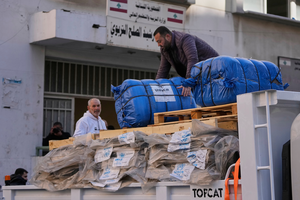 Play Podcast
About The Episode
Gas prices may be the first way Americans feel the war in Iran, but Catherine Bertini, former executive director of the United Nations World Food Programme, and Michael Werz of the Council on Foreign Relations explain why the deeper impact could unfold across global food systems—where rising energy costs and supply chain disruptions could drive prices higher, worsen hunger, intensify humanitarian pressures and destabilize vulnerable regions far beyond Iran.
This transcript has been edited for clarity.
Leslie Vinjamuri: The war in Iran is already being felt far beyond the battlefield. You may have already noticed higher gas prices, but the effects may not stop there. They may soon show up at the grocery store, too.
Disruption in the Strait of Hormuz is raising concerns about fertilizer shortages, putting even more pressure on farmers who are already dealing with tariffs, labor shortages, and rising costs. As the human toll across the Middle East continues to grow, civilians are facing hunger, displacement, and mounting instability.
So how far could this crisis spread and how long could the pain last? Who will bear the greatest cost?
To help us unpack the economic ripple effects and humanitarian stakes, I spoke with Michael Werz, a senior fellow at the Council on Foreign Relations. And dialing in from the streets of Rome, Catherine Bertini, who is a distinguished fellow of global food and agriculture at the Council, and former executive director of the United Nations World Food Program.
I'm Leslie Vinjamuri, president and CEO of the Chicago Council on Global Affairs, and welcome to Deep Dish.
You both bring tremendous expertise, and we are delighted to have you on the podcast today. Michael, let me come to you first. We can start immediately with the war in the Middle East,
In the last week, the news has become very much focused on the effective closure of the Strait of Hormuz and the consequences for oil and gas. But you've written about the impacts on a food-vulnerable region where agricultural fertilizers are blocked. What is the food context for this war?
Michael Werz: Most of what we read in newspapers here in the United States, but also in Europe, is the question of the impact on gas prices. And while those increased gas prices are a problem, they might also be relatively easily absorbed in highly mobile, Western, and wealthy societies. But what happens as a parallel dimension of this war is a potential food crisis, which has different components. The important thing to understand here is that the Gulf is a regular channel for crude oil, as well as for food and other crucial agricultural products, most of all fertilizers.
There are different dimensions to this. There are 60 million people in the region exposed to food shocks due to supply chain interruptions. This is important because the countries we are talking about in the region are dependent upon rice, corn, soybean, and vegetable oil imports, anywhere between 75 and 90%.
Which means they're extremely exposed to those disruptions because of the import dependency, and it shows that that dependency is creating tremendous vulnerabilities. In Iran, obviously, the situation is the worst. The food price inflation last year alone was 40%, and in the last few days, rice prices have increased sevenfold, and green lentils and vegetable oils threefold. It is clear that there is an immediate impact in the region, but there are also ripple effects in a system that is highly integrated in terms of global food and fertilizer production. Other countries that are not part of the immediate conflict will feel the consequences relatively quickly. And since food is the most important commodity, these effects will be felt fairly quickly within the next few weeks, should this conflict not end.
Let me also add one additional thought because I am very concerned about the first-ever attacks, as far as we know, on desalination water plants. That happened in Bahrain, where the Iranians attacked the desalination plant. There's also an Iranian rocket that came down close to a massive complex of over 40 desalination plants in Saudi Arabia. So water is part of the warfare as well, and that is a new layer of strategic, military action in a region of the world with over 400 desalination plants, in which 40% of the desalinated water is produced.
Countries like Kuwait, Oman, and Saudi Arabia rely almost exclusively on desalination for their water supplies. Water is even more immediate than food scarcity. And there are hundreds of people in the region who rely on these water resources.
So again, what is happening in Iran right now is the first real 21st-century military conflict that impacts water, fertilizer, food, and global supply chains in a way that we have not fully anticipated, and even struggled to fully understand, at this point.
LV: Let me ask you one pointed question on this. It's not just countries in the region, Iran and the Gulf states. It's also places a little bit further afield, right? Like India, for example.
MW: Yes, absolutely. With regard to the grain exports, once there is a disruption in the market, the ripple effects globally are immediate. This has to do with the fact that even though wheat, for example, is the commodity that is exported to the greatest degree globally in terms of food commodities, only 20 to 25% of the global wheat harvest and wheat production is traded internationally. Most producers like China, India, and the EU consume most of what they grow in their own regions. The import-dependent countries, especially in the Middle East, but also in the Sahel, make a disproportionate share of the demand side.
This means that every disruption of wheat trade particularly has immediate effects in Northern Africa and the Middle East, but also in the GCC countries in the Gulf. We saw that in 2011 and 2012 during the Arab Spring movements, where the inflation of food prices and the multiplication of bread prices, particularly, in a region where almost half of the people get 30 to 40% of their daily calorie intake from carbohydrates, namely bread, had an accelerating effect on the political crisis.
So yes, these are globally integrated markets, and the ripple effects can be felt hundreds, sometimes thousands of miles away from where the conflict is actually taking place.
LV: Catherine Bertini is joining us from Rome, where she's been in meetings at the World Food Program. You've been working on issues of agriculture and food security for your entire career. Now, watching this war, this moment certainly feels and looks to be acute. Can you give us some perspective, given those decades of experience, on how you read the food consequences of this war?
Catherine Bertini: Yes, we expect that as long as oil prices are at least a hundred dollars a barrel or more, there's going to be real pressure on the region and beyond. There is an expectation that by June, there'll be food lines, not just in Iran, but also in other places in the region. There's an expectation that as many as 45 million people are impacted, or will be seriously impacted, by the lack of food. There are already 3.2 million Iranians and over a million Lebanese who are internally displaced—in other words, wandering around in their own country trying to find a safe place to live and eat. This is just going to be exacerbated because this is the very beginning, and the flow in and out of the region is critical.
LV: So many things to unpack here and so many questions. When it comes to the question of food, do you see this as an unintended consequence of war and warfare? Or do you see it as something that states are using specifically because they understand its effects on people, hunger, the economy, and therefore the political leadership? Maybe you want to take that first, Michael.
MW: The weaponization of food is indeed something that we are seeing happen with greater frequency. It is part of military warfare. It is a lever in conflicts, in different ways.
I would distinguish three different ways of the weaponization of food. The first one is just blocking aid and food access. Exhibit A, of course, is the conflict in Gaza, where the Israeli side has used food as a weapon.
There are instances that are more complex, especially with insurgent groups in the Sahel in Nigeria, Niger, South Sudan, and Somalia, where we have seen food being used as a recruitment and retention tool for those insurgent groups. This means that because of the possibility of managing food supplies, young men are recruited and retained into these groups because they and their families feel safer.
The third, and mostly most warring way, of weaponization of food is what the Russian military has done from day one during the invasion of Ukraine. They're weaponizing food by the systematic attacks on food infrastructure, namely roads and railroads, the mining of agricultural fields, the attacks on port facilities in Odessa, the blocking of the port, and also targeted attacks on seed companies and even on the houses of CEOs of seed companies. That was intended to produce a shock in global wheat markets that had an immediate impact, especially in Eastern Africa. We are living in a time where close to 8% of the global population is suffering from hunger, and every disruption of the system is creating additional pressure points.
In Eastern Africa, one can make the argument that it is very likely that a larger number of people have died because of the food shortages that were a product of the Russian intervention in Ukraine than on the battlefield in Ukraine itself. The use of food as a long-range weapon is obviously distracting Western attention because of the humanitarian crisis that has been created in eastern Africa, and is also carrying the conflict to very distant areas.
That is a new quality because it is a clear military use of food for which there is no easy military response, much less a kinetic one. That makes it politically difficult to address, but also even more important to integrate these new attempts to weaponize food into the military and security equations we are discussing in the United States, Europe, and other places.
LV: Catherine, is this new? The different conflicts that Michael has walked us through, the severity of the crisis, its impacts on people, and its direct use by states—is it new?
CB: No, of course it's not new. Unfortunately, it's a great way for an effective, negative impact on populations and as a pressure point. Of course, I can't say that's what's happening here on purpose, yet. But it has happened in North Korea and in Eastern Europe.
It has happened in so many places around the world that it is unfortunately not unusual. Even in Cuba, the blockade is impeding people's access to food and fuel. In this case, the primary interest is still the fuel and the oil, but that ends up impacting everything else.
LV: Let me ask you a question, taking a step back. You've both been part of the think tank community, the international organizations, and the WFP that have tried to address the impacts. In a crisis like this, what would the so-called international community typically seek to do?
CB: First, there's an appeal for assistance to help the internally displaced people in Lebanon, Iran, and the refugees that are already in many different communities. Iran was already host to both Iraqi and Afghan refugees, and still is. Continuing to support them would be an important agenda item.
It's not just the question of moving food from point A to point B, but protecting people by getting them food. That's the bottom line. The prices not only in the region but also elsewhere, where people are reliant on the food coming out of the region or the fertilizer coming out of the region, are critically important.
We saw this at the beginning of the Ukraine war because so much fertilizer came out of Belarus and Russia, and all of a sudden, there were no longer shipping routes from Ukraine. Gradually, some of that was replaced, and the crisis was somewhat diminished over that particular issue. Only time will tell if this will happen real soon.
LV: We've watched the international network of development and humanitarian assistance, and I assume food assistance, be pretty significantly diminished in recent years, at least in terms of US support. Is the capability of those institutions and networks to respond right now as radically diminished as many of us assume it has been?
CB: It is not as radically diminished; however, it is more constrained. The Americans have decreased, but I learned today at a briefing at the World Food Program that the other traditional donor countries have actually decreased more than the Americans have on a percentage basis. So everybody's had other issues.
Obviously, there are some ideological issues, but then there are issues relating to building a country's own defense forces, trade issues, and other issues that impact priorities that Europeans and other donor governments have taken. It's not just an American cut issue; it's across the board.
We have other priorities than this issue. In addition, there are some restrictions on where food can go, such as Afghanistan or Somalia, but it can go to Somali refugees in Kenya, for instance. So there's kind of a new set of rules, including coming out of OCHA, the Office of Coordination of Humanitarian Affairs, for assistance that they're providing. It's become a more complicated, knee-jerk reaction that aid agencies have to move around and figure out a way to work through.
LV: Let me ask you one follow-up question specifically on that. The additional restrictions on where food assistance can go are a result of what?
CB: From the US perspective, it's a result of wanting to support these people or these issues, but we don't want to support these people or these issues. For whatever reason, they're making these restrictions. From the UN perspective, they're creating some of their own restrictions about not going into a region for their own bureaucratic network system setup.
I can't speak for all the other donors, but many are doing the same thing so that they can go back to their publics and say they're supporting X. Donors have always wanted to support issues that were popular in their own country.
For instance, years ago, when North Korea was starving, Japan said they'd help. Then, the minute there was a real crisis between Japan and North Korea, boom, no more support from Japan. They've always wanted to make political decisions that are popular in their country. Some of these issues are their definition of what's popular or what should be popular.
LV: I mean, I hear you, and I get it. But it does fly in the face of everything that we were taught in school and graduate school about international humanitarian law: the idea that all civilians in need should be treated equally. I guess that's slightly naive, and it feels like it's getting more naive every day, but that is the principle.
CB: That is the principle, yes. And it has been under great attack over time, yes.
LV: So, Michael, maybe you could say a little bit about the work that you did on the high-level working group for the MSC. You've been working in this space to bring food security to the attention, not of people like Catherine, who's been working in this space at a very high level for her entire career, but for maybe people in a more traditional national security sector who've been called into manage crises but haven't really been thinking about food first and foremost. Could you tell us a little bit about that work?
MW: The issue here is to recognize that food security is a national security issue. It is an issue of strategic importance. It needs to be factored not only into military planning, but also into diplomatic thinking, because food is not only relevant in the sense that we've discussed now, that it can be weaponized, and that creates widespread humanitarian crises and instability. But it is also important to recognize that understanding food security requires a multi-dimensional understanding of the world. If you want to know about food security, you need to know about regional migratory and stability issues, about agriculture, climate change, supply chains, and trade.
So it is really a 21st-century policy environment, which I think is a blueprint of how we have to think about security and national security, particularly in the years and decades to come. This is why it's important to recognize that obviously the Europeans and the United States are spending more on defense, but to calculate defense dollars and defense euros versus development dollars and development euros, and there's a clear connectivity, the Europeans have increased their defense spending from 380 billion to close to 700 billion in the last seven years.
Obviously, something's got to give, and there have been reductions in the development and official development aid environment due to the increased spending. The rough estimate after the closure of USAID and the cuts the Europeans are implementing, as Catherine has pointed out, is that there's a likely investment loss in development, which means climate, food, agriculture, stability, anywhere between 20 and 32 billion dollars until 2030.
These are considerable amounts of money, and it's important to recognize that this can't be separated from the issue that we're discussing here. The impact of the Strait of Hormuz closure on global food and fertilizer markets is showing how integrated these systems are and how cascading ripple effects can create instability in parts of the world that are far removed from the battlefield. Up to a third of the global fertilizer market is potentially being disrupted by what is happening in Iran right now.
We need to update and broaden our security thinking and include these non-traditional threat scenarios into our military and national security planning because it is also an interesting space to be politically. We can argue that food security as national security is creating clear national security threats when food is being weaponized, but they're very rarely military or kinetic responses to this. The responses need to be more in the multilateral development and investment arena.
That is an interesting policy space to think through. This is also a policy space that I think will increasingly define conflicts and ways of interacting globally in the next decade or two.
LV: Catherine, there's a lot in there. You're based in Chicago, amongst corporate interests, not very far from the farmer. The farming community interests many people who work across the private, not-for-profit, and public sectors in the space of food and agriculture. What is the level of awareness, engagement, and interest in trying to build responsiveness to the crises? Maybe we can start with private-sector engagement.
CB: Consider the private sector as in turmoil from the very beginning, with all the export restrictions and changes in the tariffs. For starters, it's hard for any individual business, and even groups of businesses, to try to get together in order to impact that kind of policy.
But they're dealing with that first; that's on top of their normal issues with the environment, prices, markets, and everything else. Then, of course, there are longer-term issues about whether there will even be markets left—like soybean markets, for instance, across different countries.
Now, on top of that, they're thinking about whether the instability in the Middle East is going to impact their business. Joe Glauber from the International Food Policy Research Institute says that a lot of these markets will settle down a bit.
I'm talking about the ones that are impacted in the Middle East, much as they did eventually, post the initial Ukraine invasion. But if countries start putting export restrictions on, as they have done earlier in the food prices back in the 2010s, then the export restrictions will blow the rest of this all out of proportion.
LV: During the pandemic, we started talking about a poly crisis. It's a multi-layered crisis for private-sector interests. Michael, when you were leading this working group from Munich, did you bring in private-sector actors to try to be part of the conversation?
MW: Yes, obviously, we did because what we tried to achieve with that task force, which worked over a two-year timeframe, quite successfully, was to bring together actors that are all concerned about the security dimension and geopolitical dimensions of food, but usually do not talk to each other.
We had high-level representatives from governments, the private sector, and the most important multilateral organizations that are engaged in the field. We had water experts, but we also had people from the intelligence community and NATO policy planning. It was a mix of people who, over a two-year timeframe, really developed sophisticated arguments. We were able to look at this question from a number of different angles.
The data that Catherine just pointed out with regard to the exacerbating impact of the liberation day, like trade and tariffs, on the food sector—it's not only that we have almost 3% food price inflation here in the United States. The estimates are that it's going to cost a typical US household about $1,500 a year. But more importantly, the global food imports are reaching record highs. The FAO estimated last year that global food imports were at 2.2 trillion in 2025. In some countries, specifically in Sub-Saharan Africa, where food imports are at 85% and where people need to spend 50% to three-quarters of their household income on food, these impacts are just much more substantial.
If we think that we can live in a world with two food systems, one in the global north that works and one in the global south that does not, I think we are under an illusion that this will provide a stable economic and geopolitical environment in which we can all thrive.
LV: Catherine, on that point, could you just give us the frame for our listeners on food dependence beyond its borders? I was in a meeting in Chicago just last week with a private company, and they made the point that there's a lot of food insecurity here in the United States.
How much has that changed over the course of time that you've been working in this space? That sort of relative degree of A.) America's food dependence globally, and B.) its food insecurity domestically.
CB: I'll start with B. In terms of food security domestically, we have huge programs with the US government in order to support people who are cut off from food, maybe because they've lost their jobs, maybe because they have lived in poverty for a long time.
For women who are poor and pregnant or taking care of toddlers as well as children, we have school lunches. We have a huge array of programs, and it has grown. More people are eligible for those programs than ever in the past. Usually, those are what we call entitlements, and those are going to exist because we don't want to see hungry children in the street.
Although some of those are under serious criticism over the way in which they're managed. Now I don't want to suggest that they're perfect. One could always look at programs like that and make improvements, but nonetheless, they still exist, and they still are quite necessary. One thing that we see in communities in the United States, as well as throughout the world, is food banks, soup kitchens, and food distribution sites.
Most of those are not government-related, and they're among the most vibrant programming because they're created by communities—people who want to do something to help poor people by providing extra food and assistance. Those exist all over the world, and probably should forever and ever.
As far as international dependence is concerned, of course, there are some products that we don't grow, and we can't grow them. There are some products that we want to be part of our diet that cannot be from our own domestic production. We are always an export and import country, especially as it relates to agriculture.
Big shifts, whether due to war, tariffs, or trade, will affect farms and farm communities throughout the country and potentially put more people back to work in those domestic safety-net programs.
LV: Michael, did you have a perspective on that? I think it's a really important thing to raise, as we come to a close, that here in the United States, we are in a moment where the leadership of the country is very much focused on America first. Their agricultural interests are complex and important economically, politically, and socially; we know that. But it does get linked, right? It gets wrapped up, potentially, in a narrative that if the war can be seen to be directly affecting America's interests, that's one thing; but if it doesn't, that's another.
So that question of how integrated and dependent America is on food and agricultural markets globally is absolutely essential. Has that been a critical part of your conversation? Or do people tend to talk about these things in different buckets?
MW: No, we are all in this together because these are global markets and global price structures. As is the case with oil, critical minerals, gas, and food markets are global markets. It's not as much a question of self-sufficiency, but of the global marketplace.
In the United States, there are two dimensions that are important to keep in mind. The first one is that the massive pressure that is put especially on the Latino population in the United States right now, with the deportation regime, will have a medium-term impact on our capacity to produce corn, vegetables, wheat, and soybeans in the United States. A big part of the labor force is impacted by what's happening domestically in the US.
What we often forget is that the US agricultural system is heavily export-dependent as well. Soybeans are Exhibit A, and after the liberation day tariffs were implemented, exports of soybeans to our largest trading partner in that field, China, fell through August of last year by almost 80%.
So there's a direct impact that preceded the war in Iran, which is now being exacerbated. We find ourselves in a situation where not only export regimes are threatened because former trading partners take their own action, but also our imports get more costly. For example, the Brazilian coffee tax has been rising by up to 50%, and sugar prices have been rising by about 6% over the course of the last year.
We will see a delayed impact of that here in the United States. Economists project a 12- to 18-month lag before those tariffs actually reach customers. That means we will see the real impact between April and October of this year. Needless to say, what is happening in Iran right now is only likely to accelerate and exacerbate the situation that we're finding ourselves in.
It is politically interesting, economically, a very scary situation that these integrated marketplaces are impacted by military conflict that is happening thousands of miles away from the US homeland.
LV: The thing I would add to close with is that it's inevitably the case that it is the immediate impacts when they come back home to the United States and to the question of prices and inflation, where we expect to see some sort of political movement.
The core of the current war we're focused on in Iran, which you've both beautifully articulated, is the spillover and the connectivity of these issues across many crises for a very long time. Catherine, final comment from you before we wrap up.
CB: We're talking about food security, but of course, the first thing Americans are seeing is an increase in their gas prices. That will keep reminding them that this war is going on. Then the food prices Michael pointed out are already going up, and they'll go up further. Those will be two big indicators to the US that something is changed in a negative way as it relates to their ability to afford their basic needs.
LV: That was Catherine Bertini from the Chicago Council on Global Affairs, dialing in from Rome, and Michael Werz from the Council on Foreign Relations. Thanks so much for listening. I'm your host, Leslie Vinjamuri. Talk to you next week.
Deep Dish is a production of the Chicago Council on Global Affairs. If you enjoyed today's episode, make sure to follow Deep Dish on Global Affairs wherever you get your podcasts. And if someone you know might find it interesting, send it their way.
As a reminder, the opinions you heard belonged to the people who expressed them, and not to the Chicago Council on Global Affairs. This episode is produced by Tria Raimundo and Jessica Brzeski, with support from Marty O'Connell and Lizzie Sokolich. Thank you for listening.



Related Content
 US Foreign Policy
"A foreign policy of abundance should make US economic strength and broad-based prosperity its first order of business, banking that bounty and stability at home are prerequisites for the United States to thrive in the world," Council Lester Crown Senior Nonresident Fellow Suzanne Nossel writes.
 Global Politics
The Iran war is presenting the greatest test yet of the limits of America's power in an increasingly multipolar world.
 US Foreign Policy
Matt Duss unpacks what the widening conflict with Iran could mean for the future of US foreign policy.