Who Should Govern the Strait of Hormuz?

A European-led international mission and the Gulf Cooperation Council are trying to determine who will guarantee openness and stability in the strait once the Iran war ends—and how.
Following Thursday's announcement of a ceasefire in Lebanon, Iran’s foreign minister declared the Strait of Hormuz “completely open” for commercial vessels for the remaining period of the agreement. US President Donald Trump hailed the announcement on Truth Social. But the American blockade of Iranian ports, he said, “will remain in full force” until a deal is reached with Iran.
The two nations' independent claims to the waterway are once again raising one of the most fundamental questions for international relations, this time with great urgency: What rules should govern the globe—and who decides? The question also inspired the founders of the Chicago Council on Global Affairs in 1922, and it took more than two additional decades to answer. The current war, launched by US-Israeli strikes that most experts still believe violated international law, now raises a second question: Can a war that many people believe to be illegal give birth to new rules seen as legitimate? And can the architects of the war be participants in the process of creating new rules?
Because the stakes are so high, some might dare to hope that the closure of the strait may prove to be a forcing event (think creative destruction) for creating new rules even beyond the Strait of Hormuz. The strait, which carried roughly a quarter of the world’s seaborne oil, has been effectively closed for nearly 50 days. On Tuesday, the International Monetary Fund cut its 2026 growth forecast for the Middle East and Central Asia by 2 percentage points. In the Northern Hemisphere, planting season is underway, making the disruption to global fertilizer shipments—roughly a third of which transit the strait—a “slow-moving food crisis in the making. ” The World Food Programme estimates that 45 million additional people could face acute hunger if the Middle East conflict continues beyond mid-2026. The current ceasefire expires on April 22.
With effects being felt around the world, the United States being seen as the source of instability, and China sitting quietly on the sidelines, middle powers have an important role to play in building consensus around new rules. But despite the post-Davos enthusiasm for a coalition-led "third path," these countries are diverse with many competing interests, and they differ in their willingness to cross or court the great powers. Britain is declining to pick a side in an ongoing debate between France and Germany over whether the United States should be part of a mission to secure the strait but is insisting that any operation should be “coordinated” with Washington.
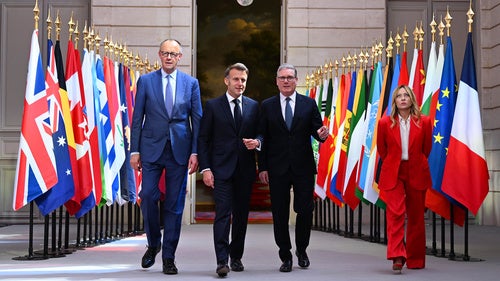
Amid the rift, French President Emmanuel Macron and UK Prime Minister Keir Starmer convened nearly 50 countries across Europe, the Middle East, and Asia willing to contribute to a multilateral effort to restore access to the strait. “Reopening the strait is a global necessity and a global responsibility,” Starmer told reporters alongside Macron, German Chancellor Friedrich Merz, and Italian Prime Minister Giorgia Meloni. He added that military planners will meet in London next week, with the mission launching “as soon as conditions allow.”
While Europe’s middle powers may have been leading Friday's meeting, there is a broader question about the role of the ‘West vs. the Rest’ in creating the rules for the future, including in the Gulf. Asian countries have suffered the most amid the closure. China, India, Japan, and South Korea together receive 75 percent of the oil and nearly 60 percent of the liquefied natural gas that travels through the strait. “The closure of the Strait of Hormuz is, in a sense, an Asian crisis,” Singapore’s Foreign Minister Vivian Balakrishnan said earlier this month.
Some arguing for new rules are thus doubling down on the idea of a world of regions. The Gulf Cooperation Council (GCC) is in the geographical center of the war and, as a logical extension of its physical location, already asserting itself as a security actor. Earlier this month, the United Nations Security Council adopted a presidential statement recognizing the GCC’s “position and expertise in understanding and promoting regional sustainable peace and security” and encouraged regular briefings from the GCC secretary-general, formally elevating the relationship to a level comparable to the African Union and the Arab League. The move came after Bahrain, on behalf of the GCC and Jordan, led the passage of Resolution 2817, cosponsored by nearly 140 member states, condemning Iran’s closure of the strait. However, a follow-up resolution draft authorizing “all necessary means” to secure transit was blocked by China and Russia.
Some states are seeking workarounds as a more rapid solution, acting to reduce structural dependence on the strait itself. Saudi Arabia is diverting oil to the Red Sea via its East-West Pipeline. Turkey has proposed connecting Iraq’s Basra oil fields to its Mediterranean port of Ceyhan. Iraq has shown new willingness to invest in overland alternatives. And the United Arab Emirates is routing crude oil through its pipeline to Fujairah on the Gulf of Oman.
Middle power diplomacy may not succeed, or not well enough. But these initiatives demonstrate the success of the old order in instilling a desire for rules that can guarantee an international order remains strong—especially in a world that risks descending into one of 'might makes right.’ Still, if such rules are birthed from a moment of destruction, those with a stake in their enforcement will need to be sure they are more than 'paper tigers.' US President Ronald Reagan had a clear view on this: "Trust, but verify.” Any solution that emerges today will need its own theory of how to create trust and robust enforcement mechanisms.
Middle power diplomacy may not succeed, or not well enough. But these initiatives demonstrate the success of the old order in instilling a desire for rules that can guarantee an international order remains strong—especially in a world that risks descending into one of 'might makes right.’
As the rules are being brokered, private interests should also be mobilized as a force for good. Following the closure of the strait, major shipping lines suspended transits within days, insurance markets pulled war-risk coverage, and oil traders repeatedly bet that the crisis would be short-lived. If influential business leaders and market influencers are brought on board the effort to create solutions, the new rules will have a better chance of succeeding.
China has so far played a quiet role, at times resorting to soft courting. This week, it hosted the crown prince of Abu Dhabi, the prime minister of Spain, Russia’s foreign minister, and Vietnam’s newly elected president in rapid succession. With Trump continuing to clash with longstanding US allies, China has an opportunity to abandon its inclination to align with Russia and play a blocking role, and instead decide to be part of the solution.
The Chicago Council on Global Affairs is an independent, nonpartisan organization and does not take institutional positions. The views and opinions expressed in this commentary are solely those of the author.