Could a Dublin-Detroit-Davos Corridor Be an Engine for a Renewal of the Transatlantic Partnership?

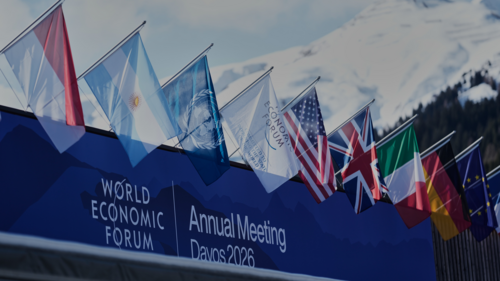
News that the World Economic Forum may come down from the mountain is symbolic of the end of an era but also signals the beginning of new thinking about internationalism. In Davos, Trump, Carney, and Zelenskyy offered competing visions for the future international order.
As Europe's leaders struggled to avert a crisis with America over Greenland at the World Economic Forum in Davos, Switzerland, news trickled out that the forum is considering alternative locations for future gatherings. Among them: Detroit and Dublin.
The prospect that the most elite global agenda-setting forum could come down from the mountain is symbolic of the current disruption to the international order.
Should Detroit be chosen to host the forum, it would be a jolt back to reality.
A symbol of America's once thriving industrial past, Detroit is now a sign of its deindustrialized decay and emblematic of the overreach of globalists. It is critical to the MAGA movement’s origin story. Detroit may be showing signs of a revival, but Michigan and Detroit are not one and the same. Michigan has been ground zero in the fight for democracy in America. Its status as a swing state would serve as a constant reminder to forum participants of just how consequential elections can be for America's global positioning, and not only with respect to Europe.
By contrast Dublin is international, young, and innovative. Perhaps there is hope for a renewal of the transatlantic partnership via a Dublin-Detroit-Davos corridor.
The news that the forum may be going through a period of transformation is fitting given the wider spirit of this year's gathering which, while hardly comforting, may have been the most productive yet.
For starters, there was no hiding that the transatlantic partnership has ceased to be an anchor for the international order, which has been permanently ruptured. This does not mean that this vital partnership is over. If anything, the meeting proved its surprising resilience, with NATO and especially its secretary general working actively to prevent its collapse. But the forum did raise a fundamental question about the relevance of the partnership in the face of a divisive American leader, China's growing power, and rapid technological change.
The first three days of the annual meeting were dominated by US President Donald Trump’s claims on Greenland and his threat to ratchet up tariffs against eight European countries if they did not do his bidding. The focus on Greenland served as a stark reminder that the terms of the transatlantic partnership have been irreparably altered. A relationship once based on shared values, trust, and mutual interest has been replaced by one based on dependency, coercion, and transactionalism. The fact that Europe's leaders are rapidly learning how to manage Trump is a good thing.
The focus on Greenland served as a stark reminder that the terms of the transatlantic partnership have been irreparably altered.
Amid the crisis management, a more fundamental conversation emerged about the future international order.
Canadian Prime Minister Mark Carney made a powerful case that rallied most of Davos around a vision that was principled, pragmatic, but also transactional. One in which middle powers would forge their own path forward together and diversify their partnerships, and problems would be tackled by coalitions of willing states advancing solutions. It was a proposal perhaps born of necessity—a bridge to what comes next.
A second proposal came from Trump. Most onlookers saw Trump as a disruptor of the old order—breaking the transatlantic partnership, asserting America’s successes, and ignoring convention, in part by pursuing a coercive form of bilateralism. But his attempt to get a wide number of states to sign on to his “Board of Peace” suggests he too has a vision of international order, and it even contains a form of multilateralism. His vision is explicit in its rejection of values as a basis for collective action but anchors the solutions to peace and stability in a group of nations that the United States deems worthy partners—one which Trump made clear does not include Canada by withdrawing its invitation to join.
Ukrainian President Volodymyr Zelenskyy declared the old order over and asked Europe to unite and lead. Zelenskyy's was a pointed vision, and he castigated Europe’s leaders for failing to take a stand.
“Just last year here in Davos, I ended my speech with the words, ‘Europe needs to know how to defend itself,’” he said. “A year has passed and nothing has changed.”
Only China appeared to hold onto the old postwar order, rejecting an offer to join Trump’s “Board of Peace,” and reiterating its commitment to the United Nations and old-style multilateralism.
What's Next
If accepting you have a problem is the necessary first step for change, then Davos was a resounding success for Europe. While an agreed-upon vision for a new international order may still be more than a decade away, there is now (mostly) a consensus that the old order is over—certainly among its founding members in the West. But building resilience domestically will be a slow and difficult process.
Just this week, a trade agreement between the European Union and the South American trade bloc Mercosur was put on hold after lawmakers decided to refer it to the Court of Justice of the European Union. The EU commission, however, appears ready to implement the agreement on a provisional basis.
“Rest assured: We will not be stopped,” German Chancellor Friedrich Merz said in Davos. “The Mercosur deal is fair and balanced. There is no alternative to it if we want to have higher growth in Europe.”
While there was less focus at this year’s Davos on the root causes of the breakdown of order, especially the unequal effects of globalization, and the looming impact of artificial intelligence on employment and inequality, news of a possible move to a city like Detroit is a reminder that all has not been forgotten.
News of a possible move to a city like Detroit is a reminder that all has not been forgotten.
“Many of the people most affected by what we talk about here will never come to this conference,” interim co-chair of the World Economic Forum Larry Fink said. “That’s the central tension of this forum: Davos is an elite gathering trying to shape a world that belongs to everyone.”
If the World Economic Forum were to build on its existing connection to Dublin and Detroit through its Centre for Urban Transformation, that may change.
For now, Trump’s battle for Greenland has gone quiet.
In just a few weeks, global leaders will come back together for the Munich Security Conference. US Vice President JD Vance will likely return, and the recently published US National Security Strategy suggests his vitriol for Europe's liberal politics has not abated. But Europe is now also a reluctant partner. In Davos, major Western allies did not attend Trump’s signing of his “Board of Peace” charter, and France, Germany, Spain, and the United Kingdom are among a growing number of nations who have so far said they will not join.
A monumental shift is underway.
The Chicago Council on Global Affairs is an independent, nonpartisan organization and does not take institutional positions. The views and opinions expressed in this commentary are solely those of the author.