The Challenges of a Nuclear Deal with Iran

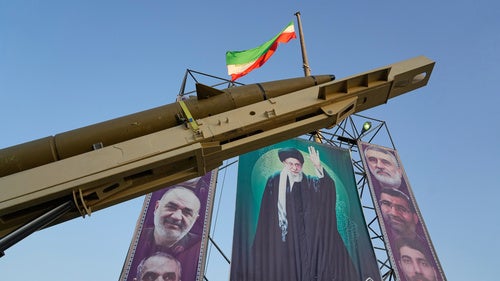
While the Trump administration's proposed agreement would curtail Tehran’s ability to develop a nuclear weapon, it would not touch the real drivers of the Islamic Republic’s power.
After weeks of war, Washington may finally get what it has seemingly wanted for years: an Iran willing to dismantle its nuclear program. But while a deal now would look like a breakthrough, it would be a mistake.
The war between Iran, Israel, and the United States has reshaped the strategic landscape. Iran’s military infrastructure has been heavily degraded, and senior commanders and top leadership have been killed. On paper, it looks like a moment of maximum pressure. And yet, the Islamic Republic is bleeding but still standing.
Despite losing control of its airspace and coastal water, the regime has continued to launch missiles and drones against Israel and across the region. It has targeted economic and civilian infrastructure across the Middle East, massively disrupted energy markets, and restricted shipping through the Strait of Hormuz. The message is clear: Even under heavy attacks, the regime can still impose real costs.
The Trump administration has proposed a sweeping agreement in which Iran would give up its enriched uranium, dismantle centrifuges, and disable key facilities. In return, Washington would provide sanctions relief and international support for a civilian program. Tehran has rejected such terms for years. Today, under pressure, it may accept them. But this would not signal a changed regime. Rather, it would mean the regime had adapted.
For decades, many believed Iran saw its nuclear program as a form of deterrence. The lesson it took from North Korea and Libya was simple: Those with nuclear weapons survive, and those without them are vulnerable and subject to invasion. That logic justified enormous investment by the regime, despite sanctions and the massive cost on Iranian everyday life. But this war is rewriting that logic.
The regime is learning that a nuclear program is not only costly, but also a source of vulnerability. It has brought sanctions, sabotage, and direct military strikes upon them, without delivering real protection. At the same time, the war is showing Iran something else: It does not need nuclear weapons to survive or to deter. Missiles, drones, proxy networks, and maritime disruption are doing that job.
Even after losing key leaders and facing sustained attacks, the Islamic Republic has not collapsed. Its security apparatus is still functioning, and its regional networks remain active. Lebanese Hezbollah and Yemeni Houthis have joined the conflict, while Iraqi Shia militia patrol Iranian streets and repress Iranians. Iran’s ability to disrupt global markets has also remained significant, as they keep the Strait of Hormuz partially closed. From Tehran’s perspective, this moment offers a powerful lesson: If these tools can ensure survival, then nuclear weapons are less necessary.
The war is showing Iran something else: It does not need nuclear weapons to survive or to deter. Missiles, drones, proxy networks, and maritime disruption are doing that job.
This changes everything for Iran. Giving up its nuclear program would not be a defeat—for the ayatollah, it would be an opportunity for strategic recalculation. The regime could trade a costly, exposed capability for sanctions relief while preserving the instruments that are actually working to keep the regime safe and powerful.
A deal could thus be a seen as a success for both the United States and Iran, but for completely different reasons. Washington would remove an immediate nuclear threat. Tehran would secure economic relief. But what looks like a solution for Washington in the short term could create a deeper problem: The deal would address Iran’s enrichment, but it would not touch the real drivers of the Islamic Republic’s power. Easing sanctions will only help the regime reinvest in and expand its missile and drone programs, strengthen its proxy networks across the region, and enable it to increase cyber operations and further maritime disruption. These are no longer secondary tools in Iran’s destructive mission, but the new center of its strategy.
The 2015 nuclear deal was built on a similar belief that economic incentives could moderate the Islamic Republic. That did not happen. Instead, sanctions relief strengthened the Islamic Revolutionary Guard Corps, expanded Iran’s regional activities, and reinforced the same security networks driving repression at home and aggression abroad. The underlying issue was that the deal misread the nature of the regime. Negotiators assumed regime flexibility where there was strategic rigidity. Repeating that approach today would be even riskier because the regime is now more centralized, more security-driven, and more war-shaped.
A regime that feels wounded but not defeated is often more dangerous. Internally, it will tighten repression and eliminate dissent, and externally, it will try to reassert deterrence through more aggressive non-nuclear means. Indeed, it will not step back but merely adjust. Thus, while a deal may reduce the risk of nuclear escalation in the near future and create space for diplomacy and temporary stability, it will strengthen a model of state behavior based on constant disruption rather than restraint.
Any serious policy must focus on the regime’s wider system of power, not just enrichment. Economic pressure should be more targeted, aimed at the financial and logistical networks that sustain the security apparatus and its regional reach. The United States should also strengthen regional defense, protect shipping routes, and reduce the effectiveness of Iran’s non-nuclear capabilities. These steps would weaken the regime’s ability to fund repression at home, limit its capacity to project power abroad, and raise the cost of destabilizing behavior across the region. But the only durable solution is political change inside Iran. As long as this regime remains in power, the cycle of crisis will continue.
The Chicago Council on Global Affairs is an independent, nonpartisan organization and does not take institutional positions. The views and opinions expressed in this commentary are solely those of the author.
Related Content
 Global Politics
Thinking about Pakistan as a South Asian power misses the fact that it has regional connections to the Middle East—and global power connections it can leverage.
 Geopolitics
“I had never seen the Middle East as chaotic, as dangerous, as spiraling out of control as it is today.” Fawaz Gerges on why he believes the region is entering a much more dangerous phase.
 Global Politics
Washington’s Iran policy should be grounded in human rights, liberalism, democracy, regional stability, national security, and economic opportunity—and treated as both a strategic and a moral issue.
 US Foreign Policy
The US-led postwar international order is being tested in the waters of the Strait of Hormuz and in the shrewd calculations of governments from New Delhi to Helsinki.