What Comes Next for Hungary after a Historic Election?

About This Event
After 16 consecutive years in power, Prime Minister Viktor Orbán conceded defeat this past weekend after his Fidesz party lost the parliamentary elections in Hungary. His successor, opposition leader Péter Magyar, is no stranger to the political scene in Hungary. With Magyar’s Tisza Party winning a landslide majority, what was different this time around that led Hungarians to effectively break Orbán’s rule? What were the main priorities of Hungarians heading into this election, and how will these results impact the broader region? Join Alexander Cooley, Armida van Rij, and Leslie Vinjamuri as they discuss these questions and more in a Rapid Response virtual program.
This transcript has been edited for clarity.
Leslie Vinjamuri: Hello, and welcome to a webinar hosted by the Chicago Council on Global Affairs. I'm Leslie Vinjamuri, president and CEO, and I am thrilled to have two friends and colleagues joining us. They're experts on Europe and European politics, and the former Soviet Union, in the case of Alex, joining us to talk about an extraordinary election result in Hungary.
We know that Hungary holds great significance, not only for Hungary itself, but also for politics across Europe. Certainly, the current US administration has had a strong relationship with Prime Minister Orbán, who lost his bid for a fifth consecutive term after voters overwhelmingly turned out in numbers not seen since the fall of communism in the 1990s.
His successor, Peter Magyar, will be forming a government by May 5th. This is an election that was widely watched. We wanted to hold a webinar to discuss its significance as soon as we could, because it really does expand far beyond Hungary's borders.
Let me give a very brief introduction to Armida and Alex. Armida van Rij is my newest colleague here at the Chicago Council on Global Affairs. She is a senior nonresident fellow on European security and politics. She is European, based in London, and is a senior research fellow at the Centre for European Reform, specializing in security, NATO, transatlantic relations, European politics, and the impact of populism. Great to have you.
Armida van Rij: Great to be here, Leslie.
LV: And Alex Cooley, well known to our listeners by now. Alex is also at the Council as a nonresident senior fellow on Eurasian Affairs. Alex, you are based in New York City. You are the Claire Tow Professor of Political Science at Barnard College. You were the 15th director of Columbia University's Harriman Institute for Russia, Eurasian, and East European Studies, and many other good things.
Most importantly, though, you're both nonresident fellows here at the Council.
Armida, let me start with you since you are based in Europe, watching this, and have followed very closely for quite a long time. Tell us, were you surprised by the result? How do you account for it? What was the tenor of the campaign and the debate? We'll get onto the significance, but maybe in a word, how big is this and how significant is this election?
AVR: The first thing to say is the fact that we are having this conversation among the Chicago Council as a US think tank about a small, central eastern European country, just shows how significant an election this really was.
Otherwise, it wouldn't have been unimaginable, really. Peter Magyar won against all odds. In his 16 years in office, Orbán rigged the electoral system and the parliamentary arithmetic. Orbán affiliates own more than 80% of Hungarian media, so he really won against all odds.
Two years ago, he was not really a prominent figure in the Hungarian political system. He came from Fidesz, Orbán's party, so we shouldn't expect him to be a revolutionary. He's more of an evolutionary. But two years ago, he took over this much smaller party, Tisza, and made huge gains in the 2024 European parliamentary elections. That's really what put him on the map politically in Hungary and also in the rest of Europe, where suddenly we all started thinking that maybe something could be going on in Hungary.
Some of the key issues that he campaigned on were about the economy and the very poor economic performance, which went down massively during Orbán's 16 years in power. A lot of Hungarians had been feeling the pinch from inflation following COVID. There was this sense that Hungary was not doing better, and people were not doing better. But at the same time, it became well known that Orbán has been filling his own pockets and those of his affiliates through corruption.
There was this sense that ordinary Hungarians are not doing well, yet our political elites are enriching themselves. That's really what the campaign was initially about. What I found quite interesting towards the end of the campaign was how increasingly it became about Hungary and Hungary's place in Europe, which is not usually a big campaign issue.
Foreign policy doesn't usually win elections, but it became a discussion about what role Hungarians want Hungary to play. And overwhelmingly, they chose to be a European country that works with the EU and NATO, and isn't just under Russian patronage, which is how Orbán had become known.
So, this is really quite monumental. One of the key questions will be how quickly this new government will be able to restore democracy and address the democratic backsliding that has taken place over 16 years of Orbán's power.
LV: Let me ask you one quick follow-up question. A lot of what drove voter decisions, as you've outlined, was that he's getting rich while we are not. Corruption. That's not unrelated to democracy, obviously, plus he was controlling the courts and the press. How much of it was about democracy? Or was it really more narrowly about economic well-being and prosperity for individuals?
AVR: There's a through line through both of those. It was very much about economic prosperity and the well-being of citizens, but you can see a throughline in how that has been negatively affected by corruption and democratic backsliding.
People weren't necessarily asking for different judges, a different president, or a different Supreme Court, but they could see how, and that's something that Peter Magyar did very well—explaining and putting a direct link between Orbán's enrichment and their economic situation.
LV: Alex, I would love to hear your response both to Armida and to the result, including the campaign and what drove this result. Yeah. As
Alexander Cooley: As Armida said, a monumental result. I think perhaps the biggest surprise is reaching a supermajority threshold. That's significant because of the signaling of the magnitude, but it also makes it much easier now for the new prime minister and his government to undo much of the institutional tinkering that was done by Orbán and Fidesz over the last 16 years. So, questions about the court system and about undoing some of these majoritarian gerrymander-style rural districts.
All of these reforms actually now seem more plausible, and in fact, Magyar hasn't wasted any time. He's called on some of the old regime's principles in these positions to resign. Resign now, or we will find a way to push you out. He is going to ride this out.
A micro issue and a macro issue, to build on what Armida said, absolutely went into the lion's den of Orbán's rural base. He campaigned, making hundreds and hundreds of campaign stops. Sometimes an itinerary of seven or eight stops a day in rural towns, villages, and prime Orbán territory, making exactly those connections. Has your life become better? We have high inflation and collapsing public services while Orbán and his childhood friends are enriching themselves.
That was a message that resonated. The link to the EU was also skillfully done; it often implied that being frozen out of EU funds was also setting Hungary back. The comparator here is neighboring Romania, which has surpassed Hungary economically over the same period. This incentive to rejoin Europe, be a constructive member, and unlock some of these infrastructure and stabilization funds was also a part of this cost-of-living grand narrative.
LV: Can you say a little bit more about the rural vote? This is very interesting. I don't know how much you know, or I certainly don't, about the breakdown, because it's something obviously we talk about in the United States, the rural/urban vote. Is this normal? To reach out in this way, campaigning in Hungary and in the Hungarian context.
AC: Well, this is Orbán's strength. This is a vote he had locked up, and frankly, previous candidates focused more on urban, more liberal kinds of strongholds. Part of what forced the opposition's hand here was that they had to get into these districts and campaign. Orbán had designed these districts when he received a supermajority to become election-proof.
Not only the court system, the media, the prosecutor general's office, as Armida said, but also the physical map, creating these districts that would have much more proportionate representation than urban areas. So he was forced to go in there and talk about these issues.
I'm not an insider in that campaign, just an external observer, but it certainly seems to have paid off. I'm not sure they envisioned such a massive sweep of some of these uphill districts. This is really a story about campaigning on the ground and doing so in a very disciplined fashion.
LV: Armida, I want to come to the question about whether he can really undo and make the change. But first, one more question on the campaign. You've been watching this from London and from Europe, I know you're on the road a lot. How have people reacted across the EU and within the UK?
AVR: So, the reason I giggle is that I think the European reaction has been quite different from the American reaction. For example, when JD Vance was in Budapest last week to support Viktor Orbán, it was a clear example of electoral interference. None of the European leaders has done something similar.
Quietly—because they would never say so publicly—they were hoping that the election would go this way for lots of different reasons, which we'll come to. One of them is the hope that Hungary would now have a slightly more pragmatic position on supporting Ukraine and providing a key 90 billion Euro loan.
That's also quite telling in some of the reactions that we've seen from German Chancellor Merz, and others who've been very muted but congratulatory—what you'd expect from statesmen, essentially. What has been interesting is watching the reaction from other European far-right leaders, who are saying this is a betrayal and that we will be back.
LV: Betrayal by who? By the people of Hungary?
AVR: Yeah. "Orbán will be back. We will keep supporting Orbán. He's the only person who could save Hungary, and who could address mass migration." All of those kinds of things that are very in line with the far-right rhetoric that we've seen around sovereignty, immigration, and those kinds of things.
It's been quite interesting watching the differences in reactions. From what I've seen, we haven't heard anything from Trump on this. Which again is quite telling because Trump doesn't want to be associated with losers. So it's interesting that he hasn't commented on this, whereas he's been such a supporter otherwise.
The one thing I just wanted to add to the campaign piece is that the other key difference this time was that the opposition was organized and centered on Tisza, which is where it fell flat in previous national elections. In election campaigns where they weren't organized, they were very divided, and as a result, every single time, Fidesz, Orbán's party, was able to run away with the victory. Being united actually made a really big difference for the opposition this time.
LV: Do you think that it mattered at all that JD Vance turned up? Was there any backlash effect, or was it just a side story?
AVR: I really think it was a side story. This was about domestic Hungarian issues.
LV: Let me ask you both, and I'll start with you, Alex, and then come back to you, Armida. You've outlined how he wants to get rid of a number of people who control institutions or Orbán people, but we've seen many people write that it took 16 years to get Hungary to where it is, and you don't just move it into a different place overnight.
How locked in are the anti-democratic aspects of Hungary's democracy? How much do you believe this new prime minister, who has to form his government by May 5th, will actually be able to change Hungary?
AC: It's a great question, Leslie, and much remains to be determined. It seems to me that the playbook is going to be through unlocking EU funds. To use these conditions, 27 of them apparently laid out by the European Union, to then enact reforms that he would've wanted to do anyway. So neutralizing the media council that oversees public broadcasting and joining the EU anti-corruption mechanism to have them investigate Hungary. In other words, there's an attempt to boomerang around a lot of these institutional battles by just saying, "these things have to be done for us to receive our billions of euros in frozen funds." That's going to be a very powerful argument.
The trickier part comes to questions of accountability regarding cronyism, embezzlement, and corruption within the inner circle. How far is that piece potentially going to go? Because that could be very divisive, attract criticism, and possibly threaten sanctions from the US, as they did with Bolsonaro in Brazil. We don't know. But initially, anyway, the playbook is to leverage EU conditions to enact these reforms.
LV: Is that dangerous, Armida? Is there a potential for the EU, given the landslide victory, to become even more divisive? Do you follow Alex's line of thinking? Is there a risk? And to that broader question of whether he'll be able to make significant changes.
AVR: Yeah, I agree with Alex in terms of what his approach will be. What I think will potentially be difficult is that the EU learned its lessons, or the European Commission, I should say, learned its lesson after the Polish election of 2023, when Tusk was reelected. That was a very similar scenario where EU funds had been blocked.
As a show of goodwill, the European Commission released those funds for Poland, on the assumption that Poland would enact reforms to ensure the judiciary becomes independent again, et cetera. But actually, as we've seen from the Poland example, it's really hard to do some of those things, even with the best fill in the world.
Even with the supermajority, things like, as Alex was saying, Magyar's called on the president of Hungary to step down and judges to step down. It's hard for him to force them to step down if they don't, and they're tied to set terms, obviously. So again, from the Polish example, we can see that actually undoing some of this can be quite difficult and complicated.
One of the things he has done immediately, which I thought was quite interesting, is suspend state television. Tusk did the same when he was reelected in Poland in 2023. Essentially, Magyar's position was that until we can be assured that the media can present news in an unbiased way, we will suspend state television. And why is that? Because many elderly communities in rural parts of the country rely on state television and actually watch it, unlike perhaps in the UK or the US. So that's a really big decision that was already taken very quickly.
The thing that I think is interesting to look out for is Orbán and his network set up a whole group of what we call GONGOs, government-organized NGOs, which are a series of think tanks. It's the CPAC Conference, which is also held in the US, the MCC, which also has a Brussels branch, which received a lot of state funds, and will presumably now be cut.
I do wonder whether there will be an element of some of these kinds of third-sector groups going away, organizing themselves the way we saw with the Heritage Foundation and Trump. Then, coming back at the next election with a plan of action. That's the one thing to look out for.
LV: Okay, so this is clearly not going to be a linear story; it's going to be a contested story, but the direction of travel, at least at the moment, is in the democracy and liberal direction, but not uncomplicated.
So we've talked a little bit about how Europe might be used as a force for democratic and liberalizing reforms within Hungary. How does this election affect the EU? For those of us watching Europe and Hungary, wondering whether the EU can move forward collectively on things like loans to Ukraine, where Hungary has been a block, how much do you think this will impact the EU? Alex, thoughts on that?
AC: It's clearly a victory for certain factions in the EU, certainly for Vendor Line. The whole question of standing firm on blocking funds, creating conditions for their release. The idea of incentivizing these domestic elections, it would seem to vindicate that approach, certainly.
As far as Ukraine goes, if this actually unblocks the 90 billion Euro loan, that's also a victory. There are other aspects, though, that are a little dicier. Orbán was always a convenient front person for certain policies. Norms and values that many other right and center-right leaders also didn't subscribe to. In some ways, he was the lightning rod for it. But many of these social policies are shared by places like Italy with Meloni, so that's not going to make the sort of contestation on the values agenda or the migration agenda go away.
Magyar comes from Fidesz and has a firm stance against migrants, and he didn't campaign a lot on social issues. It remains to be seen how far he's going to push those. But overall, this behind-the-scenes passive power that the EU has seems, in some circumstances, weak vis-à-vis the flamboyance and defiance of an Orbán.
Now I think you see the logic in it, which will probably nudge them forward in terms of cohesion.
LV: Armida, you've spent your career studying and working in Europe, grew up in Europe, and are European. How is this going to change the EU?
AVR: I completely agree with what Alex said. As I was saying earlier, Magyar's not a revolutionary. We need to expect him to position Hungary within the EU as perhaps more constructive. But he will not give anything away just like that. He will shift more into a negotiation position on particularly difficult files. As Alex was saying, he's still a very strong conservative. He will be very sensitive to his constituents at home, given the huge turnaround in the election and the mandate he was given. On certain files, he will continue to be difficult, but not in an Orbán way, not in a blocking way, but he will negotiate and find alliances with other European leaders.
Alex mentioned Meloni. The other one is Tusk, of course, from Poland. It's quite striking that Magyar has announced that his first visit will be to Poland to meet Tusk, which is quite a telling sign. They agree on things like immigration, and they share similar views, being quite skeptical of the environmental agenda and decarbonization, et cetera. They're also part of the same family within the European Parliament.
So within the European parliament, you've got all these different groupings, ideological political families, and they're part of the European People's Party in that as well. They will look to form a block around some of those issues.
On Ukraine, there is a more optimistic story than under Orbán, but he's not someone who's going to suddenly rekindle Ukrainian-Hungarian ties. He has already said that he's not in favor of fast-tracking Ukraine's accession to the EU. He may well lift Hungary's veto on the 19 billion Euro loan for Ukraine, which we've talked about, and is pretty essential for Ukraine. That's what will keep them afloat financially; without that, they will really struggle.
He will negotiate positions, and he will look to extract concessions where he can. The best thing we can hope for is someone who's a little more pragmatic and at least willing to talk, negotiate, and discuss, rather than an Orbán who just blocks.
LV: What about the other side of the coin? You've both said a little bit about Europe, about his relationship with the EU and Ukraine, but what about Hungary's relationship with Russia? How do you think he will recast that? Alex, you're going to have something to say on this.
AC: The very particular, peculiar relationship that Orbán had with Russia is really worth noting. It wasn't just anti-Ukraine, or skepticism about the war and who was at fault. You had a whole system of personal and economic ties. Hungary remains the most dependent European country on Russian energy, both in terms of gas and investments, as well as nuclear power going forward, which will take a long time to undo if it becomes a priority. There's going to have to be some pragmatism there.
But the friendly rhetoric towards Moscow has clearly stopped. He's a pragmatist about it, but one of his first statements was, "Ukraine's the victim in the war." And so that was the message delivered.
This more pragmatic stance, not open to Russia, will probably irk and pique Trump. We'll talk about that in the US context too, because this was an important node of engagement with Moscow and that seems to be something that's going to be lost.
LV: Thank you for speaking to the question of phasing out Russia's energy imports, because that was one of the questions that has come in from our listeners. Armida, your thoughts on how the new leader of Hungary will reshape relations with Russia, or not? And also, if you want to move us to this question about the US.
You mentioned in your remarks that Trump hasn't said anything. As I'm listening to both of you speak, I'm wondering, in your depiction of Magyar, whether it's partly because he isn't a radical Democrat, and Trump is certainly pragmatic in many ways, he might see a potential friend in this new leader. I'm curious about your thoughts on both of these things.
AVR: It's interesting, actually, placing Hungary within the wider arc of Russia, but also China and the US, because Hungary and Orbán weren't just Russia's man in Europe, but also China's man in Europe. With China, I suspect they will want to maintain a constructive relationship going forward.
They may also review some of the Chinese investments made in Hungary. They opened up EV factories and things like that. If we then make the link through to the US, that's one of the things that had irked a number of American Republicans, even among the MAGA movement. They were very concerned about the close relationship between Hungary and China. That's one of the things that the US will follow quite closely.
But to your question about the US more specifically, what's interesting here is what I've called the transatlantic ideological convergence between Trump and Orbán and a number of other European far-right leaders who all talk about civilization and being against immigration and the importance of national sovereignty and quite nativist ideas about a country's cultural identity.
We're really coming to the fore, and while it's not obvious for someone who campaigns on America first or Italy first or Hungary first to want to build alliances, that is what they have been doing. Many of these far-right leaders felt like there was momentum behind them and that things were going their way.
This will feel like a blow to that international movement because Orbán really was the frontman for this. He was in power before Trump's first term, even. So the fact that their frontman has gone will be a bit of a blow. But as I said, what will be interesting is what's going to happen in the third space and all this.
We know that a number of American think tanks have sought to build links with the Polish and Hungarian think tanks; that's something to watch. On opportunities, as I said, this comes back to the China question; anything that can pull away the Europeans from China is something that the US is going to be quite keen on. Péter Magyar will want to review that carefully and take his time before making any rash decisions.
LV: To your last few comments. I was in Budapest last summer for a conference, and at the end of it, we went off to the bar in a local neighborhood. It was swarmed by young American post-college students who had traveled to spend their summer in Hungary because they were intellectually compelled by the vision that was emerging.
AC: Just to weigh in on that, this is a pretty big blow to MAGA and the Trumpists, who had Orbán not just as an ally, but as a real beacon for the term they used as "post-liberalism" and "a post-liberal world." Money flowing from Hungary into think tanks and institutes, research projects, student exchange; the infrastructure Armida mentioned is still going to be there.
One thing to watch is whether Magyar's actually going to investigate these ties. Whether we're going to get a sense of just how much money flowed, where, who were the intermediaries, and how much the Heritage Foundation got? As the specifics come out about the infrastructure of this far-right transnational coalition.
Then we also get into questions about disclosures and possibly their role in US politics, too. And just a reminder to everyone watching, the Heritage Foundation's Project 2025 drew upon the Hungarian playbook and advice from this network of think tanks and postliberal thinkers.
AVR: Just to add, briefly, if I can. The thing to bear in mind as well is that the US National Security Strategy, which this administration published, explicitly allows the funding and support of projects with which they are ideologically aligned. So if they can no longer maintain as close government-to-government relationships, they may seek to reinvest and divert some of those funds through the think tank sector, universities, and other thought-leadership institutions.
LV: It is interesting. I was at a meeting in the UK under the Chatham House rule, not at Chatham House. Somebody raised their hand and said, "The Trump administration is funding right-wing organizations in Europe." Pushback came from those who might know, saying that that's not happening. But just to put that out there.
We have a question from our listeners about NATO. One would think that Hungary, with this changed leadership, would play a more positive role in NATO itself. There's a question mark about the future of NATO and its Europeanization. There are now fractures even more within NATO surrounding the fallout from the current war with Iran. What should we be watching? How are you thinking about Hungary's role in NATO, Armida?
AVR: Hungary and NATO were never really a problem. They were a problem within the EU. Within NATO, they kept a low profile; they were on boards, and they never caused issues. People have told me this from within the institution who would know. So that's actually going to be a continuity from the previous government. I don't think they will try to step up more, and I don't think they will try to do less. It will just be a very continuous working relationship, as they have operated within NATO so far. Which is a good thing. It's a good thing that, even as difficult as they were within the EU, at least within NATO, they were somewhat constructive.
LV: Alex, would you agree with that? On the lean into the Europeanization of NATO, if that's a thing.
AC: Yeah, I think that's right. Making a distinction between the EU and NATO, and despite Orbán's very public skepticism on expanding NATO post-Ukraine, they went ahead and approved Swedish and Finnish accession.
One area I would single out is intelligence sharing. Reports and rumors indicate that Budapest is a hotbed of foreign intelligence operatives operating from both Russia and China, and whether there's a clampdown on some of these activities. But that gets to the broader security priorities and reorientation.
Orbán wanted to have it all. He wanted to be in these Euro-Atlantic institutions, but to openly defy the EU and be hostile to it. Used as a political piñata, but he also wanted to have good partnerships and relationships with Moscow and Beijing. He was a multipolar populist, not making choices regarding these external partnerships.
Now there's going to have to be a bit more focus, and, again, in this post-Orbán environment, some scrutiny of the extent of Orbán's foreign ties and networks.
LV: Question from the audience on migration. I know you have already touched on it, Alex. You indicated that he's not going to suddenly become pro-migration, or that Hungary is not suddenly going to become pro-migration. But will this produce more or less contention? Will it shift the dynamics within the European Union, or Hungary's position within the European Union? Or is it just continuity?
AC: My understanding, and I'm willing to be corrected here, is that Magyar didn't campaign on the fundamental break on migration. My sense is that he was also very skeptical of the EU resettlement plan and so forth.
This has not been prominently featured in the messaging. So if there's an expectation that he somehow pivots 180 degrees and adopts a more permissive stance, they're going to be disappointed. That's probably the one sort of social area where he's most aligned with Orbán.
LV: Armida, can I ask you a slightly separate question? When I was at Munich, or for those of us watching the debates from afar, we saw more of the conversation about whether Europe needs to have multiple tracks. Return to the variable geometry question, for a variety of reasons. Does this change that at all?
One of the many reasons that conversation has emerged has been Hungary. Does this change anything, or is that still likely to be a direction of travel or a line of argument?
AVR: This goes back to something that Alex was saying earlier. It is quite possible that a number of other European leaders who have been hiding behind Orbán on a number of issues, including on enlargement, now suddenly have nothing to hide behind and actually need to come out in the European Council with their views and their country's views on things.
Enlargement is one of those issues. As Alex has said, he's not going to radically break on some of these positions. I mentioned earlier that Magyar has already said he will not approve a fast-track course for Ukraine's accession to the EU, which also indicates a bit of how he's thinking about some of those things.
It's perhaps also worth noting that this Hungarian parliament will be entirely made up of right-wing or far-right forces. The vast majority is Péter Magyar's party, which is a center-right party, and then you've got Fidesz and a small number of seats for another far-right party.
So, enlargement, immigration, and environmental policies are never particularly popular with these kinds of parties that have these kinds of political affiliations.
LV: We're coming to the close. I do want to ask you one follow-up question and then see if you have any final comments on what we should watch going ahead. You mentioned that he's suspending public television. What are people going to watch? Tell us about the media landscape, because this has been a big part of the campaign. We've been hearing that he's cracked on the courts, cracked on the media, but then suspends public television. What plugs the gap?
AVR: What this points to is essentially having to dismantle Orbán's media empire, which he had built over 16 years or whatever. As I was saying, Orbán owned 80% of the Hungarian media. Magyar did particularly well in this campaign because he spoke only to independent media, and they were able to do very well financially from his campaign as well.
So there's now a question whether there will be a bit of a lull after this. How these independent media will be able to sustain themselves, on the one hand. And on the other hand, how the new government will go ahead in dismantling the Orbán Media Empire and the extent to which they can do that.
And there are, of course, some levers they can pull: state funding, accreditation, and replacing the head of the media regulator. Those are all levers this new government will be able to pull. But it's not going to be easy or straightforward, necessarily.
LV: Final question, as we close, and I'll come to you first, Alex. It comes from our listeners. Any lessons for the US, and what might come down the road for the 2028 elections? Challengers from within?
AC: There are two big lessons, and one is campaigning. You can't just be against someone without putting in the time to really listen to concerns, and especially listen to cost-of-living and lifestyle kinds of issues, like the state of public services and everyday costs; that's one.
And then two, the linking of that to public corruption is really important as a strategic messaging campaign. That when we do away with institutions, when we smash the deep state, when we get rid of judicial independence, do we really get more efficiencies? Or do we get the executive letting in all their cronies, family members, and so forth?
Given some of the trends we have in reporting here about the Trump family and how they are using positions of influence to get into business schemes, that could actually be quite a powerful message. You've already seen some Democrats doing this. Ossoff in Georgia and his reelection campaign have been laser-focused on this cost-of-living contrast versus abuse of positions of power for personal profit. So that's one lesson I would take out of this.
LV: Armida?
AVR: That's really interesting to hear from the US context, which I'm obviously a little bit more removed from.
One of the things that was such a big feature in the Hungarian election campaign was this issue around corruption. I don't have the sense, but I could be wrong, that this is front and center among the political debates in the US at the moment, even though it is obviously happening.
The other lesson is to think carefully about your candidate, which is something the Democratic Party has already started to think about and realize. But in Hungary's case, even left-wing or liberal candidates voted for Péter Magyar. That's not necessarily because they bought into every single thing he stands for, but because they understood that he was the one who could actually defeat Orbán. Which goes back to the earlier point I made about the opposition being organized.
He appealed and was able to discredit Orbán over and over and over again, and did that very successfully. There was a scandal that came out about, allegedly, a sex tape. He addressed it head-on and said they would try to discredit him, rather than shy away from it. That's what helped him get buy-in from parts of the electorate who otherwise would not necessarily have voted for a conservative candidate.
LV: This has been extraordinary, because you've drilled down very successfully on helping us to understand the context, the nature of the campaign, what might come, what it might mean for Hungary, and the role of the EU. And broader questions about Russia and Ukraine. That was a huge amount packed into 45 minutes at a deeply consequential time. It's going to be fascinating to watch.
It's great, Armida, to have you on the first webinar in your new role at the Council, Alex, to have you back. I look forward to seeing you both here in Chicago soon, in person.
Thanks to all of you for joining us. We were on the record. Please join me in virtually thanking our speakers.



Related Content
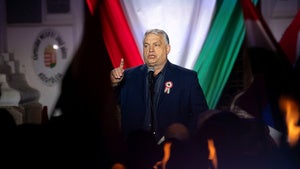 Global Politics
Prime Minister Victor Orbán’s fate may signal whether democratic backsliding is reversible.
 US Foreign Policy
Trump’s ongoing attacks on the rules and laws of war, trade, and alliances could permanently damage US power and influence.
 Geopolitics
Ahead of Munich, Georgina Wright and Sophia Besch explain how Europe is rearming and diversifying its alliances.