Why Hungary's Election is a 'Test Case' for the EU

Prime Minister Victor Orbán’s fate may signal whether democratic backsliding is reversible.
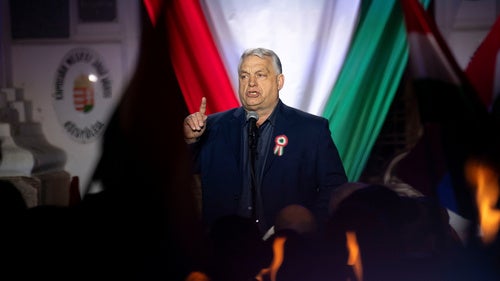
With all eyes on Iran, US Vice President JD Vance traveled this week not to the Middle East but to Hungary, where he appeared at a rally in support of Prime Minister Viktor Orbán. The visit reflected the significance of the country’s April 12 parliamentary election to players far beyond Budapest.
"I'm here because of the moral cooperation between our two countries," Vance told the crowd. "Because what the United States and Hungary together represent under Viktor's leadership and under President Trump's is the defense of Western civilization."
Both Orbán and opposition party leader Péter Magyar have made Hungary's relationships with outside powers a key issue in the race, particularly the country's strained relationship with Brussels and increased reliance on Russian energy. Recent independent polling shows Orbán's party now trailing behind Magyar, suggesting the public may be ready for change after his 16 years in power. Which party ultimately secures the majority will impact Hungary’s role in the European Union and the Russia-Ukraine war. It will also serve as a test of Orbán’s “strong man” leadership model, which has garnered admiration within the Trump administration and conservative circles.
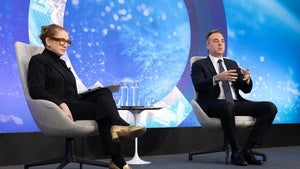
Council Senior Nonresident Fellow Alexander Cooley spoke with the Council’s Libby Berry about Hungary’s global position, Orbán’s political playbook, and what to watch for as Hungarian voters head to the polls.
This interview has been edited for length and clarity.
Hungary's upcoming parliamentary election has been described as the most important EU election in 2026. What makes it so consequential?
This is the first really realistic chance in over a decade for the EU's most entrenched, self-styled, illiberal government—the government of Viktor Orbán—to lose an election. Since he returned to power in 2010, Orbán has used a supermajority to reshape Hungary's constitutional order. No opposition force has even come close to credibly challenging his ruling party, Fidesz.
Hungary has been the single biggest spoiler from the perspective of Brussels—blocking consensus on Ukraine aid, sanctions enforcement, and rule of law conditionality, while pushing back on a lot of EU identity and EU messaging. So, in some ways, for the EU, it's a test case on whether what they consider to be illiberal backsliding within the EU is reversible. What happens in Hungary could send messages to other types of states that are on the border of a more kind of nationalist, illiberal stance in the EU.
Orbán has managed to maintain close ties with Russia while being part of both the European Union and NATO. How has he balanced these relationships, and what impact do they have on Hungary’s international position?
It's a great example of multipolar populism. Orbán wants all the benefits that come from being associated with these architectures and alliances—the European Union and NATO—and he also wants to signal that he wants to have good relationships with both Russia and China. So, he channels all of this through the identity that he is the champion and the guardian of Hungary's sovereign foreign policy, that he's open to all sorts of partnerships and that he's not for excluding or sanctioning anyone.
At the same time, Hungary has maintained deep energy dependence on Russia, even while the rest of Europe purposefully tried to wean itself off of Russian energy in response to Russia's invasion of Ukraine. It also has a deal on nuclear expansion with Rosatom in Russia. These are kinds of commercial arrangements that create structural dependence but also give Orbán a reason to present himself as a constructive kind of potential partner with Russia. It's not so much being overtly pro-Russia, or it hasn't been maybe until recently. It's more like he wants to partner with everyone.
What has Hungary’s response to the Russia-Ukraine war looked like under Orbán? How has Hungary’s position influenced the European response to the conflict?
Hungary has been the most consistent outlier in Europe's response to the war. Budapest has refused to provide military aid to Ukraine. It has blocked or delayed EU sanctions packages. And it's also obstructed the EU's common positions on Ukraine in general really since the war began. Orbán frames this as kind of a peace stance. He's very explicit that Ukraine should be a permanent buffer zone, like Finland was in the Cold War, and excluded from NATO and the EU. That's why critics of Orbán's stance say, ‘Well, these talking points sort of align with Putin and his stance on the war.’
I think probably the EU in some ways welcomes the fact that Ukraine is such a major issue in that it sets up this election as a referendum on Hungary's stance toward Ukraine. If Orbán's opponent, Péter Magyar, were to win, it would give presumably greater unity and cohesion to the EU position.
US President Donald Trump endorsed Orbán’s reelection campaign. What can you tell us about their relationship and its impact on US-Hungary relations?
Trump and Orbán have been quite close ever since Trump's first term. Orbán considers himself a self-styled illiberal populist in the mold of Donald Trump: Euroskeptic, skeptical about Ukraine, skeptical about sanctions. And Orbán has actively cultivated not only Trump by visiting Mar-a-Lago but also has been involved in a lot of political domestic organizations and action groups here in the United States. He's a regular attendee of the Conservative Political Action Conference. He sees his position within that sort of domestic political infrastructure as important.
Orbán has also evolved into describing himself as a kind of leader in post-liberal thought, which has attracted intellectual backers in the United States. Some have even called ‘Orbánism’ a model playbook of how to take control of institutions and over court systems, the media, and universities.
Orbán has championed “illiberal democracy” while in office. What does he mean by this, and how has he moved Hungary in that direction?
After he gained a supermajority in 2010, he reengineered the electoral system to create districts that reward those lesser-populated areas and rural regions and thereby solidify his own base and his own hold on power going forward. He also really redid the courts, and he put political pressure on the courts to sort of sanction these expansions of executive power. And he did this in a way that made him a champion of sovereignty and cast his political enemies not only as internal, but as external. A lot of his political allies control the main TV channels. He showed how important it is to control the information space.
Within the framework of being elected, Orbán showed how you could tinker with many of the important institutions at your disposal and also just push out political enemies.
So, within the framework of being elected, Orbán showed how you could tinker with many of the important institutions at your disposal and also just push out political enemies.
Recent polls have shown Orbán’s Fidesz party trailing the Tisza party, led by opponent Péter Magyar. What do you think is driving this shift?
When you are in power 16 years, you own everything. And the issues right now in Hungary—the domestic issues anyway—aren't dissimilar to everywhere else in the world. There is inflation, there is the cost of living, and there are perceptions of corruption in essentially a one-party state that has ruled for a long time.
The other thing I would say, and this is particular to this dynamic, is Péter Magyar comes from Orbán's circle. He's not a left-winger. He is very openly conservative, but pro-European and also pro-Ukrainian. He speaks from the position not of an outsider bringing change, but of an insider saying, ‘Orbán has corrupted the system, right? I've seen it.’ That gives him a lot of credibility that perhaps a more standard change candidate wouldn't have.
I think all of those factors together are giving real headwinds to Orbán's attempt to be reelected yet again.
What should outside observers be watching for in this election?
The concern is about the use of administrative resources, especially in Orbán-majority districts. I think it's less a concern about actual mistabulation or voter fraud and more concern about things like vote-buying schemes and the algorithmic microtargeting of voters via platforms like TikTok. It's the sort of conflation of election interference and microcorruption schemes that are outside of the boundaries of what the EU considers to be legitimate campaigning.
The second area is the media environment. Orbán controls the traditional media. Magyar's social media strategy has so far compensated—he is effective on YouTube and doing sound bites and shorts. But the general information playing field is deeply unequal. You see a lot of Orbán posters, public advertising, and his election messaging. But I think in some ways, as the population becomes younger and moves away from sort of classic media, it actually becomes harder for the tools that Orbán has at his disposal to completely monopolize the information space.
What could happen if the result is contested?
One of the things to look at is, will this be a point of tension between the EU and the United States? The EU has an incentive if Orbán loses to quickly declare that he should step down and abide by the results of the election. And for Trump, his incentives are the opposite. He's going to want to back Orbán.
There's also the possibility where Orbán's opponent wins the popular vote, but because of these single districts that are mostly in rural pro-Orbán areas, Orbán gets more seats and more representation as a result. Then we're going to be in a real political mess because it'll be Orbán versus the EU and the EU versus Washington and so forth.
If it's a blowout election, there's actually I think only so much Washington can do. I don't think Trump is going to want to spend political capital going after someone who loses by double digits.
All possibilities are on the table.
The Chicago Council on Global Affairs is an independent, nonpartisan organization and does not take institutional positions. The views and opinions expressed in this commentary are solely those of the author.

Related Event