History Doesn't Just Rhyme; It Accumulates

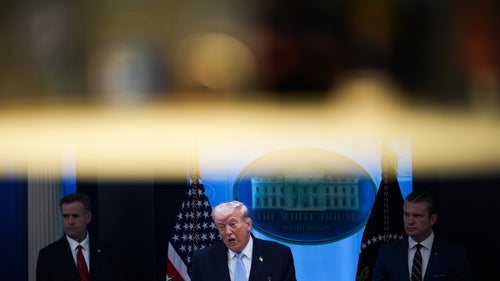
Trump’s ongoing attacks on the rules and laws of war, trade, and alliances could permanently damage US power and influence.
The story of 2026 to date has been the unwinding of US credibility as a guarantor of international peace and stability. But the greater damage may be to America’s moral authority, which has taken a grave hit.
On Tuesday, US President Donald Trump abandoned any pretense of restraint or any adherence to international humanitarian law, saying that “a whole civilization” would “die” if Iran failed to meet his 8 p.m. EST deadline for a deal. Less than two hours before the cutoff, the United States and Iran announced a two-week truce. But moving from a ceasefire to a deal is proving difficult.
Trump wants the Strait of Hormuz reopened (and appears eager to reap any benefits, saying Wednesday he was considering a “joint venture” with Iran to set up tolls). His administration may or may not press for limits on the enrichment of uranium, an issue at the center of US-Iran talks in early February. It may also seek controls on Iran’s missile and drone program. And it is likely to press for the release of the six Americans being held in Iranian prisons.
As for Iran, atop its 10-point list is a formalized end to US aggression. Iran’s demands also include the lifting of primary and secondary sanctions, and compensation for war damages. Notably, Iran wants to retain control of the Strait, but there are different factions within Iran, and they are not aligned on the next steps. The regime also appears intent on maintaining its right to nuclear enrichment.
With Iranian and US delegations arriving in Islamabad for peace talks, both parties, along with China and the Gulf states, have strong incentives to stop the war and secure a deal. Israel is the exception, and its attacks on Lebanon have threatened to undermine the high-level talks before they even begin. On Friday, Iranian Parliament Speaker Mohammad Bagher Ghalibaf said Iran would not engage in negotiations with the United States without a Lebanon ceasefire and the release of Tehran’s "blocked assets.”
As the war grows increasingly unpopular among Americans, Trump has a strong domestic incentive to use US leverage to bring Israel on board. While Trump’s MAGA base has remained supportive of the president, the movement’s leaders have grown increasingly divided over the military operation in the Middle East. Among the US public, confidence in Trump’s ability to “make good decisions” in the war has dropped by 12 percentage points, with majorities in both parties concerned about the war leading to higher gas prices and terrorist attacks in the United States.
Iran too has clear incentives to end the war. Its navy has largely been destroyed, and its missile and drone facilities severely degraded. Even though the regime remains intact, the assassination of many of its leaders has taken a toll.
Still, any talks this weekend—should they proceed—will be difficult, and the future of any possible deal will be precarious. Iran’s leadership said they are approaching talks with goodwill but do not trust the United States. With the United States focused on the Strait, Iran’s leverage sits with its ability to control transit and inflict high costs across the Gulf.
Any talks this weekend—should they proceed—will be difficult, and the future of any possible deal will be precarious.
The price of war is high for all parties, and Trump has shown little regard for the reluctance or even outright refusal of America’s European allies to be drawn into the war. But the rest of the world appears not content to follow the United States into the abyss. More than 100 states have joined an initiative to "strengthen respect for international humanitarian law and to address challenges posed by contemporary evolutions of warfare.”
History doesn’t just rhyme, it accumulates. Trump’s ongoing attacks on the rules and laws of war, of trade, and of alliances, are now threatening a loss to US power and influence that may be irretrievable. And just as the United States is losing its moral authority and ceding its role as a guarantor of international peace and stability, Iran is demonstrating its asymmetric power in a highly interdependent global economy.
Washington has a critical window of opportunity in the days and weeks ahead to draw on a deep base of expertise across the United States and Europe to drive forward a deal. America achieved moral authority because it aspired, if ever imperfectly, to embrace democracy and the rule of law, and to exercise restraint in the use of military force at home and abroad. Does it really wish to cede this power?
The Chicago Council on Global Affairs is an independent, nonpartisan organization and does not take institutional positions. The views and opinions expressed in this commentary are solely those of the author.