The Ukraine War, Already One of Modern Europe's Longest, Has No End in Sight

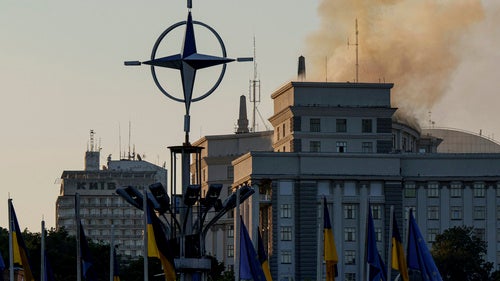
Four years into the conflict, the battle lines have barely moved and peace remains elusive.
This analysis was first published in World Politics Review.
Four years ago next week, Russia launched its full-scale invasion of Ukraine. Since February 2022, there have been offensives and counter-offensives by sides; bold and sophisticated attacks by Ukrainian forces, such as their coordinated drone strikes deep inside Russia last year; and massive aerial bombardment campaigns by Russia targeting Ukrainian civilians. The tactics of this war have ranged from cutting-edge applications of GPS for targeting and drone swarming, to the kind of artillery shelling and trench warfare that hearken back to 19th century combat. The loss of life has been tremendous, with the military casualty level projected to reach 2 million wounded or killed by this spring—a rate that few wars have witnessed since 1945.
By June, the war in Ukraine will become the longest continuous interstate military campaign in Europe in centuries. World War I lasted four years and four months. While it is customary to date World War II in Europe as lasting from September 1939 to May 1945, that is not entirely accurate, since it was not a continuous military campaign. (In fact, there were virtually no Allied military operations in Europe from September 1939 until May 1940, a period that came to be known as the “phony war.”) It was instead a series of related but separate geographically defined campaigns fought by Nazi Germany against the Allied powers, which overlapped in time frame. The longest of those discrete conflicts, the Nazi-Soviet War, lasted about three and a half years.
As the battle lines now stand in Ukraine, the map of territorial control looks largely the same as it did back in late 2022, with Russian forces controlling most—though not all—of the eastern and southern provinces, as well as holding the Crimean Peninsula. As Michael Kofman writes in a recent assessment of the conflict, “it is increasingly a war of adaptation, endurance, and exhaustion, as both sides struggle to break out of the prevailing battlefield dynamic.” It’s been four years of fighting for seemingly marginal territorial gains, rendering the human toll not only tragic but seemingly pointless.
Sadly, the protracted and stalemated nature of this war was foreseeable. At its one-year anniversary in 2023, I wrote that the war seemed “built to last,” and nothing in the intervening years has changed that assessment.
Critical to the war’s longevity is that both countries are sustained by external support. For Ukraine, the members of the NATO alliance, especially the United States, have been a lifeline. Under US President Joe Biden, that assistance largely took the form of direct military aid to Ukraine. Under his successor, Donald Trump, the assistance has shifted to indirect means, namely through the European NATO members purchasing US arms and then distributing them to Ukraine. For Russia, it has been the so-called “axis of resistance” of China, Iran and North Korea. That assistance has ranged from deeper economic and industrial cooperation with China, to troops and artillery shells from North Korea and drones from Iran.
But the core reason that the war is now in its fourth year despite the battle lines not moving in over three years is the same reason that the war started in the first place: Vladimir Putin isn’t interested in compromise. This is a war for his legacy, and that legacy is to make Ukraine once again part of Russia. In his mind, he wants to be seen as recreating the Russian Empire, or regaining the glory of the Soviet Union.
The core reason that the war is now in its fourth year despite the battle lines not moving in over three years is the same reason that the war started in the first place: Vladimir Putin isn’t interested in compromise.
Consider how, five months into the war, Putin drew a comparison between his efforts to take Ukraine and the efforts of Peter the Great in the Great Northern War of the early 1700s. “Peter the Great waged the Great Northern War for 21 years. It would seem that he was at war with Sweden, he took something from them. He did not take anything from them, he returned [what was Russia’s],” Putin argued, adding that now it was “our lot” to follow in Peter’s footsteps.
In other words, Putin sees his effort as a war to right historical wrongs. Most inauspiciously, he seemed to admire how Peter the Great waged war for two decades. As Sergey Radchenko recently pointed out, even if time seems to be running short in terms of Russia’s ability to economically sustain the war, “Putin thinks time is on his side, which largely explains the way he has approached peace negotiations.” If Putin truly does embrace Peter the Great’s endurance, then, after four years of brutal fighting, we are not at the beginning of the end, but the end of the beginning.
This is why efforts to end the war, from talks in Ankara during the early months of fighting to the current talks in Geneva, have proven fruitless. Nothing illustrates this more than Trump’s efforts to broker a peace agreement. In 2024, Trump made ending this war a core part of his campaign for a second term. He asserted on the campaign trail, “Before I even arrive at the Oval Office, shortly after we all together win the presidency, we will have the horrible war between Russia and Ukraine settled. It will be settled.”
Of course, that didn’t happen. But he nevertheless persisted in his claim that he would find a way to end the war. Whereas the Biden administration gave Russia the cold shoulder, Trump and his aides tried to position themselves as willing to talk to both sides—even willing to see the validity of the claims made by both sides.
One could have seen such actions as Trump showing favor toward Russia, especially when coupled with Trump’s disastrous meeting at the White House last February with Ukrainian President Volodymyr Zelenskyy, during which a shouting match ensued and a mineral deal between the two sides nearly collapsed. But in my view, all of that was because Trump believed he could only gain enough trust from the Russians to broker a deal if he wasn’t seen as too close to Ukraine.
Those efforts were epitomized by the US-Russia summit in Alaska last year, where Trump literally rolled out the red carpet for Putin. But other than creating a photo op, it achieved little. Even the shuttle diplomacy by Trump’s envoys, Keith Kellogg and Steve Witkoff, haven’t moved the needle over the course of multiple rounds of negotiations. Even though the US-Ukraine mineral deal was salvaged and Trump and Zelenskyy seemed to have patched up their relationship, Trump’s efforts haven’t budged Russia any closer to wanting to end the war.
As the American Civil War-era Gen. William Tecumseh Sherman famously remarked, “War is Hell.” The war in Ukraine has been hell for the people of Ukraine. It’s been hell for the Russian soldiers who have been thrown into the grinder for the sake of realizing Putin’s delusions of grandeur. But that hell is likely to continue into the foreseeable future.
The Chicago Council on Global Affairs is an independent, nonpartisan organization and does not take institutional positions. The views and opinions expressed in this commentary are solely those of the author.
Related Content
 Public Opinion
They are also divided on the United States’ participation in Europe’s “Coalition of the Willing” to defend a ceasefire in Ukraine.
 Geopolitics
Europe’s security can no longer be taken for granted. We break down why.
 Global Politics
By barring Russian athletes from competing under the Russian flag, the International Olympic Committee demonstrated its power as a global norm-maker. Now, sporting federation leaders are seeking to distance their games from geopolitics.