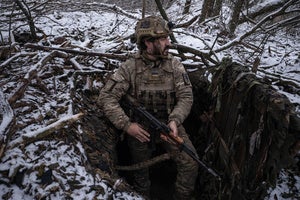
They are also divided on the United States’ participation in Europe’s “Coalition of the Willing” to defend a ceasefire in Ukraine.
February 2026 marks four years since Russia launched its full-scale invasion of Ukraine. The ongoing war is high on the Munich Security Conference agenda, which commences this week. As part of talks on ending the war, Ukraine is facing pressure to cede the entire Donbas region in eastern Ukraine.
Findings from a new Council-Ipsos survey fielded February 6-8, 2026, show that with the exception of Crimea, Americans widely oppose allowing Russia to keep the territory it currently occupies, let alone additional territory under Ukraine’s control. In part, this reflects the majority view among Americans that Ukraine, but not Russia, is committed to peace. With US President Donald Trump continuing to push for a peace deal, Council-Ipsos polling shows a slim majority of Americans think the United States’ handling of the conflict has negatively impacted the image of the United States.
Key Findings
- As peace negotiations continue, a majority of Americans consider allowing Moscow to acquire the Ukrainian territories seized by Russia in the current war unacceptable (67%).
- Americans also object to Russia incorporating the additional territories it desires in eastern Ukraine that are not under Russian control (76% unacceptable).
- Six in 10 Americans support continued military aid to Kyiv while the war is ongoing (57%, down from 62% in July 2025).
- Once a peace agreement is reached, just half of Americans support US participation in a peacekeeping force (49%), launching airstrikes against Russia if it attacks the peacekeeping force (50%), or providing Ukraine with long-term military support (48%).
Beyond Crimea, Americans Consider Territorial Concessions to Russia Unacceptable
Last week, the United States mediated trilateral talks in Abu Dhabi with Russia and Ukraine, giving the two parties a June deadline to reach a deal to end the war. While Russia and Ukraine agreed to a second round of prisoner exchanges—which took place on February 5—little progress was made toward a territorial settlement. The Kremlin’s demands for the entire eastern Donbas region were rebuffed by Kyiv. Instead, Ukrainian President Volodymyr Zelenskyy proposed the establishment of a demilitarized zone around the front line in the Donbas.
For their part, a slight majority of Americans say it is preferable (6%) or acceptable, but not preferable (47%) for Russia to keep Crimea. A significant four in 10 consider Russia retaining Crimea unacceptable (39%). Most Americans are against ceding additional territory to Moscow.
Republicans appear more comfortable with the idea of Russia keeping Crimea (66% either preferable or acceptable) than Independents (54%) or Democrats (44%). Yet, the data show broad partisan opposition to Russia gaining territory beyond Crimea. At least six in 10 across partisan lines agree that granting Russia control of the territory it currently occupies is unaccepable. An additional three-quarters or more say it would be unacceptable for Russia to acquire additional territories in eastern Ukraine that are under Kyiv’s control.
Americans Divided on Joining “Coalition of the Willing” Force in Ukraine
Since March 2025, a coalition of countries—led by the United Kingdom and France—has been working to develop a peacekeeping force to defend a future ceasefire between Russia and Ukraine. The UK and France recently formalized their commitment, signing a declaration of intent to help Ukraine rebuild its military forces and deter further Russian aggression. The multinational coalition agreed on a multi-phase enforcement plan that triggers intervention if Russia were to violate a potential ceasefire and ignore diplomatic warnings, with a “crucial backstop from the United States.”
Many Americans are hesitant about the US role in this coalition. No more than half would support the United States participating in such a peacekeeping force by providing long-term military support to a post-war Ukraine (48%), sending troops to be part of the coalition (49%), or launching airstrikes against Russia if it were to attack peacekeepers in Ukraine (50%).
Majorities of Democrats would support each of these policy options. By contrast, a narrow majority of Republicans oppose US participation in a peacekeeping force or airstrikes, and a large majority oppose long-term military support for Ukraine. Independents are fairly divided.
Republicans Now Less Supportive of Sending Military Aid to Ukraine
Most Americans support a broad range of policies to address the ongoing war between Russia and Ukraine, short of putting boots on the ground. During the second Trump administration, material support for Ukraine has shifted from direct financial assistance and arms transfers to a model where European allies purchase weapons and military equipment from the United States to send to Ukraine’s front lines. Among the US public, six in 10 continue to support the United States providing military aid (57%) and economic assistance to Ukraine (58%). As in past surveys, a majority continue to oppose sending US troops to help Ukraine defend itself (63% oppose, 31% support).
While Republican views toward economic assistance have remained stable since July 2025, they are now less supportive of sending military aid to Ukraine than they were last year (43%, down from 51%), slightly driving down overall support (57%, down from 62%). This decline in support may reflect the relatively low priority Republicans assign to this conflict compared to other issues. In a January 2026 Council-Ipsos poll, Republicans thought domestic priorities like inflation and immigration did not receive enough attention from US leaders, while issues like the Russia-Ukraine war and the conflict in Venezuela received too much or about the right amount of attention.
Democrats remain the strong advocates for sending economic (77%) and military aid to Ukraine (72%), with few fluctuations in their support since last year. Majorities of Independents also continue to back sending economic (59%) and military (58%) aid to Ukraine.
Solid Support for Increasing Sanctions Against Russia and Admitting Ukraine to NATO Alliance
While American policymakers recently introduced a comprehensive sanctions package designed to force Russia to the negotiating table, the Trump administration has been reluctant to impose additional sanctions on Russia, viewing them as an obstacle to achieving a peace agreement. For their part, Americans would favor additional economic and diplomatic sanctions on Russia (69%), with bipartisan agreement (75% Democrats, 69% Republicans, 67% Independents).
Two-thirds of Americans additionally back Ukraine’s admission to NATO (65%, down from 69% in 2024 and 75% in 2022), although Zelenskyy has forsaken Ukrainian NATO membership for now to advance peace negotiations. Democrats (80%) and Independents (64%) are more supportive than Republicans (53%).
Russia Seen as Least Committed to Reaching a Peace Agreement
A majority of Americans believe Ukraine and other European countries are at least somewhat committed to reaching a peace agreement with Russia (71% each). They are, however, more divided in their assessment of the United States’ commitment to reaching a peace agreement: 56 percent believe it is at least somewhat committed to peace, but there is a stark partisan divide. Republicans are nearly twice as likely than other partisans to believe the United States is committed to the peace process, likely reflecting their confidence in US President Donald Trump and waning support for assisting Ukraine.
Few Americans believe Russia is committed to reaching a peace agreement with Ukraine (13%, 80% not committed), and there is partisan consensus on this. However, Republicans are more likely than others to believe Russia is very or somewhat committed to peace (19%).
Americans See US Image Tarnished by Russia-Ukraine War
Most Americans believe the United States’ handling of the Russia-Ukraine war over the last four years has had a negative impact on its international standing (54% total, 33% somewhat negative and 21% very negative). Still, a sizeable share think it has improved the United States’ image (39% total, 34% somewhat positive and 5% very positive).
Among Republicans, a majority view the impact of the Russia-Ukraine war on the United States’ international standing positively (67%). Democrats and Independents, on the other hand, believe the United States’ handling of the war has negatively affected its image abroad (73% and 58%, respectively).
Conclusion
After nearly four years at war, Russia and Ukraine have yet to reach a peace agreement, despite immense pressure from the Trump administration. For their part, a majority of Americans continue to support Ukraine’s war effort and firmly oppose making territorial concessions to Russia beyond Crimea. This puts the public at odds with the Trump administration’s official position, which considers territorial concessions a necessary trade-off to reach a peace deal. However, if the two parties were to reach an agreement, Americans are reluctant to join a peacekeeping force or use US military force to defend a ceasefire.
This poll was conducted by Ipsos from February 6-8, 2026, using the probability-based KnowledgePanel. This poll is based on a nationally representative probability sample of 1,028 adults age 18 or older.
The study was conducted in English. The data for the total sample were weighted to adjust for gender by age, race/ethnicity, education, Census region, metropolitan status, and household income. The demographic benchmarks came from the 2025 March Supplement of the Current Population Survey (CPS).
Specific categories used were:
- Gender (Male, Female) by Age (18–29, 30–44, 45-59 and 60+)
- Race/Hispanic Ethnicity (White Non-Hispanic; Black Non-Hispanic; Other Non-Hispanic; Hispanic; 2+ Races, Non-Hispanic)
- Education (Less than High School, High School, Some College, Bachelor or higher)
- Census Region (Northeast, Midwest, South, West)
- Metropolitan status (Metro, non-Metro)
- Household Income (Under $25,000, $25,000-$49,999, $50,000-$74,999, $75,000-$99,999, $100,000-$149,999, $150,000+)
The margin of sampling error is plus or minus 3.1 percentage points at the 95% confidence level, for results based on the entire sample of adults. The margin of sampling error takes into account the design effect, which was 1.04.





Related Content
 US Foreign Policy
In a 21-point shift, 51 percent of Republicans now favor providing US military aid to Kyiv.
 Public Opinion
The gap between Democrats and Republicans on America's NATO commitment has reached an all-time high in Council polling dating back to 1974.
 Public Opinion
Most Americans believe the United States has too many interests in Europe to let any one country dominate the region.
 Public Opinion
While most support providing medevac services to injured peacekeepers, the public is divided over backing a peacekeeping force militarily.