How the US Public Sees the State of the Union Amid Worsening Global Tensions

Recent surveys show a rise in American skepticism of the Trump administration’s approach to domestic and foreign policy. The Council explores where they stand on the economy, immigration, alliances, and more.
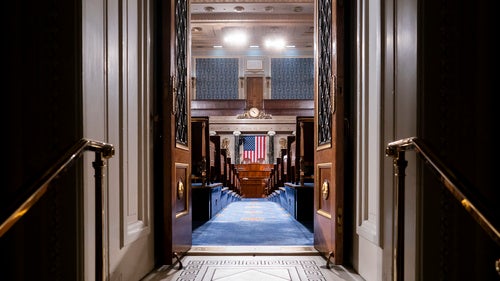
US President Donald Trump will deliver the State of the Union address on Tuesday, just days after the US Supreme Court determined he did not have the legal right to impose worldwide tariffs under the International Emergency Economic Powers Act.
Trump’s fury over the decision will likely carry into the annual presidential message on the condition of the country—a sentiment that is unlikely to resonate with Americans. The 2025 Chicago Council Survey shows that fewer than half of Americans believe tariffs are effective in achieving US foreign policy goals (44%), down from 64 percent in 2024.
The address further lands as recent polls indicate a rise in American skepticism of the current administration’s approach to national and global concerns.
For 50 years, the Chicago Council on Global Affairs has been making sense of public opinion on foreign policy issues. Here is what recent surveys tell us about how Americans feel about the Trump administration’s approach to the economy, immigration, foreign policy, and more.
Economy
On the economy in general, a series of January 2026 surveys help paint the picture of overall American dissatisfaction. According to a Pew Research Center survey, only 28 percent of American adults say economic conditions in the United States are “good” or “excellent,” with 72 percent believing them to be “fair” or “poor.” Notably, half say the Trump administration’s policies have worsened the economy.
Not all aspects of the economy are perceived to be tanking, however. A Gallup poll finds pluralities of Americans expect the stock market and the overall economy to improve over the next six months. Still, a clear majority of respondents expect an increase in inflation, and half expect unemployment to rise. According to a Marist poll, disapproval of the President's handling of the economy recently reached an all-time high across the two Trump administrations (59%).
Immigration
Despite Trump’s rhetoric, most Americans today do not consider immigration to be inherently negative. According to Chicago Council polling, a record number of Americans say the United States should either maintain current levels of legal immigration (49%) or increase it (28%), and opposition to legal immigration is at an all-time low (21%). Further, only a minority of Americans support deporting undocumented workers in the country (23%), with the majority supporting some type of pathway to citizenship or a work permit.
Even Republicans have grown less likely to favor decreasing legal immigration, recently hitting an all-time low of 21 percent. Still, a plurality and record-high proportion of GOP supporters say undocumented workers should be forced to leave their jobs and the country (46%).
When it comes to the Trump administration’s response to immigration, the Marist Poll finds two-thirds of Americans (65%) now say Immigration and Customs Enforcement (ICE) actions have gone too far—up from 54 percent in June 2025. While Republicans remain largely supportive of ICE actions, they have also grown more likely to say ICE has gone too far (27%, up from 20%).
Foreign Policy
Six in ten Americans disapprove of Trump’s handling of US relations with other countries, according to Washington Post-ABC-Ipsos polling. Specifically, Americans are, at best, divided on the US capture of Venezuelan President Nicolás Maduro, and most oppose using US military force to incorporate Greenland.
When it comes to Iran, Council polling finds that Americans favor a nuclear agreement that lifts some international sanctions for strict limits on its nuclear program (61%). If diplomacy and sanctions fail, about half of Americans are willing to support US airstrikes against Iran’s nuclear facilities (48%), with a majority opposing sending US troops to destroy Iran’s nuclear facilities (60%).
Alliances
At the Munich Security Conference earlier this month, European allies initially appeared receptive of remarks made by US Secretary of State Marco Rubio, responding with a standing ovation. But a realization appeared to set in shortly after that Rubio had seemingly reiterated the Trump administration’s call for a change in the transatlantic alliance. German Chancellor Friedrich Merz encapsulated the European mood, saying that “a deep divide has opened between Europe and the United States.”
Yet Council polling finds substantial bipartisan support for US alliances, with a least two-thirds of Americans saying they think US security alliances in Europe (68%), Asia (72%), and the Middle East (67%) benefit the United States alone or the United States along with its regional allies—the highest levels yet recorded. Further, 91percent of Americans consider maintaining US alliances to be an effective way to achieve US foreign policy goals and think the United States should mainly make important foreign policy decisions with major allies (60%) versus unilaterally (21%).
Ukraine
A major concern for European allies is the possibility of the United States coercing Ukraine to accept a peace agreement unfavorable to Kyiv’s survival. Council polling conducted earlier this month shows that a majority of Americans consider allowing Moscow to acquire the Ukrainian territories seized by Russia in the current war to be an unacceptable compromise (67%). Americans also object to Russia incorporating the additional territories it desires in eastern Ukraine that are not under Russian control (76% unacceptable).
While six in 10 Americans support continued military aid to Kyiv while the war is ongoing (57%), there is more division on US efforts once a peace agreement is reached. Just half of Americans support US participation in a peacekeeping force (49%), launching airstrikes against Russia if it attacks the peacekeeping force (50%), or providing Ukraine with long-term military support (48%).
State of the Union
An NPR-PBS News-Marist poll published this week finds that six in 10 Americans believe the country is worse off than it was a year ago. The release coincides with the publication of a CNN survey showing that 61 percent believe Trump’s policies will move the country in the wrong direction (38% right direction).
Trump's approval rating, which CNN reported to be 36 percent, is consistent with recent readings but down from a record peak of 48% in February 2025. This suggests that his base remains loyal. But his rating among Independents notably hit an all-time low, with just 26 percent saying they approve of the president’s performance (down from 41% percent).
Taken together, these recent readings suggest a difficult audience for the president’s Tuesday remarks. Some Democratic leaders have also announced their plan to boycott the speech—choosing to hold their own rally in Washington instead.
While Trump will likely declare the union to be strong, public opinion reveals it is far from united.
The Chicago Council on Global Affairs is an independent, nonpartisan organization and does not take institutional positions. The views and opinions expressed in this commentary are solely those of the author.