Results for:
US Foreign Policy

What Is America's Ultimate Objective in Iran?

In the News
WBEZ
Leslie Vinjamuri

"If the ambition is regime change, the means that are being used certainly are insufficient to achieve that," Council President and CEO Leslie Vinjamuri says. "Iran has been succession planning for a very long time."

 President Donald Trump talking with CIA Director John Ratcliffe, Secretary of State Marco Rubio, and White House chief of staff Susie Wiles
Daniel Torok / The White House via AP
US Foreign Policy

Oil Prices Surge as Iran Closes Strait of Hormuz

In the News
NewsNation
Rachel Bronson

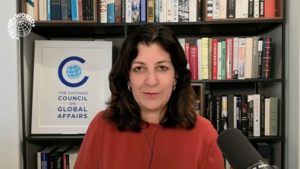
"The markets can take it for a short amount of time," Council Senior Nonresident Fellow Rachel Bronson says. "Beyond that—very difficult. Prices will increase, [and] people will feel it at home."

Rachel Bronson appears in studio at NewsNation Global Economy

The Strategic Challenges of the US Military Campaign Against Iran

Analysis
by Rachel Bronson

US President Donald Trump has called for regime change, the destruction of Iranian military capability, and the degradation of proxy groups. But an operation with multiple goals carries greater risk.

A motorcycle drives past a picture of the late Iranian Supreme Leader Ayatollah Ali Khamenei along an empty street in Tehran, Iran, Sunday, March 1, 2026, following the confirmed death of Khamenei in U.S. and Israeli strikes.
Vahid Salemi / AP
US Foreign Policy

Trump Calls for Regime Change in Iran After US and Israeli Strikes

In the News
CBS News Chicago
Paul Poast

"It looks like the very motivation that led the US to enter the war in Iraq is now in play with Iran," Council Senior Nonresident Fellow Paul Poast says.

Paul Poast speaks on CBS News Chicago US Foreign Policy

In Iran, Trump Abandons a US Strategy of Coercive Diplomacy

Analysis
by Leslie Vinjamuri

The United States and Israel attacked Iran, signaling a departure from nuclear negotiations.

Smoke rises on the skyline after an explosion in Tehran, Iran, Saturday, Feb. 28, 2026.
AP Photo
US Foreign Policy

The Deeper Consequences of Trump's Tariff Strategy

Analysis
by Jim O'Neill

Even before the Supreme Court’s decision to overturn most of US President Donald Trump’s tariffs, historic allies had begun actively exploring economic relationships with other nations.

President Donald Trump departs after signing an executive order at an event to announce new tariffs in the Rose Garden of the White House, Wednesday, April 2, 2025, in Washington.
Evan Vucci / AP
Global Economy

How the US Public Sees the State of the Union Amid Worsening Global Tensions

Analysis
by Dina Smeltz

Recent surveys show a rise in American skepticism of the Trump administration’s approach to domestic and foreign policy. The Council explores where they stand on the economy, immigration, alliances, and more.

The chamber of the House of Representatives is seen at the Capitol in Washington, Monday, Feb. 3, 2020, as it is prepared for President Donald Trump to give his State of the Union address Tuesday night
J. Scott Applewhite / AP
Public Opinion

From Munich to the Board of Peace, the Trump Administration Struggles to Reassure its Transatlantic Partners; The Supreme Court Pushes Back  

Analysis
by Leslie Vinjamuri

The United States and Europe are scrambling to reform their partnership. It is an open question as to whether the transatlantic partnership can continue to be an anchor for international order as the rest of the world presses rapidly ahead.

President Donald Trumpl listens during a Board of Peace meeting at the U.S. Institute of Peace
Mark Schiefelbein / AP
US Foreign Policy

A Healthier Alternative to Trump's Tariff Obsession

Analysis
by Jim O'Neill

The US Supreme Court struck down US President Donald Trump’s sweeping tariffs. History offers a potential path forward for the economy.

President Donald Trump speaks during an event to announce new tariffs in the Rose Garden
Mark Schiefelbein / AP
Global Economy

A New and Dangerous Era for US-China Ties

Analysis
by Evan Medeiros

With Washington prioritizing deal-making over competition, Beijing’s confidence is growing—and the risk of miscalculation is rising. Could China use America’s time-out from strategic competition to surpass it economically, technologically, and geopolitically?

President Donald Trump and Chinese President Xi Jinping walk in front of people waving American and Chinese flags
Andrew Harnik / AP
US Foreign Policy