Will China Dominate the Future?

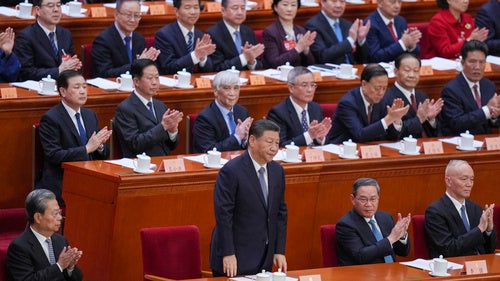
Trump and Xi meet this week with vastly different goals and theories about where the world is going.
An earlier version of this article was published by La Vanguardia.
US President Donald Trump’s summit with Chinese President Xi Jinpinge arrives at a fraught moment in both international politics and US-China relations. Trump lands in Beijing carrying heavy geopolitical baggage. The 2025 trade war between the two countries ended in a truce, but the underlying tensions have persisted. Now, the Iran war has closed the Strait of Hormuz, sparked a global energy crisis, and exposed the fragility of a global order that Washington once built and supported.
Trump rescheduled the summit from its original March date citing the war with Iran. While the conflict in the Middle East has not subsided (and arguably gotten more complex), Trump is still going to Beijing because he both wants to and needs to. US-China relations are too consequential to leave unattended. That, in itself, tells you a lot about the world that we are moving into.
The Beijing summit comes at a genuine inflection moment. Washington is simultaneously managing a hot war in the Middle East, a fractious trade relationship with China, an arms race in Asia, an ongoing war in Europe, and the deepening estrangement of allies and partners all over the world. Beijing has been patient and persistent by gradually positioning itself to benefit from the disorder. It has called for an end to the Iran war and supported a ceasefire but also declined Trump’s request to help reopen the Strait of Hormuz and vetoed a UN Security Council resolution to achieve the latter. Meanwhile, having weathered the energy shortages better than most, it has been rapidly building its economic resilience and military lethality.
The two largest powers are thus heading into the summit with vastly different goals and theories about where the world is going. Make no mistake, this is a reordering moment in international politics. The tectonic plates of geopolitics are moving faster than at any time since the late 1940s, but, as distinct from that period, the United States is now a source of uncertainty, confusion and volatility. Back then, the country built an order founded on alliances, institutions, rules and markets which became global when the Soviet Union collapsed in 1989. Today, the Trump administration is pro-actively abandoning and dismantling major parts of that order, or at least demanding others pay for it. The question of who or what fills that vacuum is not rhetorical anymore. It is the central question of our time.
Asking that question inevitably leads to China. Will China replace the United States as the dominant global power? Are we locked in a new Cold War, or is this something without clear precedent which we lack the language to describe? Can Washington and Beijing find a path to stable coexistence? Few questions will do more to shape the next several decades of world politics. There is almost no corner of the globe, no significant issue, and no major international institution that is not already being shaped by the evolving dynamics between Washington and Beijing.
As both a scholar of international politics and a former policymaker, I am confident in arguing this era will be marked by constant US-China jockeying for power and influence, a race for technological and military advantage, and the ever-present danger of miscalculation between two nuclear-armed states. The May summit may produce agreements, atmospherics, new mechanisms, and perhaps even a further easing of tensions. But it will not resolve the underlying competition. At best, it will kick the can down the road and not too far down.
What makes this competition historically distinctive, and difficult to analyze, is that it is unfolding between two nuclear powers as well as the world’s two largest economies who remain deeply integrated with each other and the global economy, after three decades of intensive globalization. There is no clean Cold War analogy. The United States and China are simultaneously competitors and economic partners, locked in competition while bound by supply chains, financial markets, and shared vulnerabilities. To make the situation more fraught still, rapid technological innovation—above all, artificial intelligence—threatens to fundamentally alter the relative capabilities of both powers in ways no one can fully predict. This is terra incognita in the history of great power politics. The Beijing summit, whatever it produces, is just one waypoint in a contest whose duration and outcome remain deeply uncertain.
The question this essay attempts to answer—will China dominate the future?—may be the most important question in world politics today. The honest answer is that we do not yet know. But the outlines of the competition are becoming clearer, and they are worth examining carefully.
China’s Strategy
China’s strategy toward today’s world is central to understanding this new era. This is not unknowable and China is not a black box, as some assert. Rather, Chinese President Xi Jinping has a clear vision for the future of China and an equally clear view of the policies to achieve it.
Xi wants China to become a global power, but not in the way that many Western policymakers and scholars think. China wants to be a global economic, technological, and military superpower so that others defer to it, and so it is free from constraints to pursue its interests (as it defines them). For China, its global strategy is mainly about freedom of action and freedom from constraints and coercion. China wants an international order that is stable, allows China to prosper and innovate, doesn’t constrain or criticize China, and allows China to resolve any issues that impact the Chinese Communist Party (CCP). Indeed, bolstering the CCP’s image and legitimacy is an explicit international goal.
To the extent that there are broader ideas motivating Chinese diplomacy, Beijing seeks to validate its domestic governance and global governance choices. China is less interested in exporting Marxism-Leninism and more interested in ensuring that China’s authoritarian political system and state capitalist economy are viewed as just as legitimate, and perhaps as more effective, than US and Western choices (i.e., democratic capitalism). China seeks to reify the role of the state in governance with a focus on social and political stability; in doing so, Beijing seeks to enhance the credibility of Xi and the ruling CCP in conducting foreign policy.
China wants to displace the United States as a global power more than replace it.
When it comes to competition with the United States, China is not deploying the exact Soviet playbook. China wants to displace the United States as a global power more than replace it. China doesn’t want the obligations or costs associated with building and running an international order, as the United States did after WWII. China doesn’t want to be bound by anything like a rules-based order, which is sees as a series of burdens and constraints. China is not interested in assuming commitments to preserve the security and prosperity for others. Beijing sees alliances more as burdens than assets. Provision of public goods has never been part of China’s vision.
Rather, China wants to diminish US power, so the CCP has full freedom to achieve its objectives of wealth, power, security and its continued rule. Thus, displacing the US as the number one power is basically about eliminating constraints and opportunities for others to pressure China, while validating the CCP internationally. When Chinese officials talk about fostering more “equality and justice” world order, this is what they are talking about.
To be sure, as China grows more powerful and influential in the world, its ambitions may expand. This is an age-old question about rising powers: Do their ambitions change as their capabilities expand. No one knows the answer to this question, perhaps not even Chinese leaders. Xi is, if anything, ambitious but he is also not impetuous or reckless. The next leadership after Xi Jinping will also have a great influence on this question. As of today, what is clear is that—as China’s global economic interests expand geographically—this will generate more political and, perhaps, even security interests. These trends are worth watching. Recent events in the Middle East are an immediate test of this – whether Beijing will expand its political security commitments in regions important to it.
Xi has basically adopted two policies to achieve his international goals. The first is to expand economic linkages and use them to create dependencies. China has been expanding its trade and investment links with countries all over the world to gain access to the inputs for growth and innovation: energy, resources, food, and technology. In doing so, China has deliberately created dependencies—real and perceived—that Beijing uses to shape countries’ choices, such as not joining anti-China blocs led by the United States. As of today, China is the top trading partner to some 150 countries, and that list is still growing. China wants to be the indispensable economy and to weaponize these dependencies to persuade/coerce countries to defer to China.
A second Chinese policy has been to make massive investments in industrial capacity to position China as a leader in the key technologies of the future (e.g., clean energy and electric vehicles). Xi believes that technological dominance is core to national power and influence, having witnessed the US rise in the 20th century. These domestic investments are also designed to make China as self-reliant as possible, so China is not vulnerable to pressure from others. Xi is effectively reengineering the Chinese economy, so it relies less on other countries while increasing others’ reliance on China. The essential goal is to maximize China’s domestic capabilities—and national strength—while minimizing vulnerabilities. So far, it is working.
China has made great strides in all these goals. China is a manufacturing superpower and is at the leading edge of producing EVs, batteries, clean energy, biotech and many consumer electronics. China’s dominance of the global rare earth industry has given it great leverage in negotiations with the United States, forcing the Trump team to back off their trade war. China has used all these tools to prevent the formation of global coalitions of countries that would or could economically and technologically contain China.
There is another side of the balance sheet. China’s policy choices have come with substantial costs and risks. For the past 5 years, Xi has allocated massive amount of capital to industrial and technology projects to achieve the above goals. The cost of doing so has been to make Chinese consumers and private businesses tolerate deflation, low profits and sluggish wages. So, the economy is not growing substantially (it has plateaued at about 65 percent of US GDP), while China has built itself into a global high-tech manufacturing superpower. To maintain such a two-speed economy, China increasingly needs to export its manufactured goods because Chinese consumers aren’t buying them. This has created a blowback to China in markets all over the world. European policymakers now talk about a “China shock” hitting their economies. It is unclear how long any of this is sustainable, both in China and internationally.
China’s economy also faces a series of long-term structural challenges. China’s demographic trends are perilous; the overall population is contracting (for the first time ever), just as the aged population rapidly exceeds the working-age population (creating a fiscal cliff). Xi has no clear solution for this, except to hope both GDP growth and automated manufacturing takes the edge off the problem. Chinese debt is about 300 percent of GDP and many local governments are bankrupt. Chinese banks are again stuffed with bad debt. This means China needs to keep its capital account closed and the RMB cannot be a free-floating currency, ceding global financial leadership to the US dollar.
US Policy and the Struggle for Dominance
US policy is the second half of the equation and will influence significantly the outcome of the contest for power and influence between Washington and Beijing. It is obvious to point out that President Trump is changing the US role in the world in substantial and enduring ways. Trump is not retrenching from the world, but he is changing longstanding US priorities. This is forcing countries not only to relying less on US power but to actively consider how to resist US actions, such as Trump’s claims toward Greenland.
As reflected in the December 2025 National Security Strategy, Trump is distancing himself from European allies while minimizing the security threats posed by Russia and China (and, especially, their links to North Korea and Iran.) Trump sees China mainly as an economic and technology challenger. Trump is agnostic on the issue of democracy promotion and coordination among them; he is critical of allies and wants them all to do more. Similarly, he dismisses most multilateral organizations and prefers to set up his own ad-hoc ones. Overall, Trump is replacing the vision and values commonly associated with a liberal, rules-based order with a series of transactions meant to serve discrete US interests. This collectively amounts to a major reconceptualization of the US role in the world, and the world has already begun to react.
China sees this moment as an incredible strategic opportunity. For Beijing, this shift in US priorities buys time for it to increase its self-reliance, to reduce vulnerabilities, to reform and transform its economy, to expand its technological capabilities, and to further modernize its military. Beijing is convinced it is on a trajectory to improve its leverage with Washington, but it needs more time to augment its relative position.
Second, Beijing believes that Trump is not only alienating traditional allies and partners, but it is also pushing away Global South countries—which account for 85 percent of the global population and nearly 40 percent of GDP. China is using Trump’s policies to position itself as the beacon of globalization and multilateralism and, thus, for Beijing to present itself as a natural alternative to a selfish and transactional US How—and how well—Beijing uses this opportunity is one of the most important questions in global affairs today.
To be sure, Trump’s actions in the last year make it easy to forget the enduring strengths of the US system. The US still possess one of the most innovative and energy-independent economies in the world, a strong financial system grounded in the global reserve currency, a source of numerous technological advantages, a world class university system, and soft power. But none of these are permanent, and some are quite fragile (e.g., soft power). Trump is doing damage at the very moment that China is making gains. China is now the leading manufacturing power in the world and is dominating advanced manufacturing in important future industries such as EVs, clean energy and batteries.
On military and national security questions, China has built a large and very technologically advanced military that rivals some US capabilities. For example, China has the largest and most advanced missile force in the world. However, China has not been at war since 1979 (when Vietnam routed them), and Xi just purged several of his top military leaders. The United States, by contrast, has been at war almost continuously for the past 25 years. The US and China are effectively engaged in an arms race in Asia, both a conventional and a nuclear one. Thus, as of today, the balance of global power and influence remains decidedly unclear, as both sides build their domestic capabilities and strive for international leverage and advantage.
The Crucible and the Future
As Asia goes, so goes the world. The US-China dynamics discussed throughout this essay will all play out—first and foremost—in the Asia-Pacific. US and Chinese interests and strategies intersect more in this region than any other. In doing so, regional dynamics in Asia offer insights into the broader questions at the heart of this essay: will China dominate the future and at the US expense?
The Asia-Pacific region is the crucible of US-China competition and, specifically, of China’s effort to displace US power. China sees Asia as its strategic backyard and the region where it historically enjoyed hegemony. Beijing wants it back and is using all its tools—dependency and coercion—to carefully create the conditions to dominate the region. China is now the top trading partner for all major Asian economies and its military—with three operational aircraft carriers—can now project and sustain military force throughout Asia.
Yet, China faces formidable barriers to hegemony. The US has five treaty allies in Asia and has been the security provider of choice for many countries for over 70 years. It is a resident power in Asia, much to China’s chagrin. The US homeland is far away from Asia, making US power less threatening and more predictable. (By contrast, China is present, big and growing.) Washington, unlike China, has been a frequent provider of public goods, such as offering quick assistance to humanitarian crises and natural disasters. A US departure from Asia could trigger regional remilitarization and broader instability among many countries.
Moreover, the US market remains an important destination for most Asian exporters, given the raw size of the US economy (and the same goes for Europe). As of today, the US is the top investor in most Asian countries—on an accumulated stock basis—but China leads now in annual investment flow in many countries. The US dollar—and US financial markets—remain critical reference points for all Asian economic policymakers and central bankers. China cannot replace any of this soon.
If the history of Asia tells us anything, it is that the region gets a vote in who dominates.
If the history of Asia tells us anything, it is that the region gets a vote in who dominates. The future of the region will be determined just as much—if not more so—by regional reactions to US-China competition as by the choices of Xi and Trump. Western scholars and policymakers often describe the core geopolitical reality of Asia as this: No Asian leader wants to choose between the US and China. That truism has been reflected in their behavior in recent years. But there is a seldom-spoken corollary to that claim: No one in Asia wants China to dominate. Chinese power is too unpredictable and coercive to go unchecked. Thus, Asia’s strategic reality will be between these two possibilities.
The same can be said for many other parts of the world, especially the Global South. None want to choose but none also want to be dictated to by a single power, Washington or Beijing. US-China competition offers a grand opportunity for developed and developing countries alike, at least the astute ones. The opportunity is to benefit from both sides: access to markets and investments, public goods provision, security commitments (when needed), participate in rulemaking, and the room to negotiate the right price for all of this.
As countries figure out how to position themselves in this new world, today’s international politics are becoming more fluid and dynamic than any period since the early 20th century. Global South countries and middle powers have more capability and agency than in any prior era of global affairs, and they are keen to use it. Therefore, on the question of whether China will dominate the future, the clearest answer in these uncertain times is that the future is more of America’s to lose than China’s to win.
The Chicago Council on Global Affairs is an independent, nonpartisan organization and does not take institutional positions. The views and opinions expressed in this commentary are solely those of the author.
Related Content
 US Foreign Policy