A New and Dangerous Era for US-China Ties

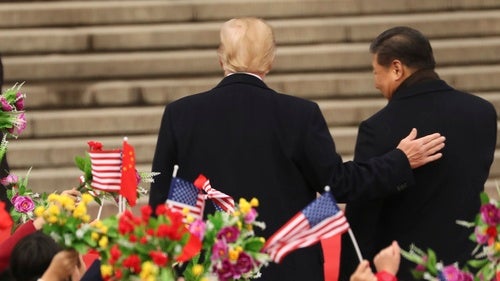
With Washington prioritizing deal-making over competition, Beijing’s confidence is growing—and the risk of miscalculation is rising. Could China use America’s time-out from strategic competition to surpass it economically, technologically, and geopolitically?
If there is one consistent feature of the US-China relationship since normalization in 1979, it is the frequency of volatility and change.
One of the most recent and consequential inflection points occurred in 2018 with the initiation of the era of strategic competition during the first Trump administration. That policy shift, more than most, heralded a comprehensive change in both US and Chinese strategies—domestic and international—toward the other, and came at a time of emerging centrality of US-China ties to global politics. The transition to strategic competition was arguably overdue, but it did provide a degree of clarity to Washington, Beijing, and the rest of the international community about the trajectory of relations moving forward.
With the advent of the second Trump administration, most expected continuity in China policy. It has been anything but that. US President Donald Trump started off in spring 2025 with a trade war and imposition of over 150 percent tariffs on China, signaling the Trump team had found a new gear in their approach to strategic competition. This was familiar, if a bit extreme, but then the situation rapidly escalated. Washington and Beijing both brandished new threats—including cutting off access to critical minerals and technologies—as punishment and leverage.
Trump and Chinese President Xi Jinping stared into the abyss of economic conflagration, and neither presumably liked what they saw. Ultimately both sides backed off and negotiated an agreement to reduce tariffs and resume trade in critical minerals, with bigger deals over the horizon. Trade talks became the arms control of the 21st century: the central venue for negotiating the terms—explicit and implicit—of long-term competition.
In the aftermath, something else began happening in China policy, a shift that will now define US-China relations in 2026.
Trump's Quiet Rejection of Strategic Competition
In fall 2025, Trump’s determination to pursue long-term and intensive competition was replaced with a personal affinity for Xi and an ambivalence toward, if not a quiet rejection of, a comprehensive approach to strategic competition. Following the two leaders’ first meeting in South Korea in November 2025, Trump initiated a new and more expansive phase of diplomatic, economic, and technological engagement with China. In order to keep these economic relations stable and diplomatic ties on track, he started backing off some of the key pillars of strategic competition. It was as if the president decided that the United States was now content to run aside China rather than slow it down or run faster.
The administration’s China policy appeared to be going back to the engagement playbook, when relations were driven by leader-level summits and economic dealmaking. Trump and Xi agreed to exchange state visits in 2026, beginning with Trump going to Beijing in April and Xi reciprocating later in the year. Senior US officials talk about convening possibly four meetings between the leaders in 2026 alone—a new benchmark in the history of bilateral relations.
Other signs of a changing strategy emerged: The Trump administration agreed to sell Nvidia’s advanced H200 chip to Beijing and, alongside private sector partners, also finalized a deal to purchase TikTok that reportedly leaves control of key parts of the business in the hands of its Chinese parent company; Trump removed several National Security Council staffers and Commerce Department officials who advocated for greater tech controls toward China; and discussion of Beijing as a strategic rival was left out of both the National Security Strategy and the National Defense Strategy. Most recently, the president said he wants to negotiate US arms sales to Taiwan with Beijing.
Policymaking is trending more in the direction of accommodating Beijing than US President Richard Nixon’s détente of the 1970s.
Today, Washington talks mainly about summits, a new “G2,” big economic deals, and, in a word, détente—even if the US administration does not use that specific term. The Trump team is focused on securing a long list of billion-dollar commercial deals with Beijing, from agriculture to planes, for his upcoming visit. Trump himself flirts with the idea of welcoming major Chinese investment back into the United States, even as resistance from Congress and state governors grows. Washington is also flush with rumors about changes in US declaratory policy toward Taiwan that would chastise Taipei and, thus, mollify Beijing.
Conservative optimists argue that Trump is wisely pursuing a “tactical détente” to buy time in order to enhance military deterrence and remove US vulnerabilities to Chinese supply chains. But at what cost to US technological advantages, US allies, the US strategic position in Asia, and, most specifically, Taiwan’s security? Such policymaking is trending more in the direction of accommodating Beijing than US President Richard Nixon’s détente of the 1970s.
The Central Challenge for US-China Relations
Thus, in 2026 Washington may break new ground in the history of US-China relations. This will be driven by policy moves away from an intensive and exclusive focus on competition and more toward diplomacy and economic deliverables. It is not that Washington will completely give up on competition (watch US policy on rare earths), but the more intensive dimensions will not be pursued (i.e., technology denial).
The central risk for US-China relations in 2026 and beyond is that Trump’s détente is unlikely to be sustainable and may sow the seeds of future instability. In fact, the relationship may be at the dawn of one of its most precarious moments: when China uses America’s time-out from strategic competition to undermine the US position in Asia and, ultimately, to surpass it economically, technologically, and geopolitically.
The divide between the structural and the cyclical forces in the relationship is too great to be stable and thus sustained. The structural forces of competition in US-China ties are deep and wide. US and Chinese interests diverge more than they converge across a wide set of issues including security, economy, technology, and views about global governance. A core tenant of China’s geopolitical strategy is to diminish US power. These assumptions are well accepted across the US political spectrum, and Trump’s engagement with China this year—his cyclical détente—will only intensify anxieties among US political, military, and business leaders about falling behind.
The administration’s moves thus increase the risk of a “snapback” to a much tougher form of strategic competition. For example, if the Republicans lose badly in the November midterm elections, Trump may pivot to a hardline position on China, as he did in 2020, to shore up his political base in advance of the presidential election. Alternatively, Democrats may embrace competition with China as a way to criticize Trump, advance their domestic agenda, and create a political vulnerability for the Republicans going into 2028. Or, simply if the president concludes that the Chinese are playing him. Whatever the pathway, the United States is going back to strategic competition in some way, shape, or form.
Whatever the pathway, the United States is going back to strategic competition in some way, shape, or form.
There is perhaps an even deeper and more profound risk. The events of the last year, especially the trade war, brought to the fore bigger questions about relative advantage between two major powers in a highly competitive global system: Who has the upper hand, and how will they use it? Xi and Trump each believe they have relative leverage and the tools of escalation dominance. Both sides also believe they can impose unacceptable economic costs on the other and, in China’s case, Beijing believes it can suffer more pain—“eat more bitterness”—than US leaders. This is a precarious place for Washington and Beijing to be. Eventually one side will be tempted to test the proposition, possibly triggering a broader crisis.
To be sure, China’s cutoff of US access to critical minerals, especially rare earth elements and heavy magnets, created great anxiety among US political and business leaders and alerted Washington to a major vulnerability. Trump himself was probably surprised that China has such leverage, defying his initial expectations. When the administration tried to impose additional technology controls in October 2025, Beijing broadened its critical minerals cutoff, revealing the depth of US vulnerabilities.
Washington now clearly understands its exposure, and the Trump team has rightly initiated several efforts to reduce US vulnerabilities. While the administration believes they can close the gap in one to two years, most experts—Western and Chinese alike—think it will take at least five. Those differing assessments add to the risk of instability if Washington underestimates its exposure to Chinese supply chains, which remains substantial. For its part, China is trying to master advanced chip production equipment and other technologies where the United States possesses advantages and can control China’s access.
The mutual effort to reduce vulnerabilities, to generate leverage, and the probing of relative advantage has created a dangerous period in US-China ties, arguably opening a new stage in the evolving strategic competition. Both feel vulnerable, both have some advantages, both are willing to weaponize their interdependence, and both are unsure of the costs associated with the former. Washington and Beijing also have their own domestic politics that complicate these calculations.
In short, the United States and China are now effectively in a race to reduce vulnerabilities and master certain technologies before the other—while also trying to accumulate new sources of pressure. It is that race that will define the already-fraught and complex US-China relationship in 2026 and beyond. None of the summits nor economic deals of 2026 will change any of these harsh strategic realities. It is incumbent on Washington to remain focused on the real challenges it faces as China sprints to maximize its power and influence in a global system in flux.
The Chicago Council on Global Affairs is an independent, nonpartisan organization and does not take institutional positions. The views and opinions expressed in this commentary are solely those of the author.
Related Content
 Global Politics
China is plotting their next five years at their fourth plenum. What does this mean for the US, and the world?
 US Foreign Policy
While Republicans remain focused on limiting China's rise, a majority of Americans now favor a policy of cooperation and engagement with Beijing.
 Global Politics
Is every move against China strengthening the US—or is it just making us weaker? Jessica Chen Weiss breaks it down.
 Public Opinion
Few see the United States as a friend to China, but a majority want Beijing to use a mix of cooperation and containment in its approach to Washington.