At Trump-Xi Summit, a Chance to Set the Terms on Taiwan
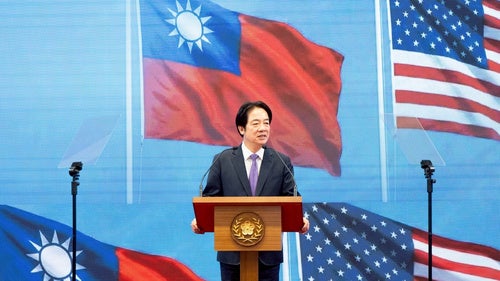
The Beijing meeting gives the United States an opportunity to push back on a Chinese narrative that worsens the bargaining positions of both Washington and Taipei.
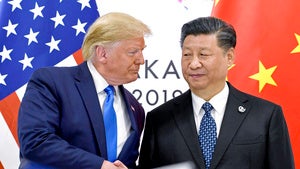
Taiwan tops Beijing’s agenda for Chinese President Xi Jinping’s meeting this week with US President Donald Trump. The two were happy to ignore the self-governing island during their meeting in October. But amid the ongoing war in Iran, China is signaling that now is the opportune moment to tackle their most likely military flashpoint.
Xi’s priority is to push the United States to scrap future arms sales to Taiwan and publicly oppose Taiwanese independence. Doing so, China claims, would reduce the risk of cross-strait war and align with Washington’s alleged past promises. Some policy analysts have already echoed these talking points, calling on the United States to rein in Taiwan to mollify China and preserve peace.
The theory is that Taiwanese politicians are provoking China by making minor changes in their terminology. These moves are “just as threatening” to cross-strait stability as massive People’s Liberation Army (PLA) blockades and missile overflights. But such claims betray a deep misunderstanding of cross-strait tensions. When analysts fixate on linguistic minutiae, they rationalize China’s pretextual fury. They fail to explain how Washington pressuring Taiwan would satisfy Beijing, let alone whether China can or wants to credibly commit to reciprocal deescalation. Meanwhile, the People’s Republic of China (PRC)’s record of military coercion under Xi makes China’s goals crystal clear: unification of Taiwan.
American acquiesce to Beijing’s demands will not pacify the Taiwan Strait. Instead, accepting China’s rhetoric will increase Xi’s options, reduce Trump’s flexibility, and worsen the bargaining positions of both Washington and Taipei. The United States and Taiwan should instead continue to deepen their security cooperation, ignoring Beijing’s disingenuous protests. Real security comes from advancing hard power, not minor changes in terminology.
The State of the Strait
While pointing the finger at Taipei, China is waging an escalating campaign of military coercion against Taiwan. In the past five years alone, the PLA has conducted multiple massive military exercises encircling the main island; fired missiles over it; launched airspace incursions by drones, balloons, and planes; and sent naval incursions across the strait’s median line. Where prior Chinese leadership saw Taiwan as an issue future actors could solve, Xi has openly made retaking Taiwan a core element of his legacy.
Taiwan has displayed restraint throughout. It has conducted monitoring and presence operations, while trying—in keeping with Washington’s desires and, not incidentally, its own self-interest—to defuse situations that all countries would find intolerable.
Nevertheless, some American pundits from across the political spectrum continue to demand that Taiwan take disproportionate responsibility for deescalating tensions. They call on Taiwanese officials to avoid referring to China and Taiwan as two individual countries; to be satisfied with the name “Chinese Taipei” in the few international fora in which they can participate; and to censor history textbooks out of concern for Chinese feelings. They also insist that Taiwan bridle its “reckless” president, despite broad continuity in language with his often highly praised predecessor.
These same pundits also expect the Trump administration to bend to Chinese demands by refraining from calling Taiwan a country, preventing high-level congressional visits, and retightening State Department rules for engaging with Taiwanese officials. More imaginatively, some commentators go so far as to suggest that Washington can strike a grand bargain with Beijing or issue a fourth communiqué, fulfilling a longstanding Chinese desire to publicly foreclose Taiwan’s international status.
These policy recommendations stem from a fundamental misunderstanding of the state of affairs in the Taiwan Strait. Far too many analysts and scholars talk about cross-strait dynamics as if Taiwan and China are trapped in a security dilemma. A security dilemma exists when “all sides see their own actions as defensive” but misperceive the other side as aggressive. Each side then takes steps to defend itself which inadvertently make the other side feel even less secure, triggering arms races, security spirals, and miscalculation. War—avoidable and tragic—becomes more likely.
Assurances are the way to escape this trap. States must communicate their aims, procure defensive weaponry, and recognize the other side’s security concerns. The litany of calls for US and Taiwanese concessions to Beijing are based on this logic. Carrots are safer than sticks in avoiding conflict. Conciliation is better than the threat of punishment.
Unfortunately, this “diagnosis” is wrong. A security dilemma only exists when both sides lack hostile or malign intent. It is debatable whether the United States and China are caught in such a dilemma. But China and Taiwan are not.
The Real Threat
Among many similar statements, Xi threatened forcible unification in 2019, stating, “We make no promise to abandon the use of force and retain the option of taking all necessary measures.” Building on the 2005 Anti-Secession Law, Beijing criminalized “separatism” in 2024, jailed a Taiwanese activist, and demanded foreign extradition of a Taiwanese legislator.
Meanwhile, Taipei does not pose a military threat to Beijing. It is not planning to invade nor preventively attack China, and the PLA dwarfs Taiwan’s military. Simply put: China has no reason to fear Taiwan.
A security dilemma only exists when both sides lack hostile or malign intent. It is debatable whether the United States and China are caught in such a dilemma. But China and Taiwan are not.
This is why Beijing has adopted a disingenuously expansive definition of security. It claims provocative military exercises are a legitimate response to word choice in Taiwanese political speeches. Those still asserting cross-strait conflict is a misunderstanding between defensively minded states must ask themselves: What level of arms would Beijing consider acceptable for Taiwan to possess for its own self-defense? If the answer is functionally “none,” it is clear which party is the aggressor.
The real question is whether Xi is willing to be mollified. According to his own words, the answer is no. In this circumstance, US efforts to clamp down on Taiwan are likely to embolden Beijing into further isolating Taipei and seeking additional concessions. Indeed, China has a long history of conducting political warfare against Taiwan to minimize the latter’s policy space. China is unlikely to reciprocate any changes in Taiwanese rhetoric with reductions in its cross-domain and military coercion.
In his upcoming meeting with Xi, Trump should avoid parroting Beijing’s claims that China is the one being provoked. Responsibility for cross-strait tensions lies with Beijing. Xi could renounce the use of force at any time.
Moreover, blaming Taipei and Washington for provoking Beijing creates the misleading expectation that slowing—or stopping—efforts to improve Taiwan’s defenses or allow for its meaningful participation in international organizations will reduce tensions. It will not. Beijing will instead simply move the goalposts by claiming that it is provoked by an ever-growing range of actions and speech. All the while, it will continue to pour resources into its conventional and nuclear buildup to ensure that when the time comes for decisive action, it will hold all the cards. At that point, Beijing might be able to win without fighting because it will have painted Taipei and Washington into a corner in which resistance becomes futile.
Trump should also make clear that the United States will continue to provide Taipei with the arms that it needs to defend itself. Real bargaining leverage comes from hard power. It is a dynamic that Xi understands all too well. As much as Beijing wants pundits to believe otherwise, Xi’s efforts to expand his military capabilities are what allow him to tighten the noose around Taiwan. The harsh reality is that by building up military power faster than Washington or Taipei, Xi is creating a situation in which he may wind up having more options than Trump.
The Chicago Council on Global Affairs is an independent, nonpartisan organization and does not take institutional positions. The views and opinions expressed in this commentary are solely those of the author.



Related Content
 Global Politics