What the Trump-Xi Summit Could Mean for US-China Relations

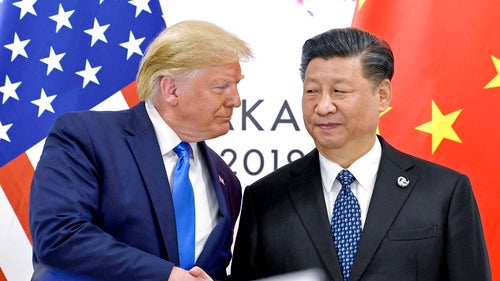
From trade to Taiwan, the two leaders are set to discuss a range of thorny issues this week in Beijing.
US President Donald Trump and Chinese President Xi Jinping will meet this week in Beijing for a two-day summit. The talks—the first between the two leaders since October’s APEC summit in South Korea—come amid a fragile ceasefire between the United States and Iran. While the war is expected to be discussed, both leaders will come to the table with several priorities, including Taiwan and trade.
Marshall M. Bouton Senior Fellow for Asia Studies Raymond Kuo spoke with the Council’s Christina Colón about how the Middle East conflict could shape the talks and whether any agreement between the Trump and Xi can hold.
This interview has been edited for length and clarity.
Beijing has signaled that Taiwan will be its top priority at the summit. Why, and how has the dynamic around Taiwan shifted since these two leaders last sat down together?
Taiwan is the flashpoint for military tensions between China on the one hand and the United States on the other. It is part of the First Island Chain that essentially contains China into its own territory and doesn't allow it to project power out into the Pacific.
When Trump and Xi met a few months ago in Korea, Taiwan didn't come up at all, and from the Taiwanese perspective, that was really good. With Trump, because of his transactional approach to foreign policy, there was always a question about whether or not he would sell out Taiwan or soften certain US policies toward Taiwan in order to curry favor with the Chinese and get a better deal. However, with this meeting and China signaling that it is at the top of the priority list, those issues are back on the table.
A big question is: Who will Trump be bringing with him to China to for these kinds of negotiations? If it's more on the economic side—someone like US Treasury Secretary Scott Bessent—then there's a concern about trading off some US positions on Taiwan for a better economic deal. If it's more of the military side—people like US Secretary of Defense Pete Hegseth or Undersecretary of Defense for Policy Elbridge Colby—then perhaps there's a bit less of that concern.
What are the other key priorities each side is bringing to the table?
Beyond Taiwan, I think the summit is going to focus pretty heavily on trade and economic issues. The United States is still in the midst of a pretty significant trade war with the Chinese. At one point, I think Washington was imposing 145 percent tariffs on Chinese goods. In response, the Chinese have curtailed exports of critical minerals and other sort of products that the United States relies upon for its manufacturing and technology base.
Both sides have demonstrated that they have the ability to inflict pain on the other. It's a question of whether we can deescalate from that and get back to more stable economic relations between the two.
I think both sides have demonstrated that they have the ability to inflict pain on the other. It's a question of whether we can deescalate from that and get back to more stable economic relations between the two. For example, will the Chinese buy more US soybeans and other agricultural products? Will the United States give up its restrictions on exports of certain types of NVIDIA chips to the Chinese? Can we get past tariffs? Those are all big, thorny questions, and I'm not sure that this summit on its own is going to be able to address all of them.
These talks were originally scheduled for late March, but President Trump requested a postponement because of the war in Iran, which is still ongoing. How could that conflict shape the summit dynamic, and does it give Beijing any leverage?
It could potentially give Beijing a little bit stronger leverage in these negotiations, certainly on the economic side. US consumers are dealing with the average price of gasoline now being above $4.50 a gallon. That's economic pain. It means that the US is likely to cut a deal to alleviate some of that economic pain with lowering prices or at least reducing inflation on other types of goods that the Chinese often produce.
In terms of security, what we call magazine depth has long been an issue for the US military. We produce missiles and ammunition, and other munitions. But our ability to restock at a very high rate—war burns through those munitions very quickly—that's been a question for some time. Right now, the US military has had to pull ammunitions from not just the United States but also the Indo-Pacific Command to be used in the war against Iran. That means the US ability to defend Taiwan, to support our other partners and allies like Japan and South Korea, is going be more limited for quite some time until we can resupply and restock those munitions.
That could give China a bit of an opening to push out its military forces a little further because the United States will be more cautious about confronting those forces. I don't know that you're going see any kind of direct hostilities breaking out in East Asia because of the Iran war. But it does offer the Chinese advantages in terms of economic leverage and negotiations, gray-zone military pushes, and diplomacy.
What is the realistic range of outcomes here: a deal, a framework, further talks? And what would it take for any agreement to hold?
One issue with the Trump administration's approach to foreign policy is the amount of legwork that's done by lower-level staff. Typically, in foreign policy, the principals do not meet until the very, very end. You have lower-level functionaries, middle-management experts meeting with their counterparts, and hashing out all the details. Trade agreements usually take about 10 years to work out just between two countries because you're going through line by line, industry by industry, and trying to work out all these really, really complex issues. With the Trump administration, that legwork tends not to happen. You can think of his meeting with Kim Jong Un of North Korea, and how they were hoping for some kind of North Korean nuclear deal. But again, the legwork just hadn't been done, so when they got in the room, there were just too many issues to work out.
I think at best we might see an agreement to work together in the future on economics. You might see some commitments by the Chinese and the United States for kind of relatively low-hanging fruit so that the Chinese will purchase additional agricultural products they need from the United States, or that the United States will give up certain export controls toward the Chinese. Maybe you can get back to reduced tariff rates as well, kind of in the 15 to 30 percent kind of range. But I think durability is a real question.
I think generally speaking, because of the administration's transactional and unilateral approach, there's a credibility deficit on the US side. Trump often talks about how the trade deals that we have with Canada and Mexico right now are the worst deals he's ever seen. The problem is, those were the deals that were negotiated under his first administration, right? So if you're turning around and ripping up your own agreements that you yourself negotiated, it makes it much harder not just for Canada and Mexico to trust us, but other countries outside to be like, "Well, how exactly are you going to hold to this deal? You've already proven to some extent that you're willing to change deals when it suits you. Can you credibly commit to it in the future?" And it just raises the cost for that credible commitment.
The Chicago Council on Global Affairs is an independent, nonpartisan organization and does not take institutional positions. The views and opinions expressed in this commentary are solely those of the author.

Related Content
 Global Politics