King Charles III's Extraordinary US Visit Followed by Trump's Decision to Pull 5,000 Troops from Germany

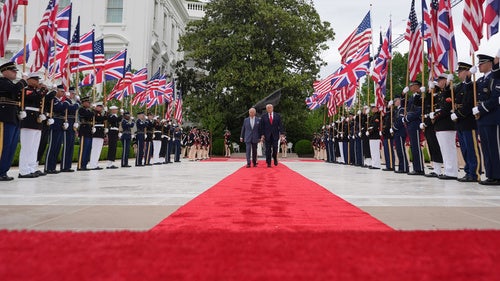
The British king’s skillful diplomacy and eloquent elevation of the US-UK relationship stands in stark contrast to a new transatlantic reality.
Amid stalled US-Iran peace talks and a downward spiral in transatlantic relations, the United Kingdom’s King Charles III’s visit to the United States was an unparalleled example of skillful diplomacy. For those who were able to climb inside the bubble, the trip served as a moment of suspended reality.
Many feared the king’s visit was poorly timed and would give legitimacy to US President Donald Trump’s attacks on NATO and attempts to sideline European allies. The visit also risked domestic backlash in the United Kingdom at a time when 68 percent of Britons see the United States as having a "negative impact on the world."
Instead, the king’s visit was a triumph, marked by a masterful anchoring of the US-UK relationship in 250 years of history. King Charles III carefully positioned this historic alliance as one from which the United States has long benefited. Many had assumed he would avoid commenting on US democracy and Trump’s foreign policy, but he did not. Instead, he used his singular status to remind a joint session of Congress that executive power is subject to ”checks and balances,” grounding this view not in the US Constitution but the US Supreme Court’s at least 160 citations of the Magna Carta. The king also reminded Congress of NATO's support for the United States after 9/11, called for the defense of Ukraine, and emphasized the need to protect nature. He quoted Trump on the "priceless and eternal" bond between the two countries, and he reminded Americans that friends can disagree without fracturing forever bonds. Congress gave him a standing ovation.
But however carefully calibrated, King Charles III’s eloquent elevation of the US-UK relationship stands in stark contrast to the dramatic and disruptive nature of its current practice. The day after the king’s speech to Congress, Trump posted on Truth Social that the United States was “studying and reviewing the possible reduction of Troops in Germany.” The Pentagon confirmed the decision two days later, announcing plans to withdraw 5,000 troops from Germany within the next year.
However carefully calibrated, King Charles III’s eloquent elevation of the US-UK relationship stands in stark contrast to the dramatic and disruptive nature of its current practice.
The firmer reality of the historic alliance was under consideration last week in London, where I attended a launch event at Chatham House of the House of Lords International Relations and Defence Committee’s inquiry report on the UK-US relationship (I previously gave evidence as part of the process). Later that week, I joined European and American leaders and experts in Greece for the Delphi Economic Forum XI. A few things stood out.
First, European leaders have abandoned any sentimentality about the transatlantic partnership. In contrast to the king’s speech, European leaders are intentionally moving beyond history to confront what is widely viewed as a new and enduring reality. The House of Lords report’s central conclusion stated that the United Kingdom must "dismiss previous sentimentality about a 'special relationship'" and prepare for a future that will be "far more transactional and interest based." It went on to identify five structural trends shaping US foreign policy that will persist regardless of who holds office: China as the dominant organizing priority, burden-shifting on European security, growing skepticism toward multilateral commitments, the rise of economic nationalism, and deepening political polarization. The conflict in Iran, the report noted, is "not necessarily a departure from these trends" but rather an acceleration of them.
Second, across the United Kingdom and Europe, leaders are attempting to press ahead with new solutions. The barriers to achieving their aspirations are significant. The United Kingdom is now unveiling its ambition to move closer to Europe. Some went as far as to suggest that it was conceivable that the United Kingdom would—eventually—seek to rejoin the European Union. But it did not take long before discussion of the complexity of doing so led to a more pragmatic estimation of alternative steps to strengthen the relationship.
Among EU leaders, there was a clear recognition that Europe had failed to adopt the proposals in the Draghi report, and that efforts to diversify partnerships and build internal resilience—including contested proposals for a Capital Markets Union and Qualified Majority Voting—should be rigorously considered. Pragmatism and principle vied for the front lane, with one former minister suggesting that while diversifying energy resources must be a priority, each EU state should make their own decisions about the use of nuclear energy.
Third, Europeans and Americans seem no closer to agreeing on a common approach to China and may be drifting further apart just as the urgency of cooperation grows stronger. Former Biden administration officials Kurt Campbell and Rush Doshi have argued that the only way to compete with China is with ‘allied scale,’ the collective industrial, technological, and military capacity that the United States and its allies can generate together to offset China's enduring advantages of size and production. China possesses scale, and the United States does not—at least not by itself. But across meetings in the United Kingdom and Europe, I heard the same lines repeated: Europeans (including the United Kingdom) need to determine their own policy and interests with respect to China.
King Charles III’s visit will stay with many Americans as a reminder of a shared history, and as a symbol of the kind of civility and eloquence that previously defined one of the most important relationships of the last century. But the continuing view from across the pond is far more realistic, couched instead in the clear assessment that, this time, the United States is not coming back.
The Chicago Council on Global Affairs is an independent, nonpartisan organization and does not take institutional positions. The views and opinions expressed in this commentary are solely those of the author.