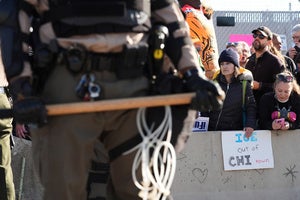
In the aftermath of Operation Midway Blitz, residents in Chicago, suburban Cook County, and Lake County say Immigration and Customs Enforcement actions have gone too far.
In early September 2025, masked federal immigration agents from US Customs and Border Protection (CBP) and US Immigration and Customs Enforcement (ICE) launched Operation Midway Blitz to arrest undocumented immigrants (ostensibly “criminal illegal aliens”). This operation continued through December and involved raiding a wide array of Chicago neighborhoods, from the Mexican and Latino communities in Pilsen, Little Village, the South and Southeast Sides to even the Magnificent Mile and River North in downtown Chicago. ICE was also active in several Chicago suburbs. Agents’ tactics were often aggressive, using tear gas and force, including in sensitive zones such as schools, hospitals, and daycares. These activities prompted protests from some concerned citizens.
This first-ever Chicago Council on Global Affairs survey of the Chicago area finds that most residents of greater Chicago (or “Chicagoland”) feel that ICE actions made them less safe, and they sympathize more with the protesters and immigrants than with ICE agents carrying out orders from the administration of US President Donald Trump. But as with national immigration sentiment, there are steep partisan differences on this issue.
Key Findings
- Majorities across Chicagoland (69% Chicago, 60% Cook County suburbs, 57% Lake County) say ICE actions make people in the Chicago region less safe. Similar proportions also say ICE actions have gone too far.
- Seven in 10 Chicagoans (72%) say they mostly sympathize with protesters and immigrants over ICE agents, as do roughly six in 10 residents of suburban Cook County (60%) and Lake County (57%).
- Against the backdrop of ICE actions, half or more from Chicagoland report frequenting immigrant-owned businesses (56% Chicago, 51% suburban Cook County, 55% Lake County).
- A third of Chicago residents (35%) donated money, supplies, or time to immigrants or immigrant advocacy groups, and two out of 10 Chicagoans (21%) say they carried a whistle to alert immigrants of ICE presence. Substantial minorities also report taking actions such as signing a petition; attending an event or protest; or writing or speaking to a public official about these issues.
- Reflecting national partisan divides on this issue, there are sharp differences between Republicans and Democrats. Republicans tend to say ICE actions have not gone far enough, the presence of ICE agents make them feel safer, and they sympathize significantly more with ICE agents over protesters and immigrants.
Majorities in Chicago Region Say ICE Actions Have Gone Too Far
Most in the Chicago region, including seven in 10 Chicagoans (70%), six in 10 in the Cook County suburbs (60%), and a majority of Lake County residents (56%), say recent ICE actions to enforce immigration laws have gone too far.
These views hold across racial lines in all of Cook County, where seven in 10 Asian American (72%), Hispanic/Latino (69%), and African American (69%) residents say ICE has gone too far, as do six in 10 white residents (61%).
However, views split along partisan lines. Nearly all Democrats in Cook County (87%) say ICE has gone too far, as do six in 10 Independents (60%). But few Republicans agree that ICE has gone too far (13%). Instead, half of Republicans (47%) say ICE has not gone far enough, while four in 10 (38%) say ICE’s actions have been about right.
Majorities Believe ICE Makes Chicagoans Feel Less Safe, Not More Safe
Trump officials stated that Operation Midway Blitz aimed to make everybody in the community feel “safe” regardless of their political views. But ICE agents’ forceful approaches to seek out undocumented immigrants—using helicopters, unmarked cars, chemical agents, handcuffs, and zip ties—and to break up anti-ICE protests seems to have had the opposite effect.
Majorities across Cook County (69% Chicago, 60% Cook County suburbs) and Lake County (57%) say ICE actions make people in the Chicago region less safe. By contrast, about three in 10 in Chicago proper say ICE actions make them safer (28%), as do roughly four in 10 in suburban Cook County (39%) and Lake County (42%).
As with most attitudes toward immigration, there are sharp partisan differences. While nine in 10 Cook County Democrats (88%) and six in 10 Independents (58%) say ICE makes them feel less safe, nearly nine in 10 Republicans (87%) say ICE makes them feel more safe.
Most Sympathize with Protesters and Immigrants, Not ICE
Prior to immigration enforcement actions in Minnesota, which started in December 2025, Chicago was considered the “epicenter of the Trump administration’s crackdown on immigration.” Peaceful protesters around the city were repeatedly met with hostile responses from ICE agents, who used tear gas, pepper balls, and physical force to disperse the crowds.
Majorities across Chicagoland say they broadly sympathized more with the protesters and immigrants against ICE actions than with ICE agents. Seven in 10 in Chicago (72%), and about six in 10 in suburban Cook County (60%) and Lake County (57%) say they mostly sympathized with those protesting and the immigrants.
In Cook County, majorities across all racial and ethnic groups are mostly sympathetic to the protesters and immigrants, ranging from six in 10 white residents (62%) up to three-quarters of African Americans (73%). Rather than race, partisanship is again the deepest divide. And it’s a stark one: While 90 percent of Democrats and 59 percent of Independents mostly sympathize with the protesters and immigrants, 85 percent of Republicans say they mostly sympathize with the ICE agents.
Personal Reactions to ICE Operations Vary by Region
Even before Operation Midway Blitz was announced, immigrant rights organizations and other groups in Chicago had formed “rapid response” teams which encouraged spreading the word if ICE agents had been spotted in neighborhoods, shared the license plates and models of the rental cars used by agents, informed immigrants about their rights, and passed out whistles for volunteers to use as public warnings.
For their part, Chicagoland residents say they were personally involved to varying extents. Large majorities of at least eight in 10 residents of Chicago (83%), Cook County suburbs (86%), and Lake County (87%) say they watched news or footage of ICE activity in their area. Many also took part in actions to support immigrants. Half or more report that they have frequented immigrant-owned businesses (56% Chicago, 51% Cook suburbs, 55% Lake). Substantial minorities (ranging from 21% to 35%) in each of these Chicagoland areas have donated money, supplies, or time to immigrants or immigrant advocacy groups; signed a petition on immigration issues; attended a political event, rally, or protest on immigration; or written or spoken to a public official about these issues. Two out of 10 people in Chicago proper say they have carried a whistle to alert others to ICE presence (21%) compared to smaller percentages in the suburbs of Cook County (10%) and Lake County (6%).
While supporters across the political spectrum followed the news about ICE activity in their area, Chicago and suburban Cook County Democrats are most inclined to report involvement in other activities, especially frequenting immigrant-owned businesses (67%), donating money, supplies, or time to immigrant families or advocacy groups (40%), and signing a petition (37%). About a third of Democrats attended a political event (34%) or contacted a public official (30%), and a quarter report carrying a whistle (23%). A smaller share of Cook County Independents took part in direct actions, with half reporting frequenting immigrant-owned businesses (48%) and a quarter donating money, supplies, or time (26%). About two in 10 report participating in other activities, and 11 percent of Independents say they carried a whistle to alert others to ICE presence.
While most Republicans in Cook watched the news about ICE in their area, about three in 10 also frequented immigrant-owned business (29%) and two in 10 say they contacted a public official about immigration matters (20%). About one in 10 Republicans attended a political event (12%), donated money, supplies, or time (11%), signed a petition (11%), or carried a whistle (6%). There are also some divisions between Republicans: Those who do not identify as being part of the “Make America Great Again” (MAGA) movement (29% of Republicans, vs. 71% who say they are part of the MAGA movement) were more likely to say they frequented immigrant-owned businesses, donated to immigrant families or advocacy groups, or attended an immigration rally or protest.
There are also some noticeable racial differences in these participation rates. White residents of Cook County are more likely than average to say they have participated in most of these immigration-related activities, while Black Chicagoans are less likely than average to report doing so.
Conclusion
According to reporting by local radio station WBEZ, organizers and local activists remain vigilant as federal immigration enforcements operations continue in the interior of the United States. At the same time, Chicago officials continue to resist federal efforts on this issue, including establishing ICE-free zones in support of private property owners, tenants, and community institutions. As broader Council research on the attitudes of Chicagoland communities illustrates, Chicagoans see their city as a welcoming one for immigrants—and most seem to want it to stay that way.
Chicago is one of the great immigration gateway cities for the United States, and immigrants have left their mark on the city and in the surrounding suburbs. These include the immediate suburbs in Cook County (within which the city of Chicago sits) as well as in the surrounding five “collar counties” of Lake, McHenry, Kane, DuPage, and Will. Often broadly referred to as Chicagoland, the area continues a tradition as home to one of the United States’ “largest and most diverse” immigrant populations.
To better understand how Chicagoland residents think about immigration and immigrants, and how local attitudes reflect or differ from national opinion, the Chicago Council on Global Affairs conducted an in-depth survey of local residents: the Chicagoland Immigration Survey, fielded April 13–23, 2026, in Cook County (n=1500) and Lake County (n=400). Cook County can be further divided into the city of Chicago (n=758) and suburban Cook County (n=742). Because of the smaller size of the Lake County samples, analysis by partisanship, race, or education are only reported for Cook County results.
| Chicago | Suburban Cook County | Lake County | |
|---|---|---|---|
| N (sample size) | 758 | 742 | 400 |
| Partisanship (%) | |||
| Republican | 13 | 23 | 27 |
| Democrat | 56 | 45 | 39 |
| Independent | 30 | 31 | 34 |
| Race/Ethnicity (%) | |||
| Black/African American | 25 | 16 | 6 |
| White/Caucasian | 34 | 49 | 58 |
| Hispanic/Latino | 29 | 21 | 23 |
| Asian American/Pacific Islander (AAPI) | 8 | 10 | 9 |
| Other | 3 | 3 | 1 |
| Age (%) | |||
| 18–29 | 23 | 18 | 21 |
| 30–44 | 32 | 23 | 24 |
| 45–59 | 20 | 24 | 27 |
| 60+ | 25 | 34 | 28 |
The Chicagoland Immigration Survey was fielded for the Chicago Council on Global Affairs by Global Strategy Group, which conducted a survey of 1,500 adults 18 or older in Cook County and 400 adults 18 or older in Lake County from April 13–April 23, 2026.
The study was fielded in English and Spanish in a mixed-mode telephone (landline and cell) and text-to-web, with the telephone and text-to-web invitations both using random digit dialing. The margin of error for the Cook County sample is ±2.5%, and the margin of error for the Lake County sample is ±4.9%.
| Region | Margin of Error | Partisanship (Cook Only) | Margin of Error | Race/Ethnicity (Cook Only) | Margin of Error |
|---|---|---|---|---|---|
| Chicago | ±3.6 | Republican | ±6.0 | Black and African American | ±6.5 |
| Suburban Cook County | ±3.6 | Democrat | ±3.6 | White or Caucasian | ±3.4 |
| Lake County | ±4.9 | Independent | ±4.5 | Hispanic or Latino | ±5.8 |
| Asian American and Pacific Islander | ±10.1 |
The data for both the Cook County and Lake County samples were weighted to adjust for gender, age, race/ethnicity, education, PUMA (Public Use Microdata Area), and 2024 presidential vote. The demographic benchmarks came from the US Census Bureau’s 2024 American Community Survey 1-Year Estimates Public Use Microdata Sample (ACS 1-Year PUMS). Self-reported 2024 presidential vote choice was weighted to the 2024 results in Lake and Cook County.
Specific categories used in weighting were:
- Gender (Male, Female)
- Age (18–29, 30–44, 45–54, 55–64, 65+)
- Race/Ethnicity (White Non-Hispanic, Black Non-Hispanic, Asian Non-Hispanic, Hispanic, and Other/Multi-Racial)
- Education (College, Non-College)
- PUMA (City of Chicago, Rest of Cook County, Lake County)
- 2024 Presidential Vote (Harris/Trump)
The Chicagoland Immigration Survey was made possible through the generous support of the Walder Foundation and Schreiber Philanthropy.




Related Events

Related Content
 Public Opinion
While most Republicans echo Trump's view that immigration negatively impacts the United States, a majority of Americans feel differently.
 Geopolitics
Republican Party supporters stand out as the only partisans in favor of using the military for domestic law enforcement, to suppress protests, and to control immigration.
 Migration
While majorities of Democrats and Independents support a path to citizenship for immigrants living and working in the United States illegally, only four in 10 Republicans agree.