After US-Israel Strikes: What Comes Next for Iran and the Region?
About This Event
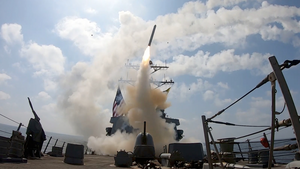
The United States and Israel have jointly launched coordinated strikes on military and nuclear targets in Iran, with US President Donald Trump declaring a “massive and ongoing operation.” Trump directly appealed to the people of Iran, urging them to pursue their freedom. Meanwhile, Iran has retaliated, striking Israel and US interests across Bahrain, Kuwait, Jordan, Qatar, and the UAE. Are we seeing the start of a new regional war unfolding with direct US involvement? How are Iranians grappling with these unfolding events and what comes next for their country?
Join this rapid response live stream led by Council President and CEO Leslie Vinjamuri as she is joined by leading policy experts and scholars to assess the current US-Iran tensions and the future of Iran.
This transcript has been edited for clarity.
Leslie Vinjamuri: Hello, and welcome to the Chicago Council on Global Affairs. It's tremendous to have all of you with us today. It's been an extraordinary weekend, although our speakers might tell you differently.
I am delighted to be moderating this conversation with two of the world's leading experts on the Middle East, on international relations more generally, and friends of mine whom I've known and worked with over many years and have great personal admiration and respect for. It is a rare opportunity to be able to call on people of this level, have them say yes, and agree to speak with our audiences on such short notice. And it's not something that we take for granted.
As we know, we all woke up on Saturday to operation Epic Fury, a joint operation by the United States and Israel, resulting hours later, as we learned in the death of Ayatollah Khomeini. We have seen Iran's retaliatory strikes across the Gulf.
We have two tremendous experts with us. Dr. Lisa Anderson is the James t Shotwell Professor Emeritus of International Relations at Columbia University. She was previously president of the American University of Cairo from 2011 to 2016. And before that, she was Dean of the School of International and Public Affairs at Columbia University. She has governed both Columbia University and the American University of Cairo through some tremendous geopolitical crises.
Lisa's also the mentor and professor of many of the world's leading Middle East scholars, it's very fair to say. I am deeply grateful for you being here today, Lisa. Thank you for joining us.
Dan Byman is the director of the Warfare Irregular Threats and Terrorism Program at the Center for Strategic and International Studies in Washington. He is also a professor of international relations in the Middle East at Georgetown University School of Foreign Service. His writings are very well known to anybody reading about the Middle East and terrorism. Both of your writings are well-known to all of us.
I'll come to you first, Dan. If you could give us your sense of the state of play, just to give us an overview of how you understand this current moment. What surprised you, what didn't, and what are you really watching for?
Daniel Byman: The United States has been building towards this moment for several months. It slowly assembled an armada in the Middle East, moved Air Forces to various spaces, and the result was the largest deployment of military force in the region since the 2003 invasion of Iraq. So the possibility, at least, that the United States was going to go to war was quite clear. In the weeks leading up to this, what was not clear was what the Trump administration wanted to accomplish.
There was no address from behind the Resolute Desk to the American people. Administration officials gave a bunch of justifications for using force, some of which were quickly debunked, frankly, by the media. There was a real question of what the United States was trying to accomplish.
When the United States did strike, we now know it does appear to be driven in part by a tactical question, which was intelligence revealed that Iranian leaders were meeting and that if the United States and Israel hit at the right moment, it would decapitate senior writing leaders, including the supreme leader. That opportunity seems to have been deemed too good to pass up. So a lot of this was precipitated by an intelligence moment.
In the next few days, we've seen this war slowly but fairly steadily spread. Iran has responded by striking at the bases, but also the cities of a number of countries in the Gulf States, as well as Israel.
There have been attempted attacks in Cyprus. The United States and Israel have hit all around Iran, striking at missile and military sites. But Israel has also been striking at numerous leadership sites. All this is quite extensive. What remains unclear is what the United States is trying to accomplish. In public statements, at least, President Trump has laid out a wide range of objectives, including the nuclear and missile programs, but also regime change. But the way military force is being employed is a little unclear as to how some of these objectives will be achieved, at least in the short term.
So I would say we're seeing quite extensive military operations, but still some confusion at the strategic level in the United States.
LV: Thank you, Dan. Lisa, let me come to you. Maybe building on that, give us your own estimation of how you saw the lead-up, where, and how you would analyze the current moment.
Lisa Anderson: Well, I agree with Dan. This didn't come as a surprise, in the sense that the United States had signaled through its troop deployments and so forth that it was likely to make some kind of military move. I'm still not completely persuaded that the precipitant, that all of the Iranian leaders were together, was quite as much of an intelligence coup as it seemed to have been, because it was the equivalent of Monday morning, and everybody was going to their office.
I'm not sure, but that will come out in the wash ultimately, I suppose. The interesting thing is that we, for obvious reasons, in the United States, are very focused on the American part of this. But it's clearly being driven at least as much by the Israelis, and I think the Israeli sense of what they hope to accomplish is somewhat clearer. They would really like to see this regime entirely dismantled. Whether that's something that the Trump administration is really in for, if that takes a very long time and turns out to be very difficult, is less clear. So what the Trump administration has done is leave itself a little bit of ambiguity about how long it's going to be doing this and see how well it goes. Then they'll decide at some point, presumably, that it's succeeded and will end the conflict.
Whether the Israelis are comfortable with that or not remains to be seen. Of course. From the Iranian side, this is an existential battle. They're doing exactly what you would expect an ideologically driven regime in an existential battle would do. From that point of view, I think in a way the most predictable of all of the players right now are the Iranians.
LV: Dan, let me bring you into this conversation about whether you estimate Israel and the US to have a common objective. I know that's a very difficult question to answer, but do you anticipate that they will remain aligned in the days and weeks ahead?
DB: The US objectives are not fixed, which makes this more difficult than it normally might be for other operations with US allies.
I think Israel wants to weaken Iran. Ideally, of course, they would see Iran abandon its nuclear program completely and have regime change. But the Israelis tend to be very cynical about that sort of thing, and in my view, are more likely to believe that this is a chance to hit around further to cripple its missile program and set it back several years. Perhaps in the future, operations might be necessary again from an Israeli point of view, but for now, setting it back is really an accomplishment, and it's something that should be done.
It's unclear to me how much President Trump is on board with a narrower interpretation or whether he really believes the more maximal objectives that he has laid out. My guess, and this is a very difficult leader to anticipate, is that he's perfectly fine with changing his mind. At some point, he'll decide the operations have run their course, that the cost, whether it's higher gas prices or additional US casualties or concerns of allies, is too high.
He'll declare victory at some point, and he'll be willing to say about regime change that we gave the Iranian people a chance, we removed the Supreme Leader and others, and they had their moment. If they didn't seize it, that's their fault, not America's fault. The alignment is likely to remain sufficient to support operations.
Politically, it's very hard for Israel to be openly in a different position from the United States. It's, of course, the weaker partner of the two, and Netanyahu recognizes that Trump's attention could easily shift. And also that Trump has tremendous political capital at home that he could use against Israel. Israel will try to keep the United States happy while achieving what it believes it can on the ground.
LV: Lisa, you've spent years studying the Middle East, but you've also lived in the region. You've traveled since you moved back to the US several years ago. You've traveled back and forth to the Gulf extensively. You understand the conversation. For informed partners in the Gulf, what will their positioning be now? What is at stake? Whatever direction you'd like to go from the perspective of the region.
LA: There are so many wild cards in this that, to add another one, it doesn't seem to change things very much. But I do think it's interesting that most of the Gulf governments didn't anticipate being drawn into the extent to which they have been. So this was going to be a battle between the United States, Israel, and Iran. The Iranians are not only attacking some of the military bases, but also what they construe as hotels where Israelis live and operate, and so forth and so on.
In Dubai, for example, I'm not sure everybody anticipated that. As we think about the day after and whether President Trump is happy, whether the Israelis are happy, I also think there's going to be a question of whether the GCC countries, which, as you point out, are actually somewhat at odds about some of this. They don't all agree on what ought to have been done or what should be the outcome here. But that's also going to be something that's a little bit hard to anticipate. We could parse the differences among the GCC countries, and part of the differences will depend on how dependent they are on the Strait of Hormuz, how worried they are about their own income, and the state of the oil markets. But they also have somewhat different views of the dangers posed by the Iranian regimes. Being drawn in as much as they are wasn't quite their calculus. They're going to have to figure out at what point they want to say, all right, that's enough.
LV: Not only not part of their calculus, but is it the case that the Emirates, Qatar, and maybe Saudi Arabia were willing to give priority to stability over this kind of shock and non-potential change, which brings with it heightened instability. I mean, attacks on the airports, right? In countries that people from across Europe, across the world like to work in, make money in, and go on holiday in. I've forgotten which European leader, a Secretary of Defense, a photo of him on a personal holiday, sitting in the airport, stuck.
Certainly, in Chicago, it's not necessarily the number one holiday spot, but for a lot of people, it is. Is it fair to say that the trade-off was one that the Gulf States were willing to make, which was deterrent stability, dial down the tensions in order to be prosperous and rich?
LA: Their calculus i they're in a complicated part of the world. If they were to say, okay, we really don't want an attack on Iran because it would interrupt our airlines at a time when the United States and Israel decided they were going to do it, that wasn't gonna happen.
They're trying to figure out how to maintain a sort of public relations position as these islands of stability in a turbulent world, when in fact this turbulence has now begun to wash up on their shores. It's a complicated moment for them. I don't think that they had looked forward to that.
On the other hand, the sense that Iran continued to be mischievous and difficult as a neighbor, if that could be resolved relatively easily and quickly, and by someone else, that is to say, the United States and Israel, maybe that's a cost worth bearing.
LV: Dan, what is your estimation of this regional perspective? I know it's not one perspective.
DB: I defer fairly strongly to Lisa on this, but I would say that sometimes the regional states don't really get a vote. That these things are going to happen. As small states in a difficult region, they're actually quite skilled at reacting and being opportunistic. A number of states, both Saudi Arabia and the UAE, do, however, have direct lines to the Trump administration, as does Qatar. They can reach the very highest levels and have numerous personal connections as well.
As Lisa mentioned, there are differences of opinion among these states about how hard to go after Iran. As the conflict has spread, they're going to be looking to the United States for protection. For air defense in particular, and I don't want to drag the people watching this through some of the more technical details, but the United States has very limited reserves of a lot of air defense munitions, and there are a lot of things that need to be defended, and that's going to be a vulnerability.
Now, one of the big questions for me is, some of these states that didn't want to be involved or had only limited interest in this war, as their civilians start to be hit, does that actually push them in a more war-like direction? Iran's calculus is that by punishing them, it can increase the pain on the United States.
It's also a way of showing the Iranian people that the regime is striking back. In the past, when Iran has tried to widen wars, it's often backfired, and that might be the case here. But that said, I think this is difficult to anticipate.
LV: Dan, maybe you could say a word about two things. One, what are the things that need to be defended that the US is now going to be called on to defend? And relatedly, we're watching these suicide drones, right? We're watching this rapidly evolving technology that seems to be cheap and capable of inflicting pain. Is this a game-changer in the region? What are your thoughts on this? It is worth hearing a little about what the US is expected to defend now.
DB: At a minimum, the United States would be defending its own forces, and its own naval forces and military bases and so on, which Iran has struck through rocket, missile, and drone attacks. Depending on where they are, the danger that Iranian proxies will also do attacks. That's a concern. But then the circle starts to get bigger and bigger. Do we talk about civilian facilities? Do we talk about allied government facilities, or hotels in allied and partner countries?
The Iranians are casting a very wide net in terms of blame on this. A lot of this is going to be a political demand, even though in some cases the United States might not see defending any of these as necessary to the military effort. But there will be an expectation of the people in the region that their governments will protect them, and the governments will, in turn, go to the United States.
Again, some of these things can be defended on the cheap, but a lot of them cannot. A lot of them require sophisticated defenses in order to do so, and the United States didn't have many of these munitions to start. It used a lot in fighting the Houthis in Yemen, which was not something that captured a lot of headlines in the United States, but it used a lot of these munitions.
As you said, what we learned in Ukraine is a lot of what Iran is sending. The United States and allies are very cheap compared with the defenses being used against them. When you get to military systems, things get really, really expensive very, very quickly. But we're talking systems where a munition costs thousands of dollars to launch, and the response can be in the millions of dollars to shoot them down. To be clear, there's a lot of variation on that.
I wouldn't quite say that the Iranian drone program is a game-changer in an absolute sense, but it makes things much harder. Iran is able to strike more targets more frequently at less cost to Iran, and this increases the pain it's able to inflict. But again, I do want to stress, there is a broader question, which is whether Iran is actually hurting its long-term interests by creating a coalition against it that didn't exist before this war began. That could happen as a result of these Iranian attacks.
LV: There is a portrayal in the media, Lisa, of Iran as not necessarily being a rational actor in this moment, just trying to inflict as much pain as possible. The narrative that's coming out of part of the media is that Iran wants to inflict as much pain as possible in order to get the US to back down. Which raises this question, building on what Dan said: where does the US go from here? Does the US back down because the next stages are too difficult? Does Congress push back in any effective and meaningful way? Does the US have a responsibility to do more? It used to be that we had the Pottery Barn rule, but we're sort of done with that now. "You break it, you fix it," was the story of the post-Iraq invasion.
How do you think the US's next steps can and will develop? I mean that not only with respect to what the region will be asking the US to do. Is this just another way that the US does things, decapitation or removing a leader and sending him to a court in Brooklyn? A bit of disruption, and then we move on?
LA: Just to start where you started, I don't think that the Iranian regime is acting irrationally. Given its circumstances, trying to widen this, trying to get a lot of other people implicated one way or another to make the whole region unstable, is probably a pretty good strategy because they're not going to win in Iran itself. They may make everything so difficult over the course of the next four weeks that it becomes very difficult for anybody to stop. That's a sort of clever, rational actor kind of approach, given their circumstances.
It's hard to imagine the United States, this administration, acknowledging that it's backing down. It will be described as something else. It will be some other rationale.
What's really interesting to me here is that, in a way, the Trump administration, as people have said forever since his first term, is very transactional, very about cutting a deal. I need somebody I can talk to and cut a deal with. The Iranians, by contrast, are very ideological. This isn't about cutting deals. This is about the survival of the revolution.
It's the blind talking to the deaf in some ways. It's just very, very different conceptions of how human behavior works and, therefore, what a strategic position is. But I do think the Iranians are going to try to draw in the Gulf countries one way or another. They would prefer if those governments decided that having hosted American facilities was a mistake. They're probably not going to do that, but they're drawn in anyway, one way or another.
There are reports now that the Israelis are considering going into Lebanon. Perfect, from the Iranian point of view. It's just evidence of instability, evidence of uncertainty, evidence that the Israelis have always wanted to do this, and this is who they really are. Just trying to make this bigger and more complicated, more expensive for the United States in whatever calculus, whether they have appropriate material, whether this is going to be expensive at home.
The last part of your question is whether it is going to be expensive at home in terms of the Trump administration. I don't think Congress has demonstrated a capacity to act on pretty much anything this president has wanted to do. It's unlikely they'll be able to do anything significant. If it lasts more than four weeks, which is what President Trump has said, we might begin to see some unhappiness, including among the president's supporters. But four weeks is an awfully long time. I don't think anybody, not the Iranians, the Americans, nor the Israelis are really thinking, where are we going to be in four weeks?
LV: Lisa, can you say a little bit about what you expect? They have to find a leader. They've lost their supreme Ayatollah. Is this just that they've been planning for succession for a long time? They've got their next Ayatollah lined up, and it just carries on. Nothing really changes.
LA: One of the things that's interesting, if you look at the history of nationalist movements and other kinds of ideological revolutionary groups, they typically can bring up generation after generation of leadership. The French regularly exile leaders of nationalist movements in North Africa, and within weeks, the next generation had appeared.
The Iranians knew perfectly well that this was in the cards, that this was possible. They have both a constitutional system and a de facto system for bringing up people who can manage the country in this state of emergency, which obviously it is. Now, again, what happens in four weeks or however long the horizon is, who ends up having been the most powerful, most useful of the various government administrations within Iran is going to matter in terms of what the regime looks like afterwards. But they were ready for this, both because they expected to have another go round with Israel and the United States on the one hand.
And because, as a revolutionary movement, they've got a lot of depth and a lot of capacity to spread across a very large bureaucracy. The kind of responsibilities that you need to be able to take in a state of emergency.
LV: Dan, if you wanna come in here. The Iranians that we see across America, across the world, across Iran, cheering the death of Khamenei—maybe you want to say something about that? Or, the US side of this question?
DB: I wanted to add one point to build on something Lisa said before I go to this, if you don't mind.
We are three professors here. One thing that academics talk a lot about is perception misperception. I do believe Iran is acting in a rational way, according to what it believes it can achieve. There are real questions for me about whether it is getting good information about what's going on, what its models are of the United States, and how it sees the Trump administration responding to additional uses of force.
Because of the constant risk of assassination, the ability of Iranian leaders to communicate with one another is also a question, and whether that affects command and control. I worry that there'll be decisions on the Iranian side that they think are de-escalatory that actually lead to escalation. This sort of thing has happened on a regular basis throughout history, but it's especially risky in these circumstances.
To shift over to your question, Leslie, about the Iranian people and regime change. There are different estimates as to how popular this regime is. One thing I've heard from a number of experts whom I trust is that perhaps around 20% of the population is embedded with this regime. Although that means most Iranians are not. 20% is actually quite a large number. Especially when that 20% are the ones who have financial control and especially control the guns.
The risk is that a lot of Iranians heed President Trump's call that we are going to be with you and they should rise up. And they do. And they're simply shot by the local police, the local Besij militias, or other regime protection forces. The United States is not positioned or even intending to help them in a serious way.
We know from repeated rounds of demonstrations, but especially the ones that ended in January, that this regime will kill thousands of its own people to stay in power. The stakes were high in January, but they're even higher now. This could be a bloodbath that the United States is perhaps inadvertently, perhaps deliberately, encouraging, and war is uncertain. There's chaos going on. It's quite possible some good outcomes could happen from all this, but I really worry that there are going to be a lot of innocent people killed with no positive political change as a result.
LV: That's certainly sobering. There are a number of questions coming in. I'm going to start with the Strait of Hormuz. There's a lot of conversation, obviously, about the economic consequences of the current strike and crisis. But would you foresee the need to establish an international force to protect the Strait of Hormuz after the conflict is resolved? If you want to start with that, Lisa, and tell us what you think international engagement might be once there is calm.
LA: I'd actually defer to Dan on how you would do that in the water, if you will. Again, one of the interesting things about this moment is that it's something the Board of Peace could take up if they wanted to. We've already got a mechanism by which the Americans have announced they're going to be resolving these kinds of conflicts. Were the Iranians actually unable to prevent this from happening?
One could imagine an international body such as the Board of Peace saying they were going to take this up, and they were going to pay for reconstruction, and they were going to pay for ensuring the free passage of commerce, and so forth and so on. So it's not inconceivable. It's a little bit far for us to get from here to there.
LV: Dan?
DB: The US Navy has been preparing for an Iranian decision to block the Straits of Hormuz for decades now. For some people, they may remember that in the 1980s, the United States was reflagging tankers as part of an effort to protect the straits. Iran suffered tremendous losses in that very brief, limited conflict. Half of its navy ended up at the bottom of the Persian Gulf. So this is a very high-risk operation for Iran. Its Navy hasn't gotten significantly better in recent years. While, of course, the United States has the best Navy in the world.
I don't think it's likely that Iran is going to want to do this immediately. But that said, this is perhaps existential for the regime. They may decide that this is not their first choice or even their fifth choice, but now they have no choice. They may put mines in the Gulf, do small boat attacks. There doesn't need to be an international force in military terms. The US Navy could easily handle this.
But there's a political logic to this. The oil that flows through the Strait of Hormuz goes directly to every major importer in the world. It is vital to the broader energy supply, and showing that this is not an American concern or an Israeli concern, but really a global concern, would have benefits. This administration seems to be very hostile to multilateralism. I would be very surprised if that was something they wanted to even consider. This is something that the Navy is preparing for.
The one thing I should have begun with is that, even though right now there's no one declaring that the Strait is closed, various oil tankers and others in gas and so on are actually not transiting the Straits. The risk is deemed too high, and insurance rates would be too high. Even though there isn't a formal threat to close it, it is having that impact.
In the short term, Lisa knows better than I that the oil markets and the gas markets can weather this. But there's a longer-term question if this disruption continues.
LV: Actually, Lisa, can you weigh in on that? On the oil and gas markets in the short and medium term?
LA: Yeah, I agree. There's plenty of supply. There'll be a little bit of volatility in prices, just because markets like a little bit of volatility. But I don't think that there's a great deal of concern in this sort of short to medium term.
Obviously, the longer this lasts, the more uncertain it is, and the more there is a de facto, if not de jure, closure. It is interesting that the insurance industry swooped in over the weekend and said everything is going to be much more expensive now. Again, there's an ample supply right now. Nobody's particularly worried, but that only lasts so long.
LV: You have a lot of questions about Europe, about US partners and allies—partners in the Gulf, non-treaty allies—and about US democracy. Let's turn the lens back on what this means. Dan, you said that Trump doesn't seem to care about multilateralism. I think that's probably right. There's probably a consensus on that. But it is a big deal not to consult domestically, and it puts our European allies in a very difficult position, not only in strategic and tactical terms beyond their borders, but with their people.
Some of these leaders are not in a good place at home. I'm thinking of the British Prime Minister, obviously, and we're seeing a divergent set of responses. The Spanish Prime Minister really pushed back; the Brits are saying they'll allow the US to use our bases for defensive purposes. If this carries on for a period of time, does it matter whether Europe gets on board or not? Let's start with Europe, and then we'll come back to the US. But for Europe, does it matter whether they get on board? Do you think European leaders are going to take a big hit domestically?
We can think back to the Iraq war, not the same thing because of the boots on the ground element, which I think none of us anticipate right now. How would you estimate and capture the implications for America's European allies?
DB: I want to cheat here. Leslie, could you chime in as well? I actually think you have certainly more expertise on European allies than I do. So I really value your thoughts, not as a moderator, but as an expert.
I would say that from a narrow military point of view, the Europeans do not merit much. There's not much they can bring to the table. They don't have the basic access in the region. Their resources are largely tied up in European contingencies, especially regarding Ukraine. To me, this is just another sign of Trump's contempt for the Transatlantic Alliance. This is something that was the foundation of US security for decades. This administration seems to be dismissing it without much thought or considered plans. So I'm troubled by it, but I don't think for this particular operation losing the support of Europeans is going to be significant one way or another.
LV: I will add a comment and come to Lisa. I think it's going to have very significant domestic consequences for many of Europe's leaders because there is so much anti-Americanism and deep frustration amongst the publics about the way that the US is treating them. It certainly will increase the momentum towards building up their own defense capabilities, which is a long-term play, but there is more movement on that front.
It's showing that Europe has very little, certainly the UK, but also elsewhere, has very little ability to stand strong and independent, and hold the US's feet to the fire. Domestically, what the leader of Spain is doing is a good play for his domestic constituents. Starmer is going to be hammered at home. But time will tell. He's already in a very weak position. Having to explain why he's allowing UK bases to be used for something where the UK was clearly not consulted puts him in a very precarious position. Lisa, your thoughts on this?
LA: I agree with both of you. This is consistent with the Trump administration's policies. It's not different. He behaves as if he forgot to tell people, which, under these circumstances, is very contemptuous of a longstanding relationship that the United States built and sustained for decades.
It exacerbates a problem I think most European leaders already have. Trying to figure out how to navigate a relationship with this administration, with this United States, was pretty much a no win proposition before. This just illustrates it quite starkly.
LV: And again, in a part of the world that, as we all know, Europeans spend a whole lot more time in for pleasure and for work than Americans might be aware of. For Europe, the Gulf is just a quick flight to respite from the god-awful, long gray winter that plagues most of Europe.
As we close, one final question. I would like to get your thoughts on what this means. Lisa, you already made a comment that Congress hasn't really done much. Does this just wash over? Are American students going to be protesting? Under what conditions does this become a major political problem for this administration? Or is it all contingent on whether it's short and sweet and maybe dies down? Is there any constraint, ability, or even desire for the US in its constituent parts to push back and demand a voice in how the US uses its military power overseas to remove leaders and get engaged in this way?
DB: I don't think there's much interest in having this fight from a congressional point of view, as Lisa pointed out. The American people are supportive as long as this goes well and the cost is low, but they won't be if it doesn't go well or the cost gets high. There has been no effort by this administration to prepare the people to try to build support.
I don't think support for the operation runs very deep, but there's a tremendous military asymmetry here. In this conflict, it is likely that Iran is going to continue to be hit very hard, and the cost to the United States will be relatively limited. That can change if Iran happens to launch a few strikes that get through air defenses and inflict significant casualties.
If the price of energy gets higher and higher at a sensitive time, there are things that can certainly change that. This is not something that people are likely to engage in the sense of putting pressure on the administration. But having said that, this is a president who I don't think is particularly dedicated to this war either. If things start to look bad, he's not the sort of person who is going to say, my reputation is at stake, I must be consistent. I think he'll say we won. And then try to move on, and for better or worse, probably succeed with that. He has a remarkable track record of being able to change his mind and not have this be a political problem for him.
LV: Lisa?
LA: The people who don't like this administration will be furious, and the people who do like this administration will be happy. It's not actually going to change the calculus in domestic politics in the United States that much. Obviously, I agree with Dan, if it drags on for a long time, if there are lots of casualties, and so forth, some of his supporters may decide to melt away.
There's a little bit of that over the course of some of this, even the sabre-rattling. Most people think it's consistent with what they expect of this administration. So, to students and people who are not Trump enthusiasts, I think you'll see some demonstrations and that kind of thing. But you'll also see some rally around the administration counter demonstrations as the weather gets nicer.
LV: Interesting. Weather matters everywhere. The Council will be releasing some polling in the next few hours on this. I won't preempt it because I might get it wrong, but our team here has been running the numbers, and I think that will show some interesting results.
It's been a terrific conversation. It feels quite high stakes, with very deep consequences for a number of people. And yet everything you've said aligns. It clearly comes from a deep base of expertise, and it puts it in perspective. I'm sure we'll return to the conversation, but for now, Dan Byman and Lisa Anderson, thank you for joining us. Thanks to all of you who've joined us.



Related Content
 US Foreign Policy
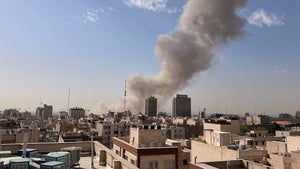
The United States and Israel attacked Iran, signaling a departure from nuclear negotiations.
 US Foreign Policy
Majorities of Democrats and Independents support a potential deal similar to the 2015 Joint Comprehensive Plan of Action, but only a minority of Republicans agree.
 Global Politics
What's driving unrest in Iran—is this time different?