Iran's Protests: Can the Regime Survive?
 Play Podcast
About the Episode
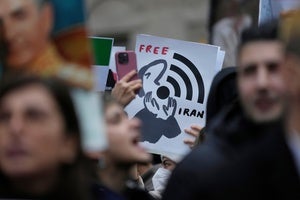
Protests are spreading across Iran, and reports suggest violent crackdowns and a rising death toll. So what’s driving this moment, and how does it differ from protests Iran has seen before? Journalist Azadeh Moaveni and Chatham House expert Sanam Vakil break down what’s fueling the unrest, how power really works inside Iran, and what might come next.
This transcript has been edited for clarity.
Leslie Vinjamuri: For more than two decades, Iranians have taken to the streets to protest their government. The demonstrations right now are large, but not the largest Iran has ever seen.
The government has responded the way it does. Crackdowns, arrests, internet shutdowns, and yet even as the space to organize shrinks, the protests keep coming back.
This week, the death toll reportedly passed 2,000. Outside voices are also growing louder. In the United States, President Trump has posted that help is on the way. What that will actually mean in a country with a long history of foreign intervention is unclear.
To help make sense of it, we are joined by journalist and New York University Professor Azadeh Moaveni and Chatham House scholar and expert Sanam Vakil. Both have spent years following these events up close and know what it looks like when a movement begins to shift. Are we watching another familiar cycle, or the early signs of a real change in Iran? What does power inside the country actually look like right now?
I'm Leslie Vinjamuri, president and CEO of the Chicago Council on Global Affairs, and welcome to Deep Dish.
Leslie Vinjamuri: Maybe we can come to you first, Sanam. I just read your piece yesterday in The Guardian. You mentioned that we’ve seen cycles of protests since 2009. Maybe you could set the stage for our listeners and for me on the context in which Iran finds itself in these current protests. Are they linked? And how significant is this moment?
Sanam Vakil: These protests are a result of a number of converging crises. They're also a result of the Islamic Republic’s unwillingness to respond to these crises, or its choice to delay or distract from them rather than address profound economic grievances, profound governance challenges that have become politicized, and, very clearly, striking at the heart of the Islamic Republic's legitimacy.
They intertwine right now in this moment, regionally and internationally, with Israel's wars in the region. Israel, Iran tensions. It’s worth reminding your listeners that just last summer, Iran and Israel engaged in a direct war where the United States also entered and hit at Iran's nuclear facilities.
Effectively, this is the intersection of economic, deeply political, and regional and international issues. But these protests go back to before 2009. There were powerful student-led protests in Iran in 1999. With each protest that we've seen become really endemic and part of Iranian political life, protests have become more powerful. They become much more political. And with each protest, the government has not responded to protesters' demands.
LV: Azadeh, let me come to you. Do you see this moment as different? And maybe you could also set the scene for us. I know it's very hard to know exactly what's going on inside Iran right now, but if anybody knows, it would be the two of you.
Do you have a sense of the scale of the number of people protesting? I know there's been a lot of different numbers, and one hates to even try to talk about the number of people who have been murdered on the streets by the regime, but can you give us a sense of the scale? How do you see the context of these protests?
Azadeh Moaveni: Regarding these protests in size, if you were to look at images of them as some sort of indication, are not as vast as previous moments of protests have been. The 2009 protests Sanam mentioned brought a million Iranians into the streets, and you could see a sea of people along Tehran's central boulevards.
We don't have images like that because people have not gone out in those numbers, as far as we can tell. We're constrained, of course, by the total internet and communications blackout that the regime has imposed. That said, their breadth is extraordinary. Our sense, as we're piecing together information from the last several days, is that they are very broad—broader than in previous moments of national protest. It's noteworthy where they've started and how granular their geographic coverage has been. Small towns, provinces, border areas, shanty towns, places that people have never even heard of in the city.
They have been propelled, initially, by the working poor. To sort pick up on what Sadam said about the convergence of crises, I think what makes this moment different—and I do think it is a profound challenge to the system, perhaps more profound than it's seen in the past—is they're more violent. The nature of the clashes between protestors, called "rioters" by the system and security forces, has been very fierce. Estimates now seem to be between 2,500 and perhaps up to 10,000-12,000 protesters killed, which is just an extraordinary number. The Islamic Republic has never had a violent confrontation so lethal with its people since its inception.
The last thing I'll say about how bad it is and how we got here is that the economic crisis Sanam mentioned over the last year has become particularly acute. The decline in the Iranian currency, which is long-running, had a massive intensification, losing its value over and over again, essentially on top of six years of inflation. Over the past year, most working families in Iran have been unable to feed themselves. The average worker's salary, even when working two jobs, does not cover the food basket for a family of three or four. People have been starving, and that's part of the desperation and the fury that we see.
LV: Sanam, the title of your article yesterday was"With thousands dead, the Iranian regime may survive these protests – but not in its current form." You clearly also see these protests as different, more consequential for the current regime. How is it different? How strong is the regime? You say it might survive, but not in its current form. What does that mean?
SV: Let's take a step back and think about the political or social contract that came into formation after the 1979 revolution. This was a popular-led revolution. It led to an Islamic government. The principle of this system of governance was social justice; the economic livelihood of ordinary citizens was meant to get better.
Then there was, of course, a religious dimension to this system of governance, where they consider themselves as a system divined or ordained by God through Islam—or their interpretation of Shia Islam. Over these four plus decades, inside Iran, the economic environment, by its own mismanagement, by endemic corruption, has become really challenging for ordinary people. The cost-of-living crisis is really severe. Poverty levels have doubled in Iran. The middle class is no longer the middle class. They are lower-middle-class or lower at this point. So that economic failure is really pervasive.
On top of that, the political governance contract has fallen apart. This is a system that has constrained civil rights and the dignity of ordinary people, and these demands have been repeatedly expressed in protests over the decades. There's a convergence of failures on this system. A constituency of Iranian politicians emerged, known as the Reformists, who advocated reform of the system, but nothing has really changed within the Islamic Republic. So, where do we stand today? The Islamic Republic has at its helm an 86-year-old leader. He's been in power since 1989. He's certainly guided this system against reform; standing up to the West is his big principle, and the social contract has broken under his leadership. The political contract has broken under his leadership, and the only way they can survive at this point is through brute force. They have shown over the past two-plus weeks that they're willing to do anything to stay in power.
There are no red lines or limits on killing through lethal force. They're relying on a narrow base and violence suppression, surveillance, which to me, conjures up memories of Saddam Hussein's Iraq after the first Gulf War. It's not certain it ends that way. There are a thousand scenarios this could all splinter into, but right now, as the protests narrow and repression is heavy, as people are exhausted and frustrated and constrained, there's no legitimacy left, and so violence and repression are what's left.
LV: The thing that we continue to hear from people who are experts on Iran is that when you do actually see a change, it's because of divisions within the regime. Are we seeing this in Iran? Is there any evidence that there is a fracture? Is there something that's going to change this, or if not, what would actually lead to a change?
AM: No. If anything, I think in the last three or four days, we have seen the regime come together. The president and the country's top security official are taking the same line that many of their protesters are actually rioters. The schema of this unrest is a plot engineered by Iran's regional enemies, Israel, and its great enemy, the United States.
Everyone is reading from the same script right now because it seems like such a moment of particular panic for the entire system. So at this point, there's no indication of a fracture at all. Although we know that the regime is not a monolith, that in the security establishment and the revolutionary guards there are elements that are more reactionary, that seek war, that seek regional confrontation. And there are ones that believe that in order to ensure the survival of the regime, Iran needs to change course in some way. We know those strands of approach and perspective exist in the background, but we're not seeing them come to the fore right now. External events will potentially hasten or shift that, but this is a system that has reached the end of its line. Whatever the trigger of the transformation—maybe a slow-burning protest movement like Sanam described—the economy is on the verge of collapse.
Even if the regime doesn't change politically at the top, it really can't sustain itself much longer. Without structural change, it will not be able to bring any income into the country. We'll just see repeated bouts of protests. The system is at a dead end, but there's no indication of a significant splinter at present to shift course.
LV: Sanam, the system is at a dead end, on the verge of economic collapse. We've seen the United States impose a 25% tariff on anybody who trades with Iran, which presumably is making the situation even worse. I assume that the cost's being passed down to the people. First of all, is there an opposition waiting to take over?
SV: No, there is no one opposition waiting to take over, and that is a blessing and a curse, to be quite frank. The Iranian opposition, I believe, exists inside Iran, and that isn't just going to be composed of people who are protesting on the streets. There have been members of the political opposition, either from within the system or as activists, who have emerged over the past four decades.
There is a very active civil society that has been constrained and under surveillance. There are activists, unfortunately, too many activists in Iranian prisons, who were rounded up just a few weeks ago, including Nobel Laureate Narges Mohammadi and many excellent lawyers, political activists, and student activists. There are also traditional activist communities in Iran, such as the labor and student movements. We know this because they've protested over the past two days, despite the government's efforts to constrain such activism; they still mobilize. But there is not one person; there is not one leader, and that's because of the dynamics inside the country,
LV: There are conversations about members of the diaspora, the Shah's son, and this happens in other countries. We see leading members of the diaspora return during moments of transition, sometimes very successfully. What is your particular view on that? Could that be a solution?
SV: The diaspora has been building. It's about five million people who are, of course, animated by their trauma of not being in Iran and animated by their nationalist impulse towards Iran, but very divided. They've not coalesced around a single figure; you have monarchists, nationalists, and all sorts of views, but there is no unified coalition-based organization. One did try to emerge during the 2022 protests, but it fragmented due to personality differences. Here is where it's very easy and lazy to think that the name of Reza Pahlavi, who has emerged in the diaspora, particularly as a candidate for a transitional figure, could be an option or alternative for Iran. Here, I would caution people. Reza Pahlavi has built a bit more of an organized coalition abroad. He's gained some support from the Israelis and monarchists in the diaspora. But he doesn't really have a political CV, if you will. He hasn't really developed a program or policy, or built an inclusive network for Iranians, but he has name recognition associated with life before the revolution. A lot of nostalgia, and I think that people mobilized using his name over the past two weeks as a counter to the Islamic Republic. It's easy to think that means he's the guy, but it's not really necessary. Iranian people should be given a chance to choose what comes next, who comes next, and what the next system of governance should be.
LV: This takes us right to the conversation that's all over the news. What, if anything, can and should the United States do?
AM: We can see that there's a range of opinion about what the United States should do. There are fears of opposition to any kind of foreign intervention. Iran-celebrated filmmakers, directors, the Nobel Laureate that Sanam mentioned, the sort of civil society opposition inside the country, are very clear and adamant that they don't believe that foreign intervention by the United States is healthy for Iran. The argument there is that it actually gives the system a pretext to crack down on protestors because it can label them as agents of the United States, as foreigners, as not Iranian.
That's language that we've heard. And it's interesting that that was also language that was used in 1978, during the revolution: Iranians don't kill Iranians. The people who are calling for the end of the regime must be outsiders. Whatever the range of options, there's a very real fear that any intervention, whether kinetic and military or economic pressure, will worsen the situation for protestors on the ground. It will also just tar the whole movement with the perception that it's been propelled from the outside.
Iranians have long had a sort of ancient hostility to the idea of having their internal affairs meddled with and having their leaders put in place or removed. You do see people very angry online, both inside Iran and in the diaspora, asking for intervention. That element of opinion is there. I wouldn't say it's the majority view, but maybe Sanam can talk us through the options and perhaps which are the least worst.
LV: That there's a backlash against an imperialist power intervening. But at the same time, if the numbers are anywhere close to accurate or perhaps worse, you can't help but think that there must be some lever that could be pulled to try and influence in a positive direction. Sanam, talk us through the options.
SV: There are three broad options. The first is to strike security and military locations inside the country, but not to debilitate the regime. That line would be symbolic, if you will. It would certainly try to empower the protestors by maybe constraining the regime's ability to further repress the society. But it wouldn't really bring down the Islamic Republic. It is sort of a neither-here-nor-there option. With it comes a variety of risks: the hardening of the regime, regional conflict, because the Islamic Republic has said very forcefully and openly for a number of days now, they will respond, and they will hit Israel. They might hit US bases in the region. Or the announcements of a drawdown of non-essential personnel at Al-Udeid in Qatar. So, that's one scenario.
Scenario two is the repeat of 2003 and the Iraq War, a regime change in the Islamic Republic of Iran. To properly alter the balance of power and invest in a bigger project, which of course doesn't sound very MAGA, or even achievable, because that project was very costly and wasn't well executed. Americans and Donald Trump have voted against such policies. The landscape of Iran is certainly not going to be easy to manage.
The third option on the table, which President Trump has repeatedly said since returning to his second term, is that he's happy to make a deal. He wants to "make Iran great again." This is a commercially motivated president. Iran is the last frontier market in the Middle East. There's a lot of money to be made in Iran, and so whether it's through a Venezuela-like scenario of copy, paste, remove, and revive the Islamic Republic, or they will succumb to Trump's maximum pressure. That can be packaged as, "hey, maximum pressure worked and the American system got what they wanted."
What worries me is that the "you broke it, you fix it" policy won't apply to Iran. The United States can break a few of the pieces, try to weaken Iran, but won't be there to support the transition to help the people. What we will see still is a ferocious but resilient Islamic Republic.
LV: Diplomacy isn't just diplomacy; it's coercive diplomacy, usually, where you're pushing for a certain outcome. But there's got to be a carrot and a stick. Usually, the stick is the threat of using some form of military force, or more sanctions, or something. But what would that look like?
SV: I would say that the terms and conditions that are currently on the table, what the Trump administration wants from Iran is a commitment on its nuclear program. Not to revive it, to leave it buried underground. That's one. Two, now in this we can state the issue of Iran's ballistic missile program is going to become very relevant, and there will need to be constraints in that realm so as not to threaten Israel, not to threaten the Gulf States, but ultimately the United States. And thirdly, of course, commitments that Iran will not re-arm or refund its so-called access to resistance. The non-state actors in Arab countries. That's principally what's on the table. It's maximum surrender as it's seen by Tehran, and thus far, they have rejected those terms. They've been negotiating for quite some time without reaching a deal. That tells us a lot about their intent. Everybody would like a deal in the Middle East. Nobody would like to see another round of conflict. All foreign ministers are working their phones trying to bring down the temperature right now, but I'm not confident that they will prevail.
LV: Azadeh, your thoughts on this?
AM: It's worth quickly thinking back to where we were in the summer: Iran found itself, despite its very costly nuclear program, which it's pursued for decades now, sustaining sanctions in an impoverished economy on the basis that it would provide the country security, deterrence, and protect it from outside attack. That it would—in the region that we've seen so destabilized since the 2003 invasion of Iraq—not become Iraq. It would not become Syria. It would not become Libya because we have this nuclear program. In the summer, and even events before that, gave the lie to that deterrence or security doctrine.
Iran was attacked by Israel. It had its nuclear facilities bombed by the United States. Before that, it was severely penetrated by Israeli intelligence such that a foreign guest, one of the leaders of Hamas, was assassinated in Tehran in broad daylight. Iranians experienced 12 days of war. At the end of this, the Islamic Republic chose not to change course, essentially. Iranians did not rise up. They nationalistically stayed in their homes and withstood a 12-day assault. You would think that, having benefited from the loyalty of its population, the strategic thinking in the regime at such a precipice would have adjusted course in some way. Perhaps not the kind of multi-tiered, total compression that Sanam just described, that the United States is demanding from it on all fronts. But perhaps, at least, small directional change domestically so that the economy, which is bleeding, could be stemmed.
An example of this is after the summer and the war with Israel, when the economy was tanking, the government decided to import high-octane fuel used only by luxury cars. This is where its priorities were. The degree to which the state, in its present form, is able to make decisions in the national interests of Iranians and decisions in the interests of Iran's territorial sovereignty and security, we see as compromised. It seems to be a state incapable, for its own survival, let alone the interests of its own population, of choosing amongst the steps that could de-escalate or even sustain it economically. Which is why I think we're in such strange and unprecedented times. The system is completely paralyzed. While diplomacy is a track and it's an option, when they do go to the table, they're not ready to make any kind of compromise.
They play for time, and they just sit in the same cul-de-sac. Perhaps after seeing the ferocity of people's anger, there will be some altered thinking inside the system in the days ahead. But at present, it's sort of hard to see them making choices that differ from the catastrophic ones they've made in the last four months, six months, 12 months, or 10 years.
LV: An extraordinarily difficult situation to talk about, and one that's deeply personal for the diaspora. It's highly consequential for Iranians, for Iran, for the region, and for the world.
As we close, Sanam, what is your realistic hope for the best case?
SV: My hope is, of course, that people in Iran are safe and protestors prevail because this has been a long road and they deserve better. They deserve dignity and everything that comes with it. But I'm a realist, unfortunately, and what I fear is that this ferocious regime will continue to strangle good people who work hard. Nobody is really gonna come and help them or save them. Hopefully, with time, they will be able to save themselves.
AM: I'm broadly aligned with the pessimistic/optimistic sense that Sanam has. Iran, despite being in a terrible bind and people being in such an aggrieved state, with the system in paralysis, ultimately always has had a lot of potential. It has a very educated, worldly population. It has tremendous human resources. It has state structures. Historically, even post-revolution Iran has been a strong state. So there's a position of strength at 10 years, 15 years, and 20 years, prior to which it can go back. I think that's the only hopeful thing to think about right now, Iran's human resources and its potential. It suffered terrible mismanagement. It suffers drought. People are losing electricity. It is just being predated upon by a state that has no solution. But its potential is profound, and its people deserve much more.
LV: Thank you for listening to this episode of Deep Dish on Global Affairs. I'm your host, Leslie Vinjamuri. Talk to you next week.
Deep Dish is a production of the Chicago Council on Global Affairs. If you enjoyed today's episode, make sure to follow Deep Dish on Global Affairs wherever you get your podcasts. And if someone you know might find it interesting, send it their way.
As a reminder, the opinions you heard belonged to the people who expressed them, and not to the Chicago Council on Global Affairs. This episode is produced by Tria Raimundo and Jessica Brzeski, with support from Marty O'Connell and Lizzie Sokolich. Thank you for listening.



Related Content
 Global Politics
With the death toll rising in Iran amid a crackdown on protests, US President Donald Trump is weighing a strike against the nation. Iran’s capacity to respond to such an action is far more limited than its leaders suggest.
 Public Opinion
Many hesitate to give their opinions on the conflict, but attitudes seem to fall along partisan lines on whether the United States made the right move.
 Global Politics
Vali Nasr and Suzanne Maloney join Leslie Vinjamuri on Deep Dish to discuss the Iran-Israel conflict.