Why a US Strike on Iran Would Not Lead to War

With the death toll rising in Iran amid a crackdown on protests, US President Donald Trump is weighing a strike against the nation. Iran’s capacity to respond to such an action is far more limited than its leaders suggest.
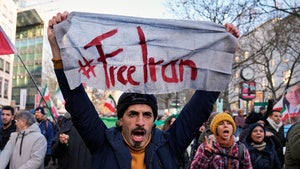
The death toll in Iran continues to rise amid the most intense wave of violence since 1979, with US-based Human Rights Activists News Agency reporting more than 2,500 deaths and sources telling CBS News the number killed could be as high as 20,000.
While the protest movement has been growing since late December, it did not emerge suddenly. Long-standing structural failures in Iran, including economic mismanagement, corruption, political repression, and regime incompetence—all of which have been compounded by sanctions linked to human rights violations, terrorism, and nuclear activities—have led to deep grievances among Iranians rooted in repression, inequality, and economic insecurity.
The protests are a direct challenge to the foundations of regime legitimacy. Protest slogans no longer call for reform or accountability within the system; they reject the system itself. The state’s response, killing thousands of people in just two weeks, reflects leadership’s panic. The response has been one of mass repression, not crowd control. A regime confident in its authority does not resort to killing its citizens on this scale. Such violence signals fear of collapse, not strength.
Protest slogans no longer call for reform or accountability within the system; they reject the system itself.
What is happening in Iran is not merely a domestic human rights catastrophe. It carries strategic consequences that extend far beyond the nation's borders. If US President Donald Trump were to authorize a targeted US military strike, as he has threatened to do, it would not trigger a regional war but instead expose how weak and constrained the Islamic Republic has become.
For years, US policymakers have treated Iran as a powerful and resilient regional actor—a perception that has become increasingly outdated. Today’s Islamic Republic is a regime under siege from its own society, surviving through coercion rather than consent. Its economy continues to deteriorate, and ruling elites are deeply concerned about the prospect of being overthrown by the Iranian population. The mass killing of protesters confirms that the regime views its own citizens as a primary threat.
Fears that a US strike would provoke Iranian retaliation misunderstand the regime’s strategic reality. Iran is in no position to escalate militarily. Opening an external conflict amid sustained nationwide unrest would be extraordinarily risky. And any serious retaliation against the United States would invite an overwhelming military response at a moment when the Islamic Republic’s coercive apparatus is already consumed by internal security demands.
Recent history supports a likely response of restraint. Following the US assassination of Iranian military officer General Qasem Soleimani in January 2020, Iran’s response was a carefully calibrated missile strike on two US military bases in Iraq. The strikes were deliberately signaled in advance to avoid American casualties.
A similar pattern emerged in June 2025 during the Twelve-Day War between Iran and Israel. Israeli strikes killed numerous senior members of the Islamic Revolutionary Guard Corps (IRGC), including Major General Hossein Salami and Chief of Staff Mohammad Bagheri, as well as nuclear scientists and hundreds of military personnel. The attacks severely damaged Iran’s missile infrastructure and nuclear facilities. Iran’s response was limited and failed to inflict significant damage on Israel.
Shortly thereafter, the United States escalated its involvement in the conflict and deployed B-2 stealth bombers to drop Massive Ordnance Penetrators on Iran’s key nuclear facilities, Fordow, Natanz, and Isfahan. Tehran responded with a symbolic missile launch toward a US base in Qatar, which they, once again, coordinated in advance to allow evacuation and prevent casualties.
Time after time, Iran has prioritized regime survival over escalation, revealing strategic weakness beneath its defiant rhetoric. And today’s regime is far more vulnerable than it was in 2020 and even last year. The ongoing protest wave has absorbed the attention and resources of the IRGC and the Basij, whose primary mission is now domestic control. Retaliation against the United States would be reckless and unlikely, as the Islamic Republic lacks both the operational capacity and the political confidence to respond forcefully.
Time after time, Iran has prioritized regime survival over escalation, revealing strategic weakness beneath its defiant rhetoric.
While critics warn that external strikes could trigger a “rally ‘round the flag” effect, that assumption no longer holds true. The June 2025 Israeli and US attacks prompted protests in Iran and demands for the dismantling of the regime. The recent mass killings have further eroded any remaining nationalist credibility, and the state is now openly at war with its own society.
A limited, targeted US strike focused on regime security assets would not unify the population behind the government. Instead, it would highlight the regime’s isolation and vulnerability, and signal that mass repression carries tangible international costs. The objective should not be full-scale war, which is unnecessary. A calibrated strike could disrupt key security forces, intensify internal fractures, and generate psychological momentum for change driven by the Iranian people themselves. It would puncture the myth of regime invincibility, reinforce the costs of repression, and remind elites and security personnel that blind loyalty to a collapsing system is increasingly dangerous.
For decades, the Islamic Republic has projected power abroad while crushing dissent at home. That model is now breaking down. Exaggerated fears of Iranian retaliation should not paralyze US policy. Iran’s capacity to respond is far more limited than its threats suggest. A targeted US strike would reveal what the protests have already demonstrated: the Islamic Republic is weak, isolated, and running out of options.
The Chicago Council on Global Affairs is an independent, nonpartisan organization and does not take institutional positions. The views and opinions expressed in this commentary are solely those of the author.
Related Content