Is Iran on the Brink of Collapse? What Might Come Next?
About This Event
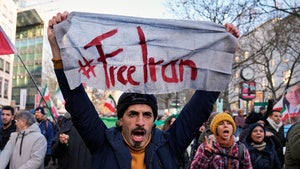
Amidst intensifying anti-regime protests across Iran, the government has sought every method to suppress and silence its people—even threatening the death penalty. Despite these threats, anti-regime protests continue to grow within Iran and throughout different global diasporas. As the world watches with much anticipation, the question writes itself. Is Iran at an inflection point?
Join us for a rapid response live stream with International Crisis Group's Ali Vaez and the Council’s Lester Crown Nonresident Senior Fellow on Energy and Geopolitics Rachel Bronson to assess the current situation within Iran and the future implications for the country, region, and world.
This transcript has been edited for clarity.
Rachel Bronson: Good morning. I'm Rachel Bronson, the Lester Crown nonresident senior fellow on energy and geopolitics at the Chicago Council on Global Affairs, newly minted and delighted to be back. Welcome to everybody out there for this Rapid Response Live Stream program. Before we get started, by means of a disclaimer, please note that the Council is an independent and nonpartisan organization, and takes no institutional positions. The views expressed by participants in the program are their own.
Now turning to our Rapid Response Live Stream topic today. Over the course of the past few weeks, we have seen mounting anti-regime protests in Iran and global diasporas. My daughter is in Los Angeles and has been reporting on protests in Westwood, California, among other places.
Despite internet shutdowns and escalating violence by the government to suppress and silence these protests, the anti-regime activity continues to grow and take on new dimensions, some of which we will discuss today. As these developments unfold, the world awaits. I am delighted to welcome back to the Council, Ali Vaez, senior adviser to the president and project director of Iran at the International Crisis Group, to discuss these questions. Many of you will have already seen Ali in multiple outlets. He's one of the most respected and often-quoted thinkers on Iran.
Ali, I saw you quoted as early as this morning in The New York Times on what comes next in Iran. So, Ali, welcome, and let me throw the first question to you. Can you get us up to speed on what you're seeing and hearing in Iran and from Iran? It is very difficult to get information. You yourself have tweeted that you have family there you haven't heard from. Friends of mine who are Iranian haven't heard from their families since as late as Thursday. Is there new information coming out? What are you seeing happening in Iran today?
Ali Vaez: Sure. Thank you very much, Rachel. It's great to be with you again. It's an incredibly grim and difficult moment for Iranians at home and abroad. I have not been able to reach my family in the past five days. There are some landline connections that have been reestablished as of today, but the internet blackout continues.
So it's also very difficult to get an accurate image of what's happening inside the country. But there is some information trickling out. I have had some contact with foreign embassies based in Tehran in the past 24 hours, and all evidence indicates that this round of protests has subsided significantly in the past few days. And it's not a surprise.
The reason is that the regime brought down its iron fist in ways that are really without precedent in the past three decades. Regime officials themselves are admitting that there are at least two to three thousand fatalities. Now they are blaming it partly on terrorists that were deployed by the US and Israel, but putting that aside, it is really the most atrocious bloodbath that this regime has committed in many, many years. That obviously has a chilling effect on an unarmed, unorganized, and leaderless group of people who are going to the streets just out of pure desperation. At this stage, I think it is very likely that this movement would have fizzled out for now. But then the issue, as always, is that the regime is not able to address the underlying causes; it's only able to suppress protests—they're going to reemerge.
There's no doubt about it. The question of whether they would reemerge in three days or in three weeks or in three months, no one knows. Between the Women Life Freedom Movement of 2022 and this round of major nationwide protests, it took about three years. I feel that society has reached a breaking point, and so I expect more turmoil just around the corner.
RB: Thank you for that. Many analysts who know Iran well have said this time around, it has been different. They're more widely spread, and you're seeing groups come together in ways they haven't before. There were conversations about the merchants and the Bazaaris and how important it is for them to join this movement, different from maybe what we saw in 2022 and even 2009 before that. Can you talk about what was different in terms of how widespread this is, and the unifying issues around the economy?
AV: Right. I think there's a bit of exaggeration in terms of this being described as the most serious threat to the Iranian regime. I remember the green movement in 2009: 3,000,000 people were on the streets in one day. It also cut across social sectors of society, across gender and geography. It was a very broad-based movement.
So this is not necessarily new. I think what's different about this round of protest is this sense of, number one, regime fragility, especially in the aftermath of the Twelve Day War between Iran and Israel, briefly joined by the US. And also a sense of desperation, a kind of finality that we're getting close to an endpoint, which I think does mobilize people in ways that we have not seen before. This is no longer the zero-to-100 that happened very quickly. This is no longer about specific demand; it's about regime change from the get-go. The trigger was economic, but it became a cry to see the back of this regime immediately.
The second way that it's different is that it is, for the first time in many years, a convergence of internal threats that the regime is facing, because of its lack of legitimacy and its inability to resolve the problems it has caused across the board economically, environmentally, socially, etc. Also, I would say there is a sense of an external element, with the threat of intervention in ways we have not seen before. That's obviously related to the president threatening to go to the rescue of Iranian protesters if there's bloodshed. So these are the two elements of the sense of finality and the convergence of internal pressures and external threats that I think make this round of protests different.
RB: There's so much to talk about there. I want go back to our conversation at the Council in July, right after the Twelve-Day War between Israel and Iran.
You were saying then, and you continued to talk throughout the year about those two camps that emerged from it. One who pointed to the strikes as an utter defeat for Iran, and those in Iran, particularly the regime, who talked about it as a success that they weathered that storm and were able to continue. Is that debate playing out in this context? You talk about how many feel the fragility of the regime, based on those twelve days, but perhaps others feel they got through that, so they can get through this. As you've watched that discussion evolve over the year, how is that playing out now? Or is it?
AV: Well, Rachel, clearly the former camps—those who were saying that Iran needs to change its ways, also those who were saying within society that the sense of nationalism that emerged in the immediate aftermath of the war should not be confounded with—support the regime. Those who were asking for reforms, a moment of national reconciliation, and re-engagement and diplomacy with the United States lost the debate. Because the regime believed that it had wind in its sails, having survived the worst that Israel and the US could do to it. It doubled down and, in fact, it decided to dig in its heels. That's why it made no concessions to facilitate diplomacy. If you think about it, the ideological lunacy of Iran's approach is that it refuses to accept that it will not enrich, yet it is unwilling to make concessions along those lines. By the same token, it didn't give the Iranian people anything. It didn't try to open up politically. It didn't try to push economic reforms until it was too late.
It's completely understandable for a population that just went through a major conflict and is witnessing its national currency devalue by more than 50% since the war. Bread prices have been going up 100%, more than 100%, in the course of the past few weeks. This is a basic staple for Iranian families. It's a disastrous situation. And the regime, again, focused on blaming the West and Israel for trying to undermine its stability by pushing for some kind of chaotic uprising in Iran without actually trying to do anything to address the underlying causes. This is, again, one of the reasons people reached the stage of "enough is enough" when they took to the streets this time.
RB: Are you surprised then that there seems to be, at least in the last 24 hours, a waning in the protests? Because these underlying factors are not going away. The economy tomorrow and next week will remain broken. It's hard to imagine any way out of that. The conditions for this uprising are not going to change at all.
AV: I'm not surprised that they're waning because the degree of brutality that the regime deployed is hard to withstand, as I said, for ordinary people who are not organized. They don't have leaders, they don't have organization, and they're not armed. But it is almost guaranteed that this will erupt again. There's no doubt about it. If you look at the pace of these uprisings in Iran, they are becoming more frequent, and they are becoming more violent. This is why, again, there are some elements within the system that understand that the country is at a deadlock, that something's got to give.
But they're still not able to convince the head of the system, especially the supreme leader, to make concessions even to its own people. The problem for the supreme leader is that he learned the wrong lesson from the Shah's experience. Remember that these are the revolutionary Jacobins of 1979, who realized that the Shah's mistake was that, as soon as the revolution began, he admitted to having made mistakes and began making concessions to the people. When you give them an inch, they ask for a yard.
The supreme leader learned the lesson that you never make concessions under pressure. The problem is that he also doesn't make concessions after the pressure has dissipated. As a result, the country is in a deadlock. Some people understand, but I don't think they would do what's happening in Venezuela right now again, because they worry that removing the supreme leader or pushing for some sort of regime transformation at a moment of peril would result in the whole thing unraveling.
RB: Picking up on Venezuela is perfect. I wanted to segue to American policy. In fact, right now in Venezuela, the lesson very much could be learned that you can remove the leader, but keep the regime in place. So I'm curious what you think some of those lessons are.
But before we think through that, let's just back up one step. The president has come out and offered American assistance, or threatened American-assisted military response and assistance, if there's a bloodbath, which sounds like there really has been. Those are certainly the pictures we're seeing and what we're hearing. You and I were talking before the program started that this kind of statement for the president is unusual. Do you want to talk about that and how it might be playing out domestically?
AV: Sure. US presidents have had a long history of dealing with protests in Iran, and during the administration of the green movement, we saw the US opting for restraint. In Trump's first term, we saw the US actively encouraging and supporting the protesters. In the Biden era, we saw serious denunciation of repression. But we've never seen any American president actually threatening direct intervention, and President Trump has now done that.
Of course, he's threatened in the past interventions that he hasn't delivered on, and sometimes he has. There's a wild card here, and it's that the president is unpredictable. I think the dilemma he now faces is that if he doesn't deliver on the threat, it might be portrayed as another "Obama red line in Syria," which would basically undermine his credibility and embolden the Iranian regime. But if he does deliver on the threat, the consequences could be unpredictable, as there are no good options for the United States to intervene here. In the case of Venezuela, when you're dealing with a very entrenched regime, there is no shortcut to a perfect solution.
There is no magical shortcut to an outcome fully desirable for the United States. And by the way, I think one of the reasons that the Iranian regime brought down its iron fist in the way that it did—before the US had the time to relocate military assets from the Caribbean to the Middle East in order to be able to also protect Israel in case of Iranian retaliation—is because of the threat of US military intervention. My point is that there are options available to the president, both kinetic and non-kinetic. Let's think about some of these kinetic options.
Of course, you can order the political decapitation of the Iranian regime. It's harder to do now that the element of surprise is not there. I don't think it's impossible, but even if it happens, just like in the case of Venezuela, it doesn't necessarily mean the current regime will be replaced by a less repressive one. In a case of the US doing something militarily to cause regime collapse, let's say, targeting every Revolutionary Guard base and leader, the country could fall into some sort of violent chaos. Iran has the same fault lines that have resulted in civil strife in other countries in the region, like Libya, Syria, Yemen, and Iraq.
There is also more than 400 kilograms of near weapons-grade uranium that is unaccounted for in that country. That kind of chaos and what happens to that stockpile in its fog is the real security concern for the US, Israel, and the rest of the region. That stockpile is enough for 10 nuclear warheads and probably dozens of dirty bombs. Then there are non-kinetic options, such as cyberattacks, which I don't think would move the needle significantly. It might temporarily disable some of the technology that the IRGC is using for repression. But it might already be too late for it, at this point. And it might not be as spectacular as some of the interventions the president has demonstrated in the past, which he likes to engage in.
Or he might double down on the enforcement of sanctions. But Iran is already sanctioned to the hilt. If he is to impose an embargo on Iranian oil exports, he might endanger oil shipments from one of the most critical choke points in the world. The reality is that the US military is not a tool for ushering in democracy in Iran, and rescuing the protestors is a goal that is simply unachievable.
RB: I do suspect we will see something around Iranian exports. And I do think the administration will be thinking about how they take lessons learned from Venezuela, which are not yet learned, and whether to apply that in the case of Iran.
A lot of the questions in the chat have to do with what kind of outside intervention could be helpful. There is no silver bullet. What's so difficult is that, in Iran, different administrations have tried different approaches, but none have been terribly helpful. Are there actors in the United States or elsewhere in Europe who could help those in Iran build a better future? Are there things we should be doing and shouldn't be doing, in your mind? Because that's what's tricky. Just sitting and watching isn't helping either. The president seems to say that help is on the way, so I think this is an active conversation. Are you hearing anything from Europe, from your European colleagues or elsewhere, that you think would actually be productive and useful at the moment?
AV: The Europeans, I'm afraid, have basically reduced themselves to the position of irrelevance, almost, in this case. They still have a presence on the ground, including embassies. But strategically, they have no leverage left over Iran. The neighboring countries of Iran are very concerned about being caught in the crossfire if US intervention results in another round of serious conflict. As you remember, Iran did attack Qatar in a performative strike, but crossed that red line in retaliation for US strikes on Iran. There is concern that this time around, Iran—with its desire to rectify perceptions of its weakness and restore a degree of deterrence, and also its sense of being cornered and in an existential battle for its survival—might actually take even more high-risk action.
The Gulf countries are concerned, but there's not much more they can do beyond efforts at mediation. We've seen Oman trying to once again facilitate discussions between the Iranian foreign minister and Steve Witkoff. But there are no perfect solutions; this is the first thing we have to admit. There are important things that could be done, including trying to facilitate the Iranian people's access to information so they can make their voices heard.
I've been shocked and disappointed since 2009, when we were all talking about the first Twitter revolution, when the Green Movement started in Iran, and people were talking about providing them with satellites and internet connection. Now it's 2026 and we still don't have the ability to counter the regime's kill switch on internet access. That is within the US's control to rectify. Then there is something diplomatic that is important to start thinking about. I don't have a perfect solution, but I'll share the idea that we should start thinking about what kind of soft landing one could engineer in Iran.
The reality is that this is a process. It's not something that could be done with the US pushing a button; there's no shortcut to it, as I said. The question is: how can we set a trajectory that would not result in the tragedies we have seen in other US interventions in that part of the world, but a stable, sustainable solution that serves US interests, the region, and the Iranian people? One way to do this is for the US to exert tremendous leverage through its diplomatic and economic pressure on Iran. We've always tried to use that leverage as part of negotiations on hard security matters, like Iran's nuclear policy, Iran's missile program, and Iran's regional policies. We've used it as an incentive as well. But to address hard security issues, like the nuclear program, Iran's ballistic missile program, or regional policies, I do believe that time has come. Given the overwhelming demand for political reforms in Iran, we can now connect the dots between what the Iranian people want with US sanctions relief by providing incentives and an exit ramp for those within the system.
One of the reasons that these protests do not succeed is that there are no cracks at the top of this system because everybody believes there is no exit ramp. That exit ramp should be provided by using US sanctions as leverage. Not to dictate what the US wants, but to support what the Iranian people want. 17 prominent civil society actors in Iran, backed by hundreds of human rights activists, lawyers, and academics, have called for a constitutional referendum. We should listen to them; we should put our money where our mouth is and try to use the sanctions to help the Iranian people achieve those objectives.
RB: Thank you for that. In some ways, you're generous in saying there was an off-ramp. There was an incredible off-ramp in the Iran deal about what the Iranians would get if they made certain concessions. They made many of those concessions, and we killed it. We had something in place to do this, and then the United States killed that. We had institutions available to actually create some support for civic societies. We killed that in USAID, but the critics were also right. That organization hadn't done a lot of the work, over time, that was necessary to build something that provided a different path. There are plenty of things the US could do over the long term that we're not doing.
There is an opposition leader in the Shah's son. He doesn't seem to have the presence that you would expect. It reminds me of Chalabi in Iraq, but maybe this is different. Those who have been outside a country for a long time often aren't very effective, but internally, they're not allowed to operate. Tell us your views on the Shah's son as a possible returner, and the fact that he's surprisingly gained popular support in this nostalgic look for anyone to help. What are your thoughts on that?
AV: The reality is that Reza Pahlavi's stock has been improving in the past few months. There's no doubt about it. But what we don't know is the extent of his support. His supporters would say he is broadly seen as a viable alternative. The simple fact is that we don't know. He might be at 30%, 50%, or 60%, but one thing is clear: he's not yet seen as a unifier. He's not seen as a consensus leader whom people inside or outside the country believe can lead the transition from this regime.
The second problem that he has is that, unlike Khomeini in the run-up to the 1979 revolution, he doesn't have an organization and network on the ground to do his bidding. That is a major factor hampering his ability to be an agent of change.
RB: Thank you. I think one of the key takeaways from this program is your sense that this revolution of fervor, or this change, may be waning, just as the president is leaning in to say help is on the way.
We're at a crucial moment where we can observe the effects and recognize that the dynamics within Iran are also shifting. You've helped shape this moment for us and will help us understand the hours and days ahead. For that, I'm grateful. Thank you for taking time out of your conference in the Dolomites, where you're working on nuclear issues and helping the next generation, to take time to speak to the press in general and us in particular.
Thank you to all who have joined us today. It was a pleasure.


Related Content
 Public Opinion
Many hesitate to give their opinions on the conflict, but attitudes seem to fall along partisan lines on whether the United States made the right move.
 Global Politics
Vali Nasr and Suzanne Maloney join Leslie Vinjamuri on Deep Dish to discuss the Iran-Israel conflict.
 US Foreign Policy
Majorities of Democrats and Independents support a potential deal similar to the 2015 Joint Comprehensive Plan of Action, but only a minority of Republicans agree.