Trump's First Year Back: What Stood Out
 Play Podcast
About the Episode
The past year has made one thing clear: this version of Trump on the world stage is different. From the Caribbean to Europe to America’s own institutions, familiar rules don’t feel so fixed anymore. The Guardian’s Jonathan Freedland looks back at the moments that defined Trump’s year so far and why the next one could be even more dramatic.
This transcript has been edited for clarity.
Leslie Vinjamuri: When you look back on the past year, it's hard not to notice how unsettled foreign policy has felt. Decisions made in Washington have moved fast, and they've rippled right across Europe, often in ways that feel more direct, more disruptive than we're used to.
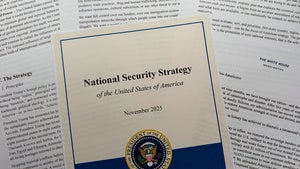
Now, the second Trump administration has put its approach on paper with a new national security strategy that lays out how it sees power, pressure, and America's role in the world. We're already seeing pieces of that strategy show up in how the US works with allies, confronts rivals, and tests rules that once felt fixed.
What from the past year really stands out? What should we be paying attention to as we head into what comes next?
Jonathan Freedland: The length he will go to not lose that election…I think we could be in a place this time next year of high drama.
LV: My guest today is Jonathan Freedland. Jonathan is a columnist at The Guardian. He is the author of 14 books. Eight of these are under the name of Sam Bourne. He has recently published his newest novel, The Traitors Circle: The True Story of a Secret Resistance Network in Nazi Germany―and the Spy Who Betrayed Them.
I'm Leslie Vinjamuri, president and CEO of the Chicago Council on Global Affairs, and welcome to Deep Dish.
We are not quite to the one-year mark, but we are pretty close to the one-year mark of President Trump's first year in office. You've written about this regularly, you have your own podcast, and you're one of Britain's greatest thinkers. How would you capture the year that we've just seen? What are some of the most significant foreign policy developments? As you're watching the United States, what really stands out to you?
Jonathan Freedland: It's funny, I'm balking slightly the word “highlights,” because the key moments that stand out were moments where people outside the United States were really jolted by what they saw. They knew that this was going to be a very different kind of presidency.
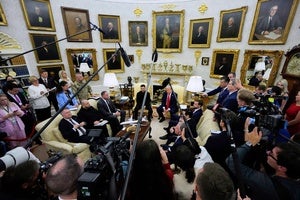
Obviously, they had seen Trump's inaction in his first term. This whole decade has been the age of Trump. Donald Trump went down that famous golden escalator in 2015, and we are coming to the end of 2025. He has been the dominant figure for an entire decade, including, I would say, the four years when he was out of office because he was in everyone's heads all the time. So we knew in a way that this was going to be big. But a key moment that stands out to me is that showdown with Zelensky in the Oval Office in February, because it put the world on notice that a new sheriff's in town. This is a new way of doing business. Nobody could have imagined a situation where an American president essentially humiliates an American ally whose cause is joined by the rest of America's allies, but who fits entirely the narrative that would merit support from every previous president.
Jonathan Freedland: If you go from Truman onwards, of course, they would side and sympathize with a country that had been on the receiving end of Russian aggression. Reagan would've done, Kennedy would've done, Clinton would've done, Eisenhower, all of them would've done, and instead he was browbeaten and bullied by an American president.
I felt at the time, and since, that this was a statement from the United States. This is a new world in which, after an 80-year-long conflict of the Cold War, in all its different forms, the United States has changed sides. I feel that with the bookend events of the year, Zelensky in the Oval Office and then the publication of the National Security Strategy just last week, there is genuinely a new strategy. Which is pretty relaxed about Russia, not even looking at that document, that exercise by China, the thing that really gets its blood up that the Trump administration is so animated about, is Europe. It’s a historic ally and it treated us like a foe. And so, everything that's been the premise of all foreign policy was predicated on a set of assumptions that I think have been upended.
LV: Let's come back to this Zelensky moment. There's always a sense that Donald Trump is kind of more aligned with Russia than with the European Union or even with NATO. But you're right, that Zelensky moment is extraordinary. Donald Trump comes in, and if you go back to his inaugural, he wants to end the wars. In some ways the shocking thing is the tactics. It's the style, it's the utter disregard for Zelensky. Why has Europe been so surprised that Donald Trump has taken this tack? The writing has been on the tin, so to speak. Do you see the second term as radically different?
JF: I'm, I'm more in the camp that it sees a real break and a difference, not perhaps in him, but his instincts, his motives. There remains some degree of mystery about the affinity to Russia. The fact that it's the one country he never really criticizes. The one leader he never really has a harsh word for is Vladimir Putin. There's an assumption that it is almost more psychological. It is this affection for strong men.
Plus, his ideas have not moved on in decades, and therefore, he's still in a kind of 1970s-80s mindset and sees Moscow as the other superpower. He gives it more respect than, in a way, the actual raw data would demand.
The thing that has really changed—and I think we did anticipate, but maybe we should have anticipated it more—is the extent to which he was hugely hemmed in before. This is not a new point, but the National Security Strategy last time around was kind of traditional Washington foreign policy boilerplate. There was a preference there for the democratic world over the autocratic world.
Yes, of course, it was just rhetorical, and people like me on a newspaper like The Guardian would point out where the United States departs from that grand ideal. But at least it was the ideal. Then comes the second term, this new document, and it's Trump unbound. He's no longer hemmed in by the adults in the room or the foreign policy establishment who make him write in a document what he would never say in a speech. The first Trump White House never sounded like him in that he sounded like other people. He was allowed to be himself in press conferences and speeches. But now you feel Trump's stamp even on a document like the National Security Strategy, a formal document. For Joe Biden, the cause of his foreign policy was being at Ukraine’s side. And there, this cherished project of the West, preventing Ukraine from being gobbled up by a hostile autocratic Russian neighbor. Trump's no longer in that game, and to me, that was the big change.
LV: It's a shocking change, isn't it? Because it's not only about Ukraine— a symbol of post-Soviet democracy, however flawed, but still democracy—as a sovereign country gives up its nuclear weapons. The president is sort of calling us out on the significance we attach to sovereignty over power, to democracy over authoritarianism, all the rest of it. You raise the National Security Strategy, the language, Jonathan. It’s civilizational erasure; Europe faces civilizational erasure. You're right, the extent to which Donald Trump has taken on Europe as a target of his opposition.
JF: I think so. In a way that invites a wrinkle on what I was saying before, about this is Trump unbound. Because in a way, that document, yes, it no longer reads like the foreign policy adults are writing the script for him. Does it absolutely channel Trump, or is it channeling more the JD Vance/Stephen Miller view of the world? Probably, yes. It's now the words of “Team Trump.” It's the Trump circle. But it is this view of the world, which is the same view that circle views the United States itself, which is in culture-war terms. Which, in crude shorthand, “things were good when white, Christian, Europeans were the dominant markers in the US, and things have gone downhill since we've drifted away from that.” That's the burden of JD Vance's speech, most recently, I think, at Claremont College, when he was talking about how bonds of blood and soil really rooted us in the land. They matter more than an idea, very mocking of the idea that America coheres around a creed.
That's the dominant thought inside the United States. It was being applied in that document to the rest of the world, and particularly Europe, because it was essentially saying Europe is no longer European. If you drill into that, what can it possibly mean? I think without it ever absolutely stating explicitly, we know what it means. It means “European,” in the sense that the word would be used inside the United States, is white, Christian, broadly. It was a castigation of Europe, saying, You have drifted away from the direction that we in the United States are keen to get back to. Which is how things used to be, a kind of dominance for those core groups. To disparage the drift away from that, it's DEI, it's “woke,” it's migration—all these ills are variations on that theme. So, it was suddenly seeing Europe through a cultural lens and saying, essentially, you are on the wrong side. We are going to go at Europe the way we would go at Democrats or the way we would go at the media, all the universities—for all of your “woke” nonsense and for your departure from the people who ran the country a hundred years ago.
LV: It must be unsettling. The fact that it not only lodges this critique, but then takes that next step and talks about supporting the patriotic parties of Europe. How do you read this? This is not a sovereignty doctrine. This is not a live-and-let-live for our European allies.
JF: Just to make a slightly nerdy point: there's a built-in contradiction in the document. Because on the one hand, it reasserts the Monroe Doctrine. It essentially says we are going to go back to the Monroe Doctrine, which had said, we'll dominate in our sphere here, the Western hemisphere, the Caribbean, South America, and you guys can have Europe. But you just don't intrude into our sphere. This is a new version of that. The Trump version says the Western Hemisphere is for us and we’ll be influential there. And Europe's for us as well, and we’ll be influential there too.
LV: It would be funny if it wasn't so unsettling.
JF: Exactly, it would be because it's just so brazen to say that we will meddle in both. It's unsettling because they mean business. This isn't just a think tank document. It's saying we are not going to let that happen. We’re going to get on the battlefield to prevent Europe from becoming unrecognizable in 20 years. And the way we're going to do it, as you've said, is that we are going to do whatever we can to help the trajectory move away from how it's currently headed. We will support, as you say, so-called patriotic parties.
It's very obvious who they mean. You only have to dip into the world of national conservatism to know the parties they favor. JD Vance was explicit on this in the German elections. He supported not the traditional Christian Democrat allies, or the Angela Merkel conservatives of Germany, but the AFD, Alternative for Deutschland, which is a far-right party. Which, for a long time, has been shunned by mainstream German politics for its echoes of Germany's very unhappy past 90-odd years ago. Here was an American vice president absolutely intervening for them.
Elon Musk spoke by video link to an AFD rally. His fingerprints are present in this document, by the way, as well, I think. Along with them will obviously be Viktor Orbán of Hungary, a man who people here in Europe consider eroding democracy and posing a real threat to the Democratic project of the European Union. Sitting in Britain, I've got to say, it looked to me a lot like a warning that the United States will do what it can to help reform the UK. Nigel Farage and his very Trumpian project prevail in the UK.
Just imagine what it's like to sit here in Europe. We are now feeling like we are going to be squeezed by this pincer movement. We know that the Russians intervene in elections, disinformation, flooding social media, and all kinds of below-the-radar moves. We are going to get that from Russia. Now the fear is declared in America's most formal statement of foreign policy that the United States is going to do the same. And as it happens, they'll both be intervening on the same sides. They'll all be supporting the Orbáns, the AFDs, and the Farages. This is a chilling moment in a country that, for 80 years or more, we would've seen as an ally in the fight against authoritarian and anti-democratic politics. He's actually on the battlefield against us. That's quite a change.
LV: The playbook is interesting too, isn't it? Because it's using the language of freedom for freedom of speech. It's drawing on those principles that Europe holds dear and that the United States holds dear. Some would say that there shouldn't be red lines on freedom of speech. Is there an argument being made, by different corners of the intellectual elite on either side of the aisle, that there is something to this? Is there anybody supporting this when it comes to saying, “There have been too many limitations on freedom of speech. Europeans are too elite; they're keeping people out of the playing field.” Those parties have a legitimate set of policies, and they're speaking to a population that's been left behind or left out.
JF: Yes, there definitely are. The parties themselves, obviously, they’re first allies. If you are in the Le Pen party in France, AFD themselves, Farage—there are national populist national conservatives in each of these countries. As a side point, one thing to watch that's interesting to me is Italy, because Giorgia Meloni was elected, and we all thought she was going to be the Italian Trump. But actually, it is not quite there and has been with the other Europeans on something like, for example, Ukraine. Overall, there is a strain of intellectual thought that actually has the same bête noire. It too is frightened of migration, particularly Muslim migration, so it has that in common with the Trump project. You do see these sorts of mini-mes around the continent who will say, “Make X great again.” Slovakia, Poland—there definitely is a whole squadron of them across Europe.
Then, there is obviously a whole layer of intellectual life, particularly in the press, that is very sympathetic to this. Newspapers like the Mail, the Telegraph, and people in the Spectator, who are very drawn to all this stuff and who believe that there has been a civilizational decline. You think of somebody like Douglas Murray, and it's about the slow death of Europe. There are takers for this view that Europe has become less European. It doesn't matter if there are Black Europeans who are third or fourth generation. That's not what they mean. They think, great, we've got the Americans as an ally in our domestic project of combating that change.
The other reason why this document is most scathing is not about Europe but about the European Union. Christopher Caldwell wrote an interesting op-ed for the New York Times saying Trump is not against Europe. He likes Europe. His issue is the European Union.
There are lots of political parties, European intellectuals, and others who have grievances with Brussels and are very open to the message that the bureaucracy has gotten out in front of democracy. It is a kind of deep state argument that the commission in Brussels is analogous to the feared deep state in Washington, and therefore, our fight is the same as Vance's or Trump's fight.
There are takers for that view. Even though I would say the entire European Commission bureaucracy is smaller than the city of Birmingham, England, in terms of payroll, it actually can only do what the European national governments want it to do. We are already in a Europe of nation-states, but that Europe can achieve things when it comes together. That's the basic argument that I was on the losing side of in 2016 with the Brexit referendum. But I think it still stands.
LV: You've made the point, and it's an important one, that Donald Trump, both in term one and term two, has had a singular antipathy towards the European Union. The sort of conventional wisdom was that the Prime Minister Starmer was managing the Trump moment tremendously well, that he shored up European support, and that he brought Donald Trump's level down. But just recently, it looks like maybe this is starting to change. The US is pulling back on the trade deal that's been agreed. Is the UK going to be able to maintain this sort of sweet spot with the US, bridging its relationship with Europe and with Donald Trump? Or is it now going to come under the chopping block?
Can you tell us a little bit about what has happened? What's suddenly gone wrong?
JF: The initial promise of Keir Starmer was, “I may not be able to do this, this, and this, but one thing no one can deny is that I have managed to stay on the right side of Donald Trump.” One of the very first trade deals was with the UK. The Trump administration signed that trade deal. We were hit with tariffs, like everyone else, but the common thread was that the blow would be softened for Britain, and people gave high marks to Keir for just getting on Donald Trump's good side. How? Two things. I think one, Trump likes a winner and Keir Starmer arrived in office with a huge landslide win. He's got 400 plus seats in the House of Commons, and Trump likes that; it's part of his “strong man” thing. He thought, “This guy's a big winner. He is going to be around for five years. My kind of guy.”
We saw it the same way with Zohran Mamdani the other day; election winners are his thing. But the other thing was this slightly pathetic thing that Starmer pulls out of his pocket: an invitation for a royal state to visit. Trump loves that stuff. I saw somebody say, obviously with their British tongue very firmly in their cheek, “Can we have a state visit every three months?” Is that what we're going to have to do to keep Donald Trump liking us? Do we have to get him here for a ride in a sort of golden carriage, in London or Windsor, every six weeks, 12 weeks? Because otherwise he's going to turn on us.
That was prompted by the fact that this big tech deal of 30 billion plus is apparently on ice. We are back to being treated like everyone else. People like me were saying, at the time, that a promise from Donald Trump is not worth the paper it is either written on or isn't. Because he is so mercurial, he is so fickle; he changes his mind. A big issue here is that the consensus, more and more, in terms of polling, is that Britain leaving the European Union was a mistake, that Brexit was a mistake. We need to somehow get closer. Opinion polls say majorities now favor even rejoining the European Union.
A small step in that direction would be to at least look at the so-called customs union. These are ways of being closer to Europe without actually being a member of the European Union. Keir Starmer ruled it out just last week, and what was his reason for ruling it out? Because we've got this great deal with the United States, and we mustn't unravel it.
LV: Shocking, given the percentage of trade that Britain has with the European Union.
JF: A hundred percent, my view exactly. Double shocking when Trump himself is saying, “That big deal that you're sacrificing everything to preserve. It's on ice. It’s not going to happen.” All of that is in the mix.
I just want to say one last thing about the European Union itself, though. Just a small point that I think often gets overlooked. All that cultural stuff, JD Vance, civilizational erasure, high-minded things about Europe, a few days before the National Security Strategy was released, the European Union slapped Elon Musk with €120 million fine for the way that the X platform operates. They said a couple of the things were “deceptive.” It wasn't full transparency. The minute that happened, really within hours, a whole lot of senior Trump officials, the Deputy Secretary of State, later Marco Rubio, hit hard at the European Union, dressing it up in lofty terms about culture and civilization, so on.
But really, the European Union is the one body in the world powerful enough, with enough economic muscle, to make life difficult for those tech companies. For those tech giants, of course, they want 27 European individual states whose power will be weaker. They want to divide and conquer. Put aside all the grand rhetoric and just think. Follow the money. Is there a reason why perhaps Trump and his circle really dislike the European Union? And maybe that reason is that it's the one thing in the world that they can't control and dominate.
LV: That's right. And they dress it up as “this is bad for Europe.” Not enough growth, not enough productivity. Don't have big tech companies.
I have to bring you back to the United States. As we turn the corner to the new year, America will be marking the 250th year since its founding. I think people are saying, “What's happened to America? Why is everybody folding? Why are universities doing all these deals?” How Americans, both collectively and individually, have responded to Donald Trump's efforts to expand the power of the presidency and to restrict the autonomy of civil society—whether it's universities, law firms, or freedoms of speech—what are your reactions to the last nearly 12 months of Donald Trump's pretty intense crackdown on civil society?
JF: This book I've written, called The Traitor Circle, to me, is an extraordinary true story. A group of very elite Germans, including aristocrats, but high officials previously in the German government, who were all opposed to Adolf Hitler and to the Third Reich. They gathered in secret for a tea party on September 10, 1943. That was the sort of cover. What they did not know is that someone sitting around the table with them, who they thought was a kindred spirit, was in fact about to betray all the rest to the Gestapo. That's a real event that happened. The response to the book has been so fascinating because in the United States, people have really responded to the thing that you've picked up on. What is it that makes some people, in this case, these nine or 10 people sitting around that table, stand up to tyranny when everyone else falls in line? So that's the question.
When I was writing it, I wasn't expecting it to have this kind of very urgent contemporary resonance. And I saw it. I was in the United States doing a book tour, and audiences immediately responded to this. I wouldn't say that Trump is Adolf Hitler. That would be facile. It would be insulting to the victims of Adolf Hitler. What I am saying is that when a country that was a democracy begins a slide towards authoritarianism or even autocracy, it does it the same way, decade by decade, and in different places.
The common element is that the democratically installed leader sets about removing one by one, or at least weakening, those elements of society, which might act as a check or restraint or curb on his power. You've name-checked a whole lot of them. It might be the courts, therefore will include the lawyers. That's why that move for the law firms was so revealing at the universities. The free press, the civil service, and sometimes science were all on the list. In a rapid fashion, in the period I describe in the 1930s and 1940s. You look at the first year of Donald Trump, one by one, he has targeted those bodies of institutions that would exact some restraint. I mentioned science simply because where does the anti-vax thing of Robert F. Kennedy Jr. fit in? It fits in because if people trust their doctors, then that's something that's separate from and out of the control of the president. He wants himself to be the only source of truth and information. “You can't trust the doctors. You certainly can't trust the media. You have to trust me.” That is the autocrats’ playbook every time.
The people in this book, the Traitor Circle, that's what they realized was happening. They didn't have a precedent to draw on. It was new, but the one thing they realized was that you have to move extremely fast. They learned that lesson, in some ways the hard way. They perhaps didn't move quickly enough. That, I think, is one of the echoes. You don't have the luxury of being able to say, “Let’s see how this plays out,” or “He won't be as bad as he says,” and “Don't get hysterical,” and “There'll be grownups in the room who will restrain him.” All of those arguments were heard in the thirties and forties, and they turned out to have been tragically misplaced.
LV: I think there's a tendency to think the country's so big, the economy's so resilient, there’s no stronger civil society, arguably, in the world. But the approval rating for the president is very low right now; this is a highly polarized country. As we look ahead to 2026, America's 250th, an important time in the Middle East for Gaza, for Syria, one year after Assad has left, for Ukraine and Russia, clearly for China, for the European Union. But for America at home, what are you watching and looking for?
JF: I think these midterm elections are so important because the project of Donald Trump is to weaken or remove any potential restraint on his power, at home or abroad. That's where the European Union slots in. He's after CBS or CNN, the same way as he’s after the EU. Anything that can clip his wings, he doesn't like. If I'm right about that, that's the animating logic of the Trump administration, then the ultimate block or restraint or curb would be the House of Representatives in the hands of the Democrats. Suddenly, powers of scrutiny, the ability to block legislation, the ultimate power of impeachment, all of those things would be out of his hands. Until now, he's had a free ride with Republicans controlling the House, the Senate, and conservatives controlling the Supreme Court to an extraordinary degree. That would all change if he loses. And that's why he has no intention of losing. That is the story already. It's been a big story of 2025. It's going to be big in 2026. The length he will go to not lose that election.
I think we could be in a place this time next year of high drama, where perhaps Democrats have won the election, but they're thwarted anyway. Because he will say that the election wasn't free or fair, or it wasn't legitimate, and he'll demand that the elections be thrown over to the state legislatures, which are controlled by Republicans. These things are possible. They're conceivable. They wouldn't have been conceivable in a different era, but we're in the Trump era now, and everything is conceivable.
LV: That was award-winning journalist, Jonathan Freeland. Thanks so much for listening. Happy holidays, and we'll be back with a new episode next year.
Deep Dish is a production of the Chicago Council on Global Affairs. If you enjoyed today's episode, make sure to follow Deep Dish on Global Affairs wherever you get your podcasts. And if someone you know might find it interesting, send it their way.
As a reminder, the opinions you heard belonged to the people who expressed them, and not to the Chicago Council on Global Affairs. This episode is produced by Tria Raimundo and Jessica Brzeski, with support from Marty O'Connell and Lizzie Sokolich. Thank you for listening.


Related Content
 Geopolitics
The Trump administration rejects the post-Cold War international order and sets out a new vision in its National Security Strategy. At the Doha Forum, world leaders reckoned with its impact on long-standing alliances and its implications for war and peace.
 US Foreign Policy
The Trump administration's recent posture toward Venezuela reflects a long-standing focus of US foreign policy: control of the Western Hemisphere.
 Global Politics
Colin Kahl and Tom Wright join Leslie Vinjamuri on Deep Dish to unpack US strategy shifts.