Trump Redefined Transatlantic Ties in the NSS. Where Does China Stand?

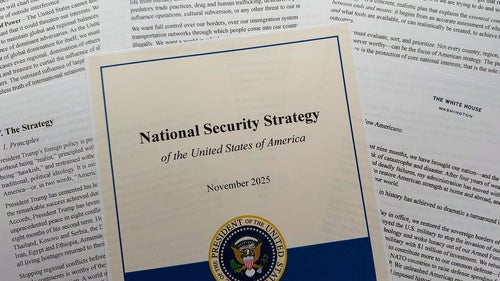
The Trump administration rejects the post-Cold War international order and sets out a new vision in its National Security Strategy. At the Doha Forum, world leaders reckoned with its impact on long-standing alliances and its implications for war and peace.
Even in his absence, US President Donald Trump dominated many of the discussions at the 2025 Doha Forum, which took place last weekend in Qatar. Released just as international high-level delegations began to arrive, the Trump administration’s National Security Strategy (NSS) shaped the highest-level panel discussions—which included, on separate but successive panels, Donald Trump Jr., Tucker Carlson, and former US Secretary of State Hillary Clinton—and galvanized corridor conversations across the two days of meetings. Some of the key points in the strategy appear to serve more as a reminder than an announcement. But their integration into a single document confirms that a reversion to the post-Cold War liberal international order—one premised on the sanctity of US alliances, multilateralism, free trade, and democracy—is officially off the table.
In his first term, Trump released a strategy that espoused great power competition. In practice, however, the president sought to accommodate Russia and adopted an increasingly ideological opposition to China. Former US President Joe Biden, aided by Russia’s illegal invasion of Ukraine, successfully revived the Western alliance and doubled down on an ideological approach that also included derisking the US relationship with China.
Now, there is ample confusion as to whether this new NSS is Trump’s doctrine or merely a document that will in fact bear little resemblance to the president’s next steps on foreign policy. The strategy reads as a combination of US Vice President JD Vance’s opposition to what he views as liberal illiberalism in Europe and US Under Secretary of War for Policy Elbridge Colby’s focus on deterring China with respect to Taiwan. Trump’s own vision appears in a few areas, first and foremost in a push for a Trumpian international order that prioritizes US dominance in the Western Hemisphere—to the exclusion of China’s influence. On Russia, the NSS is clearly Trumpian in its ambition to recalibrate the US relationship with Russia through “strategic stability,” end the war in Ukraine, and focus on economic competition with China. Europe is left with the continuing reminder that it will soon be left carrying the bag for its own security.
"The greatest confusion continues to rest with the US-China watchers, and this may be by design."
The greatest confusion continues to rest with the US-China watchers, and this may be by design. We recently held a closed-door meeting at the Chicago Council on Global Affairs with a select group of expert China analysts. Some insisted that the United States remains committed to great power competition, especially with China, and to strategic ambiguity with respect to defending Taiwan. Others said that Trump’s China strategy, now reflected in the new NSS, will continue to be led by Trump and there is now more opportunity for cooperation between the two great powers. They pointed to a series of planned meetings between Chinese President Xi Jinping and Trump in 2026, and highlighted Trump’s effort to shift US-China policy away from an ideological mooring and hypercompetition and toward a strategy that seeks accommodation and possibly even a grand bargain involving Trump striking a deal with Xi on Taiwan. Suffice it to say that for better or worse, there was far more clarity on Biden’s approach to China and the Indo-Pacific.
Chinese reactions to the National Security Strategy have been more buoyant. In another closed-door session at the Doha Forum, Chinese participants pointed to the end of unipolarity and the decline of the United States due to its “diversity,” and championed China’s rise and future success. After celebrating China, one speaker concluded, “Wait until you see our weapons.”
It is Europe, though, where the publication of Trump’s new strategy has generated the greatest cause for concern. While many commentators have said the NSS signals the death of the transatlantic relationship, it in fact seeds the prospect of forging a different kind of transatlantic relations and signals a proactive determination to forge relationships grounded in a certain understanding of free speech. It bolsters American support for the “patriotic” parties of the far-right and further calls for the United States to cultivate resistance and promote these parties in Europe to preempt Europe’s “civilizational erasure.” The illusion that the United States has unwound its expansionist tendencies and recommitted to the limits of sovereignty is uniquely challenged by the European and Latin American policies put forward. In its description of the European Union as a body that “undermines political liberty and sovereignty,” US hypocrisy (a constant feature of US foreign policy from the perspective of most of the rest of the world) shines through.
How are Europe's elites responding? Mostly not so well. Many already have called, once again, for Europe to unite. Others appear to still be in denial. In a jaw-dropping moment on day one of the Doha Forum, European foreign policy chief Kaja Kallas said that the United States is Europe’s “biggest ally” and could help “correct” Europe’s “current trajectory” when asked about the contents of the NSS. America's new forcefulness on Europe may lead to a stronger Europe, but a Europe possibly less aligned with the United States.
No one knows for sure of course whether the NSS will amount to more than a doctrinal repositioning. Trump has oscillated on Europe and Russia. And the tariffs have been disruptive but not the radical change that many anticipated when they were first announced on “Liberation Day.” The United States is still in NATO and still absent from the WHO and the Paris Agreement.
In the Middle East, the view of the United States is far from singular. There is little confidence that the United States will see the Gaza ceasefire through to the delivery of an International Stabilization Force. Still, many have expressed enthusiasm for the Trump administration’s willingness to give Syria a chance by lifting the Caesar sanctions.
There does seem to be an emerging consensus on one thing: the United States continues to set the tone and agenda. When the United States rolled back foreign assistance, Europe used this as cover to do the same. When the United States turned away from democracy and human rights, others followed suit. For better or worse, America continues to be the elephant in the room, even when it does not turn up, and will likely continue to set the pace for international relations.