Davos Shockwaves: A Turning Point for America and Europe?
 Play Podcast
About the Episode
The World Economic Forum doesn’t always deliver clear answers—but this year, it delivered drama and tension. From President Trump’s speech to Europe’s pushback and a rare standing ovation, a few moments stood out. What do they tell us about America’s relationships with its allies? Leslie Vinjamuri talks it through with Martin Wolf and Sir Robin Niblett, straight from Davos.
This transcript has been edited for clarity.
Leslie Vinjamuri: Last week, I traveled to Davos for the World Economic Forum. Even before it officially began, tensions were running high between America, Europe, and other allies, with President Trump's escalating threats over Greenland on everyone's mind. One of the most notable moments came from Canada's Mark Carney, whose speech earned the third-ever standing ovation in Davos history.
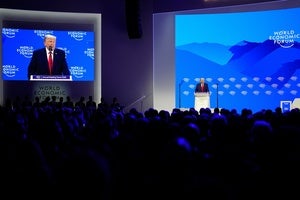
The following day, President Trump took the stage.
Afterwards, attention shifted fast to tariffs, Greenland, and the wider fallout. Among the sharpest reactions was the UK's Prime Minister Keir Starmer.
Keir Starmer: ...I consider President Trump's remarks to be insulting and frankly appalling.
LV: What does this moment tell us about America's relationship with its closest allies and about the future of the global order?
To help us make sense of what Davos revealed this year, I'm joined by two people who were also there: Martin Wolf, Chief Economics Commentator of the Financial Times, and Sir Robin Niblett, who was previously Chief Executive Officer and director of Chatham House for 15 years.
I'm Leslie Vinjamuri, President and CEO of the Chicago Council on Global Affairs, and welcome to Deep Dish.
You were both in Davos last week. The week felt like an extraordinarily long time, with much happening. Martin, maybe you could tell us what the mood was like? We've all read the headlines, and we're gonna talk about the big issues, but you were there, and you've been there for how many years?
Martin Wolf: This was my 27th World Economic Forum annual meeting, but one of them was virtual, and one of them was in New York. So strictly speaking, it was my 25th in Davos.
LV: How did it compare? How would you capture the mood? I know that's a big question. There are lots of moods, but how would you capture it?
Martin Wolf: I spent most of my time with economic policy makers, including American ones, and with intellectuals, advisors, economists, and journalists. But I didn't really speak to the businesspeople, and I would've liked to find out what they are really thinking beneath all the rubbish they're talking. Many of them, of course, are dissimulating because they have to. On the other side, I had a pretty good sense of the mood. Among these serious policy makers, economists are pretty concerned about what's going to happen to the economy. They're certainly not buying the Trump-Lutnick rhetoric about the miracles they've achieved. There's real anxiety and concern about the future of inflation markets. Obviously, the long-term implications of the decoupling of the US in important ways from the world system. Where are we going? There are very big issues there.
But the interesting thing is that Europeans feel they sort of defeated Donald Trump. They saw him off, thank God for the markets which he cares about, and their solid response made him back off on Greenland. They felt rather good about it. That's basically what I got out of my discussions.
LV: You are both in the United Kingdom. I'm in Chicago, and it's certainly not what we're hearing here that Donald Trump has been defeated by Europe, I will be very honest.
Robin, I want to get your thoughts on the mood, and also your numbers. How long have you been going?
Robin Niblett: Since 2009, with two years missed in 21 and 22. 2021 was interesting because there we were in January, two months before the full COVID outbreak, in Europe, at least. The whole subject was climate change. But everyone has their own Davos these days—there's not one thing people take away—but at least in my Davos, climate really didn't crop up.
Somebody made the point that climate is part of the mass, not a religion. This idea that if the numbers add up, we'll think about it. But if they don't add up, it's a religion, so we don't bother. Pretty brutal.
LV: It's interesting to hear you say that there are many Davos. It depends on which conversation you're in, which dinner, which side conversation. But from the outside looking in, it felt like there was one conversation. The first few days focused on Greenland, Donald Trump's claims, and Europe's fixation on the issue. Then, the Mark Carney speech and the Board of Peace. It felt like it was one singular, linear flow from between those three points.
RN: I lean into that agenda myself as I'm interested in foreign policy, and I gravitated towards that debate. But I have to say that if you are part of the "AI bro network," Davos has become an alternative meeting venue for the AI revolution, whether it will or won't work, and the deals that are done around it.
There is a promenade on that main road that runs along the top with all of the frontages along there. You can take a walk along the frontages and see the shift in aspects of the global economy and countries. Interestingly, the top entrance to the main congress center, where everyone wants to go in, was bracketed at one end by the Saudi house. For the first time, the US house, maybe inappropriately, I will say, was located in a church. So all of the church windows had been filled with these giant eagle posters looking down.
It didn't quite say "Make America Great Again," but I found that kind of intriguing.
In a nutshell, I came away thinking "peak Trump" after witnessing that long, rambling speech, which included a lot of insults trying to disguise his folding. It felt like folding because he'd used certain types of language, and as you said, the expectation was that he was going to come with an offer that Europe couldn't refuse. But instead of the offer, it just was a sort of, "Well, we're not going to invade, but if you don't give it to us, we will remember." That just doesn't cut it anymore.
I thought the Board of Peace—which thankfully I wasn't in the room for the launch of, because it was a lot of repetition of the same speech—just looked like a fail to me. I thought Europe took that moment. It was a moment when Europe recognized a red line that they had to stick by. They said, " We will not back down," and ultimately, I think Trump blinked.
LV: It will be surprising to many of our listeners to hear you say that Europe won and Trump was defeated at Davos.
MW: I wouldn't say he was defeated at Davos. There are limits to what Trump, at the moment, is able to do. And that has nothing to do with what happened in Davos, but it's where it was shown most. To me, that looks like an encouraging moment.
The way I see it, what happened over Greenland is that he encountered three significant constraints.
One, the Europeans basically said, "We are not going to accept this. This is just something we cannot accept. If you want to do this, you're going to have to invade." Second, it looks to me, from the outside, that forces in the United States, in Congress, and I suspect strongly in the military, said, "We're not gonna start a war with NATO countries. We are just not going to do that. That's crazy. That defeats the purpose of everything."
And finally, the market said, the United States is the world's biggest debtor. Europeans are not just public creditors of the United States; they are also private creditors. The rest of the world is a major creditor. The United States is going to start a war with its creditors. I'm sure behind the scenes, sensible people in the administration were saying this doesn't look like a policy with much upside and a hell of a lot of downside.
Trump, who is nothing if not flexible in these situations, bent. Those three forces together: the will of the Europeans, the obvious fact that they have serious leverage in finance (which I stressed in my column), and the fact that powerful entities in the US are still prepared to say we don't start wars with our allies over nothing.
LV: Robin, let me ask you: many people are weighing in with strong, divergent views on the future of the Transatlantic Partnership. Some people say it's dead. Secretary General of NATO, Mark Rutte, basically said, "Europe can't do this without the United States. We remain very dependent." This remains an essential partnership alliance in his case.
However, there is a range of views, and some are quite extreme. How do you see this moment?
RN: I certainly don't see it as over; there were plenty of comments in Davos this year, like the famous rupture comment by Mark Carney, and the question as to whether anything could be put back together again. You have to separate out a sense of a shift in the balance of world power, whatever that means for order, and the specific aspect of the US-European relationship. For Europeans, at least, the US relationship remains indispensable. At the top of the European list of priorities is Ukraine's survival as a sustainably sovereign state. Even if it doesn't actually possess all of its territory at the end of this dreadful war, or whenever it slows down or stops.
Doing that without America, even Trump's America, for the next three years, is going to be extremely difficult. I wouldn't say it's impossible, because Europeans have been trying to buy time with the Trump administration to try to strengthen their own capabilities. And very importantly, to start to make Ukraine's defense industrial capability, at the very least, more resilient and less dependent on America.
At least one session I attended in Davos encouraged me. But the reality is that our ability to spend money at speed and scale to build up military capabilities—not only to look after ourselves, but also to help Ukraine look after itself and survive—we're not there yet. It's going to take years, maybe two to three, to get a bit of the way there. Ten more to even be able to replicate some of the things that America does.
The sense that Europeans discovered their red line, stuck by it, and saw Trump step back does not change the underlying factor that all Europeans want NATO to survive as an alliance.
I am of the view that we should not allow our extreme distaste for aspects of what Trump does at home and abroad to allow us to perpetuate beyond his term in office the definition of what the transatlantic relationship is. Whoever succeeds him. My view is that they will need allies to address China and Russia together, which I don't see splitting anytime soon.
One of the conversations taking place, both in the lead-up to and at Davos, is "Is this Europe's moment?" The famous line that Europe only acts when there's an external crisis. Now the external crisis is Trump, and no doubt, it is definitely forcing decisions. Consider Germany's one trillion potential investment in infrastructure and defense. Real things are happening, but it's going to take some time. We're still squabbling everywhere. We've got such a long way to go on defense innovation, and there was a lot of conversation about that as well. Everyone knows what Europe needs to do to become more competitive, but we've got limited steps in that direction. Certainly, in terms of delivery so far. Yes, Europe had its moment of realization that it stands for something, and it stood up for it, but the journey ahead is difficult and uncomfortable, and it must do so without America or in competition with it. With China coming up on the outside of this, that's my other big Davos takeaway. China just kept quiet, but is this invisible presence. That is, in the end, a disciplining force for America and for us.
LV: Our polling has shown consistently that a very large majority of Americans support the NATO alliance, contrary to many of the headlines.
Martin, I want to come to you on this question of Europe and its ability to reduce its dependence. Maybe you can first assess its level of dependence on the United States, and also whether Europe can diversify to build and sustain resilience. Can it hold together as an entity on economic and financial side?
MW: I think there are very, very different dimensions of that. It's clear that Europe is highly dependent on the security side. I am less concerned about the financial resources question. I think it's the real resources question. The truth is, Europe in aggregate is a surplus region, and a huge surplus region can finance itself by shifting a lot of its external capital flows domestically.
Now, that might involve quite a bit of interference with the markets, but actually, in a war, that's what you do. Europe is less dependent on the outside world for resources because it's a surplus region, whereas the US has external deficits, which is our real weakness, and Trump is not wrong about that. It's just that he has no idea what to do about them.
You don't run a bigger fiscal deficit if that's your problem. But it's not a financial problem, it's a security equipment problem. It's a huge problem, of course. And it's a will problem. But if you look at the other aspects of the economy, we can do without US aid. We are not Canada. We are far less dependent on US trade. If you take Europe together, it's one of the three huge trading powers.
If you knock out the US and China, that's roughly 30% of world imports. The rest of the world is 70. And Europe is, by the way, the second biggest import market in the world, excluding its internal trade. Trade is not a major problem; security is a huge problem. Then there are two others: one being the currency issue. The dollar is the world's currency. The US financial markets are the world's financial markets. And while Europe could replace them through extensive reform, it's closer to doing so than anywhere else.
The Euro could be a world currency; you could imagine it. It would require integrating the bond markets, which means integrating Europe's public finances. But we're a very long way from that. So currency is a real, clear weakness. Then, of course, finally going to the global public goods of which we clearly can't do on our own. But nobody knows what to do about a rogue US in the climate area.
So I would say trade we can handle. Currency is difficult. There would be real costs with that, and it would disassemble a lot of our financial arrangements. But the primary issue would be security; I agree with Robin on that.
Then I'll just throw this in briefly, because it's the thing that I simply don't understand, which is the underlying strategy of the Trump administration. I'd love to know what Robin thinks. They seem to suggest that the highest priority is to go back to the early 19th century and make the Americas secure, which means basically giving up Asia to China and abandoning Europe and abandoning the world.
I would've thought the lesson of the last hundred years is that a huge global power has economic interest across the world. This is completely crazy. Are they serious?
LV: Your analysis is phenomenal. However, there is one weak link, which is that Donald Trump doesn't think in buckets. So maybe the weak link is in his analysis, right? He clearly thinks that he can use America's markets, access to them, or denying access to them, to cut across areas to push Europe on security.
MW: My view is, and you showed it already with Canada. Beyond a certain point, Canada overwhelmingly depends on the US markets. But once it becomes completely and utterly unreliable, you have to find an alternative. You stomach it. But in the European case, yes, of course, we have very powerful companies, particularly in Germany, which are deeply engaged with and dependent on US markets. More importantly, the US supplies us with some very important stuff, particularly in the tech sector; we really would have trouble. It's not the US market that's the problem, the real US leverage, which is they're the dominant monopoly producers of tech services to Europe. Just as China is the dominant producer of rare Earth and so forth. That's the dependency that's really worrying. We can give up the US market, but we can't give up some of the most important US services. If they do weaponize those, Europe would probably take a year or two or three to replace them. It will be very painful. Then the US tech industry will find no one in the world who will trust it. We'd rather use the Chinese. That's hell of a cost for the US to bear.
LV: And for the next US president, whoever he or she might be—what an inheritance.
Robin, what are your views on this? I guess your response to Martin's question about this national security strategy, this US preeminence in the Western Hemisphere. Is that really a thing? Is Europe going to move closer to China? Is that what the Starmer visit is about?
RN: On those two very important questions, it does feel, to me, like a hemispheric pivot. Is it logical? I think it is logical to Donald Trump and to his "America First" agenda, and to many of those around him who are most committed to it. Why? Because they believe what matters to their electoral base is immigration, and the bulk of the immigration that people see either emanates from or comes through South America and Central America. The drug running, principally, is a real issue. It has been the case for the last few years in America. If you look at the rate of opioid and fentanyl deaths, it's a real thing that was also coming through the hemisphere.
In a sort of Trumpian sense of America first and Americans first, going back to your own region and dumping all of this 20th Century post-World War II strategic stuff has a certain appeal. It happens to then fold into resources and his very personal idea that he could be the next Andrew Jackson on Alaska. Nevermind that he only got Alaska. I actually got all of that Greenland space. Whether it needs to be defended or is exploitable, it doesn't matter. It's just the scale of real estate that's worth another bit of Mount Rushmore right there. I don't think we should discount this literally personal, egotistical obsession. I'm afraid it does seem to be running a lot of American foreign policy right now.
On the one hand, there's a political and personal logic to the Trumpian American First agenda to be hemispheric. I think the flip side of it is that he sees allies as a cost. His completely uneconomic idea—I'm not an economist, but even I understand the illogicality of this—is that he believes we've been defending Europeans who've then been running a trade surplus with us. Therefore, we've been paying for their defense, and they've been stealing money from us. Bad deal. I'm not gonna put up with that deal anymore. I'll leave you to the Russians and I'll look after my area. What are you doing for me that's worth my reaching out and sustaining American security by investing in the defense of countries that are abusing us in the trade agenda? This is why the whole Greenland situation was so contentious: the Europeans kept saying to him, "Don't you understand? We can defend Greenland together."
He doesn't want to defend Greenland together because, as he sees it, that would simply be America paying for European defense and getting nothing in return. He was never interested in a NATO Arctic Century; all of this sort of stuff that we're rationally proposing doesn't fit with his mind.
What's been interesting, however, is that this is a Trumpian, MAGA kind of view. If you look at the National Defense Strategy that just came out, following the National Security Strategy, its bottom-line message is that Russia is still a threat to NATO. We're members of NATO—it doesn't actually say it, but we are. The Europeans should be able to handle it. We'll be there on the margins. We don't want the end of the alliance, but where we really need to put our effort—and it says it—is defending the first island chain. That phrase, "first island chain," was explicitly said.
They've also got a trade deficit. When we have trade deficits for Japan and South Korea, it is an implication that China should not be allowed to dominate the Pacific region. To do that, they need allies, such as Japan, South Korea, Australia, and others. That leads me to think two things.
The first one is that it's possible that if this hemispheric logic were to settle, it would be that the hemisphere needs forward defense. The four defense in Europe should be handled by the Europeans. We'll help you on the margins, but we've helped you by forcing you to spend 3.5% of your GP on defense and another percent and a half on defense-related infrastructure. That's the way we're helping you, by forcing you through trade threats to do what you should have done in any case. You'll keep us both safe by doing it. And then where we, America, put our effort is in trying to manage this more vulnerable flank to the hemisphere, which is the Pacific side. The view in Washington is that you guys look after NATO, Europe will look after the Pacific.
Last point: what should Europe do? Clearly, we need to invest more in protecting our own security. We may not be able to rely on America in the future. Under the Trumpian America First strategy, China is the bigger threat, and Europe should be able to do it. Trump's not wrong on that. I believe, as a European, that we should be taking more care of our own security, so I'm fine with that. The bit I do not accept is whether we have to choose as Europeans.
This is a moment, as Europeans, where we need to say no, we work out what's best for us. Yes, we need to focus on European security, but we also have an interest in the security of Japan, South Korea, and Australia, because they are part of what's left of a rules-based, trust-based, liberal-democratic group of countries with which we're willing to deepen our supply chains, precisely the things that Martin said are so critical to our future.
We don't want to rely only on America for high-tech semiconductors and rare-earth minerals. We need to ensure we don't follow the Elbridge Colby line, which places policy authority with the Secretary of Defense. Europeans look after Europe. We'll look after Asia.
I'd say that's not for America to decide. We will do more on Europe, but we should not accept that trade-off and should work to ensure that, post-Trump, there's a larger community in which America, Europe, and the Pacific allies are knit together.
LV: Martin, where do you anticipate Europe going, and will it be a singular answer to the question of China? Do you see America as something that's increasingly going to be in the rear view? Or is this just an extended three-year period to manage, as Europe considers its relationship with China? Where are you on these very big questions, Martin?
MW: It's pretty obvious that Europe is now in a world it never expected. Maybe it should have expected it, but it is in a world it never expected. First of all, what do we do about the power in the East? It's not going away, and we have to work out a modus vivendi with it. That has several elements. We can't become completely dependent on the Chinese supply of anything that matters any more than we can be completely dependent on the American supply of anything that matters.
We are going to have to hedge, and hedging is costly. We need to make it clear to both the US and China that we don't really trust you. Different ways, but we don't. We are going to have to create a system that allows us to be reasonably sure we can survive whatever you try to do to us.
With China, we will need to limit our dependence on Chinese manufacturers, rare earths, and other inputs. Within that, those fundamental interest constraints. The same applies to currency; we are going to have to diversify away from the dollar.
All this is obvious, but we're not going to pay an infinite price. We can still do lots of deals. We can still have trade and constructing that will be complicated and difficult. We have to think about it. What are our weak points? How can we deal with them? That takes too long; we can't discuss that now, but it's sort of clear, and we've discussed a lot of it.
I think managing the security of the continent, if we leave aside the nuclear balance, we don't need that many nuclear warheads before Russia will think very seriously about starting World War III with Europe. We can end every Russian city, with maybe 50 or 100. But we clearly unambiguously have the resources, human and physical, to match this miserable Russian army we're seeing in Ukraine, easily. We have three times the population and at least 10 times the economy. Of course, we can match them; it's just a matter of producing the resources. We're not going to fight a land war with China.
It's Russia. We can deal with that. We have to treat China as a potentially hostile power, and I'm sorry, we have to treat America as potentially hostile. However, this is not a question of what will happen after Trump. I hope very much that we won't have a figure like Trump again, but we may.
We have learned that the US is not a country we can completely rely upon anymore. We don't know what the future will be. It's immensely powerful, and the degree of trust we had in the past we cannot have in the future. That is obvious. But we still would love friendly relations with the US.
LV: That was wonderful. Incisive, lots to discuss. I just want to come to you as we close, Robin, and ask you about this question of trust. Maybe it's been overrated. Many people think that you can't have trust. You're foolish to trust too much in international relations, a world of sovereign states. We heard a line from Christine Lagarde, "we need to be worried about truth, not trust." Which is also very difficult in a world of disinformation and divided media environments.
All sorts of issues here with trust, but do you think trust is over? Is it sort of out the window now, as Martin has suggested?
RN: It's a very interesting question. I'm very much with Martin. We cannot afford to be dependent on anyone. We've learned that lesson very painfully recently, and we're on a long journey to hopefully be a bit more autonomous in all sorts of areas. I think the reservoirs of trust are being rapidly exhausted by the range and intensity of the insults thrown at Europe by the Trump administration. But right through to this idea that they know best to make Europe great again. It needs to be like America, that somehow small European states, who had hundreds of years of fighting each other and realizing the limits of sovereignty and the dangers of nationalism, should go back and rediscover both things. Only if we get them are we somehow liberated and free to be great again. There could not be a more misreading of what Europe is about and what it means to be European.
And I'd say global security. There are only three or four countries in the world that can take that approach. China, Russia (Russia shouldn't, but it does), America, and India, probably at some point. It really is undermining to trust when an American administration seems to be advocating what would make us weak and try to force us in a direction. They actually back political parties within our own domestic ecosystems that have our own country's worst interests in mind.
I believe that very strongly. Having said that, we can't trust China. With China, we will never have that confidence because we can never trust the Communist Party of China, because the Communist Party of China doesn't trust its own people. Nevermind anyone else.
We need to be constantly on our guard. Yes, a closer relationship, as Keir Starmer said in his visit, to focus on the energy climate. There is a market we can get into in both directions without being dependent. Batteries, storage, wind farms—there's plenty we can do with China that would not create an overly dependent relationship, providing, obviously, they're investing in Europe. But so long as China is a partner of Russia, we cannot trust it. So long as it's trying to build a version of a world system that makes the world safe for autocracies, we can't trust them. We can't trust them if they're America's rival. If in the end we, in America, are stronger together, which I believe we will be for the long term—and we're going through a painful rebalancing of that relationship and hopefully partnership and very much hopefully alliance—we can't triangulate between America and China.
We will be on America's side in the long term, and they will be on ours. With China, that kind of relationship is impossible. Trust was damaged by the relationship with the Trump administration, but I think aspects of it can be rebuilt. There will never be trust between Europe and the Communist Party of China.
LV: That was Sir Robin Niblett, distinguished fellow and former chief executive of Chatham House, and Martin Wolf of the Financial Times.
Thank you for listening to this episode of Deep Dish on Global Affairs. I'm your host, Leslie Vinjamuri. Talk to you next week.
Deep Dish is a production of the Chicago Council on Global Affairs. If you enjoyed today's episode, make sure to follow Deep Dish on Global Affairs wherever you get your podcasts. And if someone you know might find it interesting, send it their way.
As a reminder, the opinions you heard belonged to the people who expressed them, and not to the Chicago Council on Global Affairs. This episode is produced by Tria Raimundo and Jessica Brzeski, with support from Marty O'Connell and Lizzie Sokolich. Thank you for listening.



Related Content
 Global Politics
News that the World Economic Forum may come down from the mountain is symbolic of the end of an era but also signals the beginning of new thinking about internationalism. In Davos, Trump, Carney, and Zelenskyy offered competing visions for the future international order.
 Public Opinion
Majorities also oppose using US troops to overthrow governments in Cuba or Colombia, occupy Venezuela, and gain access to the natural resources of other countries.
 Global Politics
As foreign ministers from Denmark and Greenland prepare to meet with Trump officials, Ambassador Julianne Smith explains what US actions to acquire the autonomous territory could mean for the United States’ most important alliance.