How Congress Can Still Influence Trump's Iran War

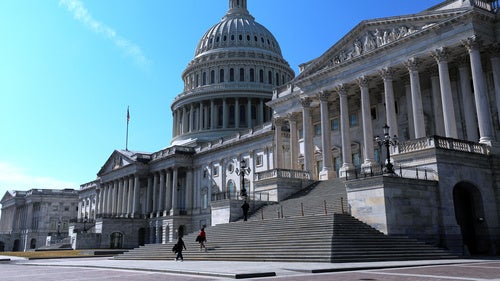
The congressional split over the war powers resolution signals that US President Donald Trump lacks broad support for the military intervention in Iran—and opposition on Capitol Hill is likely to grow if the war grinds on.
The US Senate rejected a motion on Wednesday to advance legislation that would have prohibited further US military action against Iran without congressional authorization. Only one Republican, Senator Rand Paul of Kentucky, voted with Democrats in support of the motion, while just one Democrat, Senator John Fetterman of Pennsylvania, voted against it. The US House of Representatives rejected a similar war powers proposal on Thursday almost entirely along party lines—laying bare the sharp partisan divide in Washington over US President Donald Trump’s decision to launch a war against Iran.
The framers of the US Constitution would likely find this moment alarming given their decision to grant Congress—and Congress alone—the power to declare war. Yet presidents have been flouting the constitutional war powers framework since 1950, when President Harry Truman deployed the US military to defend South Korea against a North Korean attack despite a lack of congressional authorization for the use of force. For decades, the courts have declined to rule such presidential actions unconstitutional, allowing the establishment of a precedent that the commander-in-chief can order US forces into combat without a congressional mandate. Still, recent Chicago Council on Global Affairs-Ipsos polling shows that most Americans saw congressional approval as necessary for the president to get before launching strikes on Iran.
Notwithstanding this week’s votes, history suggests that members of Congress may still be politically consequential on the Iran war. The congressional split over the military intervention signals that Trump lacks broad support for the action, and opposition on Capitol Hill is only likely to grow if the war grinds on for an extended period. Wars typically become more unpopular over time, as casualties and costs rise. If that pattern holds, we may already be at the high-water mark of public support for the use of force against Iran—and that water mark is strikingly low. A CNN poll conducted shortly after the war began found that just 41 percent of Americans approved of the military action against Iran, while 59 percent disapproved of it. If public support for US military action drops further, Republican lawmakers representing competitive swing districts will have a growing incentive to distance themselves from Trump’s campaign and congressional efforts to limit the war will gain momentum—meaning Trump will face added pressure to bring the war to an end.
The Vietnam War and the Iraq War highlight how Congress can matter in a prolonged conflict. When US President Lyndon B. Johnson began deploying US combat troops to Vietnam in 1965, most members of Congress backed the decision. But as the war became a quagmire, lawmakers began to express deep concerns and the public turned against the war effort. In 1973, after President Richard Nixon had expanded the war into Cambodia and Laos, Congress brought the increasingly unpopular intervention to an end, enacting legislation that prohibited the spending of any more money on military activities in or around Cambodia, Laos, or Vietnam. That same year, Congress enacted the War Powers Resolution, which prohibits the president from conducting any combat operation for more than 90 days without congressional approval—overriding Nixon’s veto.
In the case of the Iraq War, higher levels of partisan polarization prevented Congress from coming together to force an end to the war. But the war triggered growing opposition from lawmakers and voters over time, contributing to a major political realignment in Washington. The House and Senate authorized the use of force against Iraq in 2002, and most lawmakers approved of President George W. Bush ordering the military to overthrow Iraqi President Saddam Hussein the following year. But as the number of casualties and the financial costs soared, more members of Congress began to speak out against the war—including some longtime national security hawks, such as Democratic Representative John Murtha and Republican Senator John Warner. Like with the Vietnam War, the congressional shift came alongside a steady decline in public support for the war, the latter of which contributed to the Republican Party’s loss of congressional control in the 2006 midterm election and the election of Barack Obama to the presidency in 2008.
Even in some cases of limited military interventions, members of Congress were influential.
Even in some cases of limited military interventions, members of Congress were influential. In 1999, President Bill Clinton joined NATO allies in conducting a bombing campaign against Serbia in an effort to protect the population of Kosovo, and in 2011, Obama joined NATO allies and Arab partners in carrying out an air war intended to prevent the slaughter of civilians in Libya. In both cases, American lawmakers and voters were split over the use of force, and Congress did not take action either in support of or in opposition to them. But the lukewarm congressional and public support made it clear to Clinton and Obama that they would face serious political risks if the interventions became prolonged or generated US casualties. This recognition influenced both presidents’ decisions not to deploy any ground troops.
Still, the congressional record on the US use of force is far from inspiring. The most important storyline concerning war powers issues in recent decades has been Congress repeatedly ceding power to the president. The trend has been fueled by the increased polarization of American politics, which has made lawmakers far less willing to challenge a president who belongs to their party—even when that president is taking the country into an unnecessary and unwise conflict.
Yet lawmakers who oppose the Iran war can still exercise influence by demanding more information from the administration, raising concerns about the administration’s actions, and countering misleading administration narratives. This type of congressional activism—especially when relayed by the media—can raise public awareness about the war’s missteps and costs. In turn, if the war becomes increasingly unpopular among the public, congressional support for constraining the president’s prosecution of the war will grow. Already, a group of moderate House Democrats has introduced an alternative war powers resolution that would terminate military action in Iran within 30 days (rather than the immediate termination mandated by the measures voted on this week) unless the use of force has been authorized by Congress. This type of measure could gain momentum on Capitol Hill if Americans sour further on the war.
More broadly, a prolonged and costly war could shake up American politics—weakening Trump’s stranglehold over the Republican Party and providing Democrats with a powerful campaign issue heading into November’s midterm elections. If Democrats do gain control of Congress next January, they will be able to carry out more extensive oversight of any continuing US military deployments. They could also develop new legislation to restore a more even balance of power between the branches on critical issues of war and peace.
Editor’s Note, March 5, 2026: This analysis was updated to reflect the outcome of the House vote.
The Chicago Council on Global Affairs is an independent, nonpartisan organization and does not take institutional positions. The views and opinions expressed in this commentary are solely those of the author.
Related Content
While few Americans want to see Iran develop a nuclear weapon, just half expressed support for US airstrikes against Iran’s nuclear facilities—and most believe direct military action would spark a broader regional war.
Is this a contained escalation, or the start of something much bigger? Former US Ambassador to Israel Daniel Shapiro joins from Tel Aviv to unpack what’s driving this moment.
A live stream with Lisa Anderson, Daniel Byman, and Leslie Vinjamuri on the emerging developments following the joint US-Israel coordinated strikes on Iran.