The 2026 FIFA World Cup is a Pitch for Global Politics
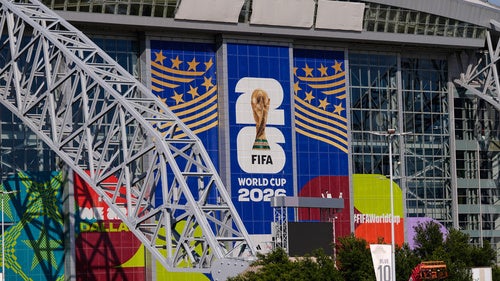
With the tournament set to kick off at a moment of geopolitical strain, authoritarian powers are seizing an opportunity.
The 2026 FIFA World Cup is set to be the largest ever.
Cohosted by the United States, Mexico, and Canada, the tournament—which runs from June 11 through July 19—will feature 48 teams and draw millions of soccer fans to 16 stadiums across North America.
But the lead up to the games has been anything but smooth. Conflict in the Middle East continues to roil the global economy, Russia’s war in Ukraine appears far from over, and news that ICE agents will be in attendance has sparked concern of a crackdown. Meanwhile, FIFA is dealing with its own set of internal challenges including the legacy of its 2015 corruption scandal, growing criticism of FIFA President Gianni Infantino’s cozy relationship with US President Donald Trump, and complaints over Saudi Arabia’s selection as the host of the 2034 games.
“International sporting events have always been tied to geopolitics,” Council Senior Nonresident Fellow Alexander Cooley told the Council’s Libby Berry. “What's different now is the explicit tie between World Cup hosting and authoritarianism and FIFA's governing body.”
He joined Dictating the Agenda: The Authoritarian Resurgence in World Politics co-author and University College Dublin Associate Professor Alex Dukalskis to unpack FIFA’s global role, the significance of this year’s World Cup, and what to watch for beyond the pitch.
This interview has been edited for length and clarity.
The upcoming FIFA World Cup has drawn a lot of attention. What is the significance of this year’s tournament?
Dukalskis: Soccer/football is popular globally. Every region, basically every country in the world from Italy to the United States to North Korea to Australia loves football. So, it's a massive draw every time. This year is a little bit different in the sense that the tournament has been expanded from its previous norm of 32 teams to 48 teams. About one out of every four countries in the world is participating.
The other thing that's a little bit different this year is that it's being held in three countries—the United States, Canada, and Mexico. This isn't the first time this has happened: In 2002, the event was held in Japan and South Korea. But it's relatively rare that it's a shared event.
And then of course there's the politics behind it.
Cooley: International sporting events have always been tied to geopolitics. What's different now is the explicit tie between World Cup hosting and authoritarianism and FIFA's governing body.
We have had two consecutive World Cups, 2018 and 2022, that were held in authoritarian countries—Russia and Qatar respectively—and both were awarded at the same time as a rigged and corrupt bidding process. FIFA has put itself in the spotlight because of these rigged types of procedures and perceptions that they are chasing the money, and that they are cozying up to authoritarian regimes.
FIFA President Gianni Infantino has notably established close relationships with several world leaders, including US President Donald Trump, to whom he presented the inaugural “FIFA Peace Prize.” Does this signal anything about FIFA’s global position?
Dukalskis: It's worth remembering that the FIFA Peace Prize was essentially made up very recently. And it came after Donald Trump himself was putting on the hard press with lots of politicians around the world to earn himself the Nobel Peace Prize. The inescapable conclusion is that this is a prize made up as kind of a side consolation.
I think this illustrates how Infantino is a consummate political player. He oversaw the process of the World Cup in Qatar and in Russia. He's very close with Mohammed bin Salman (MBS), the crown prince and de facto ruler of Saudi Arabia. He's at home hanging out with Putin and Trump and the leaders of Qatar and so on. He's very comfortable navigating these circles and catering to the needs and desires of these kinds of leaders.
The Trump administration has indicated that ICE agents may be present at US venues What has been the global reaction to this, and what impact might it have on attendance?
Cooley: The immigration issue has become increasingly salient. There's a perception that traveling fans might get caught up or even targeted. And there are concerns about due process. All of this, coupled with stories of overseas tourism being down, has added to sort of an apprehension.
In terms of actual ICE presence at events, I think this is going to be a matter of local politics and local politicking. There are some cities in which workers have declared that they will not go into work if ICE is present. This complexity about what the rules are, how immigration is going to be enforced, and what recourse tourists have is a really live one.
Have we seen anything like this with past hosts?
Dukalskis: There's very often controversies around whether people should attend or whether people feel safe attending. The World Cup and the Olympics have, in recent years, been held in Russia twice, China twice, Qatar, and—going further back—South Korea in 1988 and Argentina in the 1970s. I think the reality is that you will have a good number of people who are sports fans who set aside the politics and will go no matter what.
The World Cup draws significant global attention. What motivates a country to want to host or invest in such a major sporting event? What risks are associated with the spotlight?
Dukalskis: A lot of countries want to do this for status and prestige. You're earning the esteem of those outside your country. I think countries also often use it to promote particular narratives about their own politics and their own societies. South Korea in 1988 used the Olympics to promote its liberalization and its changing politics and society. And of course, countries also see a boon to tourism. There is also the idea that it helps boost the game locally.
But there's a trade-off. If you invite somebody into your house, they can then see the inside of your house. There's definitely an element of risk. Journalists who cover the event can look around, do investigations, and expose things that you might not want the global media to see or global audiences to see. Over time, a lot of countries have tried to kind of corral and steer journalists in particular ways and prevent them from reporting on certain things. Some countries in the past have also censored the phones of athletes or censored their internet access.
It’s been more than a decade since the 2015 FIFA corruption scandal, in which executives from FIFA and other soccer governing bodies were charged with bribery offenses, among other crimes. Is this type of controversy unique to FIFA?
Cooley: I think what was so stunning about that 2015 case was just the scale. This wasn't just a couple of rogue officials who were bad apples. You saw a systematic use of the organizing structures, the regional committees, the corporate sponsorships, the money that was supposed to flow to go to develop the game and build pitches, that everything actually was opaque, non-accountable, and, in many cases, sort of tampered with. The scale of bribery was also noticeable: over $150 million in bribes over a couple of decades, more than 50 defendants, over two dozen guilty pleas.
These bodies that are supposed to be guardians of these sporting events—these pastimes that fans love and care for—are very much political agents.
We had a little bit of accountability in that the scheme was exposed. But the structural dimensions of a committee of unelected and unaccounted for people who control these vast media contacts and sponsorship contracts and the whole process of bidding—that very much remains intact.
To me, part of this is a story about FIFA culture, but part of it is about these bodies that are supposed to be guardians of these sporting events—these pastimes that fans love and care for—are very much political agents. The billions of dollars involved here touch upon global issues and global political economy.
FIFA has selected Saudi Arabia to host the 2034 World Cup. What do you make of this decision, especially given the controversy around the 2018 competition in Russia and the 2022 competition in Qatar?
Dukalskis: The background here is that Mohammed bin Salman has made sports and entertainment a major priority of his rule. And this is embedded in a larger program to transform Saudi Arabia's oil wealth into other forms of wealth and diversify the economy. Part of that is investing in sports. The Saudi Public Investment Fund has spent huge amounts of money in bringing top footballing talent to the Saudi domestic league, most famously Cristiano Ronaldo. The PIF has also purchased Newcastle Football Club, which is a major football club in England. And it has invested, of course, in the global game. And, as you mentioned, the World Cup is coming to Saudi Arabia in 2034.
MBS says it's just to grow GDP, diversify the economy, and make money. That may be part of the rationale, but there's clearly a political rationale as well. Six months ago, you saw a major White House event with Saudi representatives and the Trump administration, and who else was there? Cristiano Ronaldo. So they're clearly not just doing this only for economic reasons.
What will you be watching for throughout the tournament?
Cooley: If there are protests or negative news stories that are associated with the tournament, I’ll be looking for whether they escalate to where Trump administration officials feel like they need to send a message to Infantino to crack down. If that happens, then the story is more about FIFA doing this administration's potential bidding than anything else.
I think the administration would be really wise to just let this stuff go. The United States is going to be the host of the Summer Olympics in 2028. In some ways, this is the first part of the United States being the center of the global sporting world for this two-year period.
Dukalskis: One more thing that will be interesting to watch is the reception and conversation around the Iranian team being in the tournament. It'll be interesting to see how not only the US administration but the public actually responds to this team, how that team's presence is talked about, and whether they progress in the competition.
Geopolitically, does it matter who wins?
Dukalskis: There's a famous saying that football is a very simple game. It's 11 versus 11 for 90 minutes and at the end Germany wins 2 to 0. So, you know, I don't think this year it'll be Germany, but one of the usual suspect teams will probably win. It's unlikely a team like Iran would win. But if it did, of course that would be a major story.
Cooley: Four years ago, Morocco made the semifinals—the first time an African team had ever made the semifinals of a World Cup. And they felt that sense of representing an entire continent. So, there's always sort of an unexpected country that puts together a string of good performances or good results. At that point, whether they want it or not, the politics tend to be projected onto them, even if they themselves are just playing the game.
The Chicago Council on Global Affairs is an independent, nonpartisan organization and does not take institutional positions. The views and opinions expressed in this commentary are solely those of the author.


Related Content
 Global Politics
By barring Russian athletes from competing under the Russian flag, the International Olympic Committee demonstrated its power as a global norm-maker. Now, sporting federation leaders are seeking to distance their games from geopolitics.
 Global Politics
Major sporting events offer unique opportunities for the host countries, the competitors and the world, Paul Poast writes.
 Global Politics
Why do some governments use sports to launder their reputations – and does it work?