How Russia's War on Ukraine is Reshaping Europe's Defense Strategy

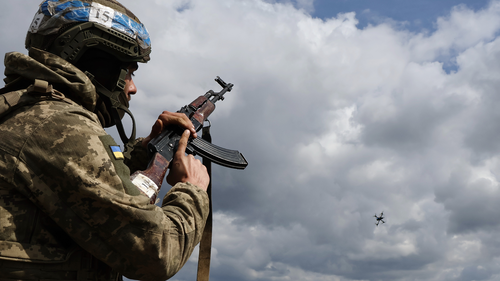
The conflict offers lessons for how to bolster European security with less support from the United States.
Russia and Ukraine remain locked in a stalemate, but much has changed since the start of the war. The conflict, now in its fifth year, has forced Europe to reevaluate its defense strategy—and whether it can continue to rely on the United States.
“We've got a Russian threat that's increasing, and then we've got US presence on the continent that's decreasing, which leaves this deterrence gap for Europe," Council Senior Nonresident Fellow Armida van Rij said.
She spoke with the Council’s Libby Berry about where things stand on the battlefield, the prospects for peace, and what Europe can learn from Ukraine.
This interview has been edited for length and clarity.
Russia's war on Ukraine is now in its fifth year. Where do things stand?
There's been very little movement on the front line, and that says quite a lot about Russian military capability, but also particularly about Ukraine's ability to defend itself and hold the line. Russia needs to win, whereas Ukraine just needs to not lose, essentially.
Starting to shift things a little bit is the way in which Ukraine has been able to strike deeply into Russia, and not just on oil refineries and energy infrastructure. They've been targeting Moscow, bringing the war much closer to the Russian public. The regime and Putin can no longer deny that this is actually impacting ordinary Russians.
One of the things that's come out of the NATO summit is that Trump said the United States will provide licenses to Ukraine to produce Patriot missiles. If that actually were to happen, that would provide quite a big advantage for Ukraine.
US President Donald Trump said this week there is interest on both sides in ending the conflict, referencing recent calls with both Russian President Vladimir Putin and Ukrainian President Volodymyr Zelensky. What would meaningful progress toward peace look like at this stage? What sticking points might emerge?
We need to differentiate between a ceasefire or a peace agreement. It's much more likely that a ceasefire will be negotiated rather than a more sustainable, longer-term peace agreement. Part of that is because, ultimately, Putin does not want Ukraine to exist as a sovereign nation. The ideal scenario for Russia is that Ukraine becomes this depopulated gray zone where foreign companies are not willing to invest, a lot of the population has left, and so it becomes effectively this buffer state between Russia and NATO where nothing really happens, and if Russia were to renew its conflict on Ukraine, there would be very little resistance.
One of the big questions in any kind of ceasefire or eventual peace agreement is what happens to the territories that are currently occupied by Russia, the Donbas and Crimea in particular. Zelensky has started preparing his population for the fact that they might not be able to regain all of the land that's been lost.
The complicating factor is that Putin has rarely negotiated in good faith. So even as Trump says that he's spoken to Putin and that he's willing to come to the table and willing to negotiate, recent history shows over the past 20 years or so that we haven't been able to take Putin at his word on that front, and that he has continuously come back for more. That's the real fear for Ukraine.
If the two sides do reach an agreement to end the war, what would credible security guarantees for Ukraine entail? Who would enforce them?
What Ukraine really wants is a kind of NATO-like mutual defense agreement where if Russia were to renew its attack on Ukraine, NATO allies or European countries would come to the fore and defend it. It is very unlikely to get that, not just because of the United States, but there's also a number of European countries who are quite uncomfortable with that.
The best Europe has been able to come up with so far through this Coalition of the Willing, which the United Kingdom and France have led on, is a "reassurance force," where if a ceasefire were to be negotiated and would hold, European countries would send troops to Ukraine to help reassure Ukraine that they are there. It would very likely be a small force, light footprint, very defensive posture, quite far away from the front line, in which case you could raise the question: How useful actually is that as a deterrent to Russia? There's this bigger issue around the credibility of such a force and the credibility of a European deterrent without a US backstop. Whether the United States is actually willing to provide that backstop is one of the issues that continues to come out in negotiations.
You recently published a report on how Europe can bolster its defensive capabilities to deter further Russian aggression. What steps do you think are needed, and what might stand in the way?
We've got a Russian threat that's increasing, and then we've got US presence on the continent that's decreasing, which leaves this deterrence gap for Europe. There are really three key things to be thinking about. The first is about capabilities. One of the things that could be done when thinking about equipment and capabilities is just making sure that the kit European countries have actually works, is fully serviced, and has a pipeline of trained personnel and stockpiles of the right munitions to use it. The other thing is there used to be this perceived trade-off between building the European defense industrial base or buying off the shelf, usually from the United States. Because of how much more money there is going to defense these days in Europe—the European allies and Canada together in 2025 spent $574 billion on defense—that trade-off no longer exists, and they could both invest in Europe as well as get things off the shelf quickly.
The second area is on the people and the skills side of things, a whole-of-society approach to national security. Some people may want to join the armed forces, in which case we need to think about facilitating and incentivizing people to do so, which would be through developing more flexible service commitments. People don't necessarily want to sign up for 15 years anymore. The second category of people are those who work for defense industries. We really need to think through how we can facilitate using the skills that exist in the civil workforce and how they can much more easily join defense roles by speeding up security clearance processes.
Then the third factor is thinking through much more carefully about what a European way of war would look like. The premise of NATO has always been that we would fight the Russians or anyone else based on the American way of war. Europe would not be able to do that because we wouldn't be able to deliver the people, and we would need to do it much more cheaply. So, how can we bring mass in different ways than the United States would? There are things like ensuring that forces are interoperable, ensuring that forces are integrated together. But a lot of this also comes down to leadership, to risk-taking, and who makes decisions.
Ukraine has relied heavily on drones throughout the war and has started exporting its drone technology. How has this industry evolved over time?
The reason they had to turn to drones is because they couldn't get 155-millimeter ammunition quick enough. They had to think much more creatively and find different solutions, which has allowed this ecosystem to develop and flourish. The government has driven a lot of those changes. They have reduced red tape. They have accelerated the pathway for certification, so what equipment can be used by the military. There's also been huge elements of decentralization. For example, in the Ukrainian Armed Forces, brigades have their own procurement authority to procure their preferred equipment. They don't have to go through the Ministry of Defense.
At the same time, lots of different, very localized manufacturing hubs have propped up all around Ukraine to be able to respond to innovation. The innovation cycles in Ukraine are about six weeks. Manufacturers are able to update equipment, drones in particular, through almost real-time updates from the battlefield in terms of what's working, what's not working, what's Russia doing, how can Ukraine gain advantage. That very swift cycle is really what has set Ukraine apart in a way that is almost unimaginable for most of NATO.
What we're seeing as a result of that is Ukraine really becoming a contributor to European security. Ukraine has embarked on a whole set of joint ventures with other European countries, Germany and the United Kingdom, for example, to try and export some of this expertise. Following Tehran's rebuttal attacks to the US-Israeli strikes on Iran, Zelensky was also on a plane to partners in the Gulf to share knowhow. That led to a whole range of defense cooperation deals between Ukraine and Saudi Arabia, Ukraine and other Gulf states, to share the lessons learned in terms of what's worked in Ukraine and export Ukrainian defense technology as well.
What can Europe learn from Ukrainian tactics against Russia? How might these lessons inform Europe’s future defense strategy?
The Ukrainian defense ecosystem is so different from the American procurement system or the European procurement system, so there's lessons there about procurement. But when we talk about adaptation, there's two key factors. The first is modularity. We still tend to think of defense systems as all of a platform: As part of your F-35, you've got the plane, you've got the missiles that go with it, you've got all the different components that are all part of the same thing. Ukraine has been able to think more about modularity, so bits and pieces, which are then able to adapt much more quickly, and it's easier to upgrade them when needed.
The second piece is software. Ukraine's been able to use software to make pieces of kit that aren't meant to communicate communicate and use those to gain advantage on the battlefield. And again, software updates are a much cheaper way to adapt rather than ordering a whole new tank or a whole new plane. There's lessons here for the defense industry about shifting from systems and platforms to modularity and ways in which we can much more easily update and upgrade systems.
The Chicago Council on Global Affairs is an independent, nonpartisan organization and does not take institutional positions. The views and opinions expressed in this commentary are solely those of the author.

Related Content
 Global Politics
From Turkey's F-35 ambitions to Zelenskyy's meeting with Trump, Council expert Ariane Tabatabai unpacks how burden sharing, Ukraine's evolving role, and unresolved tensions over Iran shaped this year's summit.
 Public Opinion
They are also divided on the United States’ participation in Europe’s “Coalition of the Willing” to defend a ceasefire in Ukraine.
 Geopolitics
North American and European industry representatives met in Ankara to discuss how to enhance the alliance’s capabilities through increased production, cooperation, and joint procurement.
 Global Politics
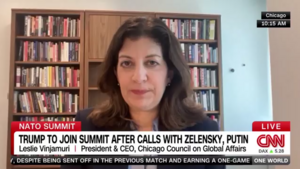
"Having that provocation on the eve of the NATO summit could lead President Trump to do what he should do, which is to double down on NATO's demonstration of unity," Council President and CEO Leslie Vinjamuri argues on CNN. "I mean, after all, this is this is a summit."