Inside the NATO Summit in Ankara: Ukraine, Iran, and Turkey's F-35 Bid

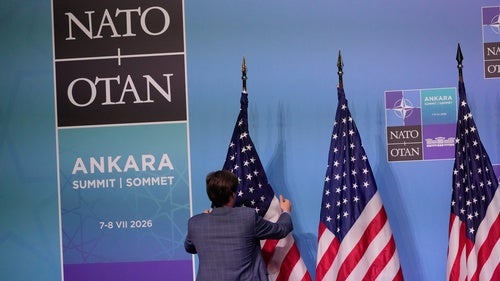
From Turkey's F-35 ambitions to Zelenskyy's meeting with Trump, Council expert Ariane Tabatabai unpacks how burden sharing, Ukraine's evolving role, and unresolved tensions over Iran shaped this year's summit.
North American and European heads of state and government gathered in Ankara, Turkey, July 7-8 for the annual NATO Summit.
As anticipated, European security and defense spending dominated the conversation, with leaders announcing a $50 billion effort to strengthen and modernize their industrial base. The alliance also affirmed their support for Ukraine and called for Iran to allow ships to move freely through the Strait of Hormuz. And despite US President Donald Trump’s criticism of allies, renewed remarks about US control of Greenland, and disagreements around the Iran war as the ceasefire appeared to be falling apart, the alliance emerged with an “ironclad commitment” to collective defense and “the transatlantic bond.”
Council Vice President of Research for Security and Defense Ariane Tabatabai was in Ankara for the summit. She spoke with the Council’s Christina Colón about Turkey’s role as host, Trump’s meeting with Ukrainian President Volodymyr Zelenskyy, and how NATO allies are thinking about the Iran war.
This interview has been edited for length and clarity.
You were in Ankara, Turkey, for the 2026 NATO Summit, which arrived after months of tension between US President Donald Trump and European allies. How would you characterize the mood among delegations?
It has been very clear that for the past few months the Turks were working to make a big impression with this summit. Just getting into the city, you could see that the Turkish government went all out. Everything was NATO branded; large billboards and screens advertised the summit, and the roads had been freshly paved to welcome and impress delegations from the allied countries and other participants.
The Turks have also clearly tried to manage the intra-NATO tensions and avoid an embarrassing situation where US President Donald Trump would leave the summit early or engage in some sort of public feud with counterparts. They really tried to make the summit—the first they've hosted since 2004—a success. And because of this, on the European side, the hope was that it would go as smoothly as possible under the circumstances.
Even so, as Council Distinguished Nonresident Fellow and former US Permanent Representative to NATO Julianne Smith predicted in the lead up to the summit itself, a lot of participants’ attention was focused on managing the United States and avoiding major tensions. NATO Secretary General Mark Rutte and many European leaders thus came into the summit prepared to tackle Trump’s top priority of burden sharing, even if at times only cosmetically. And then Trump in his bilateral meeting with Turkish President Recep Tayyip Erdoğan made comments that revived some of the anxieties and frustrations of the past few months, including about Greenland.
Allies came into this year’s convening with three key priorities: increasing defense spending, expanding European security, and building support for Ukraine. What were the expectations for conversations on these priorities and what was the reality?
There is increasingly a conversation happening, especially among Europeans, about what a less-involved America means for NATO. Allies are thinking about the different models for a Europeanized NATO certainly conventionally, but even in terms of strategic deterrence. An important theme that was encouraging to hear was the notion that we have to make sure that Europeanization does not lead to fragmentation or duplication of efforts and capabilities. In other words, integration should remain a key priority. A lot of the debates in Ankara thus centered around what military readiness looks like for the alliance, what capabilities are needed to achieve the desired effects, and what resources need to go into making it all happen.
Another throughline of the conversations was the defense industry piece of things. There was a defense industry forum happening down the street from me, where defense industry delegations came together to talk about innovation and acquisitions. An encouraging point of discussion was ensuring allies do not develop defense capabilities in silos, with a push for integration to be considered on the front end.
An important priority for many allies has been a reiteration of the commitment to the security of Ukraine, and Ukrainian President Volodymyr Zelenskyy and other Ukrainian officials were in Ankara. An interesting and positive development was the shift in the way Ukraine is now being discussed within NATO. Allies are no longer solely talking about Ukraine as a recipient of support and military aid but as a security provider for the allies. Ukraine has made huge progress in defense innovation during the war, especially in counter-drone capabilities. So, there has been an interesting kind of evolution in how the alliance writ large is viewing Ukraine today.
Trump, of course, met with Zelenskyy on Wednesday. How did that meeting go?
Trump made disparaging comments, including that Ukraine and its aggressor, Russia, are like kids at a park who sometimes just need to fight it out. But in welcome news, he granted Ukraine’s request to produce Patriot missile interceptors domestically to meet its own defense needs while the United States has its own requirements in the Middle East. It remains to be seen whether and how the government will follow through on this.
As you mentioned earlier, Trump also raised the prospect of US control over Greenland. How did the allies respond, and what should we make of Trump’s decision to raise it at the summit?
When you watch what the administration has been saying about Greenland from the United States, it's easy to dismiss it as something the president occasionally brings up and is not that serious about. But it's perceived very differently in Europe. Europeans are watching this whole episode with Greenland with surprise and frustration. They have been actively preparing for contingencies in case Trump decides to take over Greenland by force. And people not just at the official level but also the general public are starting to see the United States not just as a challenging ally that they need to manage, but as a potential threat within the alliance itself.
As much as many would like to put Greenland behind them, it is still looming, not least because of Trump’s comments in Ankara. Denmark’s Prime Minister Mette Frederiksen responded to Trump’s threats noting that her country would be ready to defend NATO territory, including its own. And other allies have joined the Danish delegation in condemning the renewed threats.
I think the fact that Trump keeps bringing it up means that he’s not entirely joking. That is not to say he is going to deploy troops to Greenland tomorrow. But even musing about it is a breach of trust that makes it harder for the alliance to focus and work on the actual threats to the alliance together.
A sideline meeting took place to discuss the Strait of Hormuz. How is the alliance thinking about governance of the waterway?
The allies are still trying to make sense of the Iran war and the memorandum of understanding. It’s not super clear what the role is going to be for Europeans on an individual level, let alone for the alliance more broadly.
On the Strait of Hormuz specifically, there is a history of certain European allies contributing to freedom of navigation efforts there. In fact, France and the United Kingdom have led maritime security initiatives. Because there is a history of allies being part of multinational arrangements, there is a foundation upon which they can build to secure freedom of navigation in the strait and allow for the free flow of energy and other goods going forward. But there is a bit more confusion when it comes to the larger Iran issue set and what the plan is.
Trump famously did not consult with European allies before starting the campaign in Iran and has not really welcomed them into the diplomatic process. He has repeatedly said he is not happy with the way the Europeans have dealt with the war, saying they have not given the United States what it needs when it comes to logistics, access to airspace and bases, and so on and so forth. All of this has sent the message that the United States is just interested in the benefits of NATO’s militarily capabilities, but not in the expertise they bring to the table and factoring their interests into Washington’s calculations. These fissures may deepen as the ceasefire appears to be falling apart.
Trump has signaled he'll allow Turkey to purchase advanced F-35 fighter jets, reversing years of restrictions tied to Turkey's S-400 purchase from Russia. What does that reversal signal about Trump's approach to Turkey specifically, and to alliance discipline more broadly?
It was clear Turkey saw this summit as a moment where it could signal that it is not just a junior partner in the alliance, and senior Turkish officials said as much in every public panel they participated in. Part of what they were telegraphing was, ‘listen, we have the second largest military in the alliance, a very robust defense industrial base, and we are contributing here. We should be taken seriously, and we should be treated in the same way as the rest of the NATO allies.’
Turkey has historically been viewed as a difficult ally and has had complicated relations with several allies. It also doesn’t see alliances in the same way as many other NATO allies:. Erdoğan has a more transactional approach to foreign policy and has been diversifying the country’s partnerships and seizing opportunities—even those that potentially conflict with NATO interests. This cooperation with Russia, for example, is precisely why Turkey has been sanctioned by the United States. Erdoğan has also been echoing a lot of the language that we've heard from the Trump administration around burden sharing and countries needing to pull their weight in the alliance. And Trump seems to have a personal affinity for Erdoğan, as the US president tends to with leaders of other authoritarian states.
When it comes to the sale of F-35s, we’ll have to see what actually happens. There are a number of obstacles. Already, Israel has been pretty vocal in its opposition to Turkey rejoining the F-35 program, and the Israelis and the Turks have been launching escalating rhetorical attacks against one another. This decision is likely to be divisive in the United States given the real national security concerns. Turkey is designated under the Countering America's Adversaries Through Sanctions Act for its procurement of S-400s from Russia.
The president can of course decide to ignore all of this and go forward, as he has in other instances. We'll have to see. But I think just the fact that he seems to be entertaining it sends a message and probably hands Erdoğan the kind of win he was hoping for with the summit.
The Chicago Council on Global Affairs is an independent, nonpartisan organization and does not take institutional positions. The views and opinions expressed in this commentary are solely those of the author.

Related Content
 Global Politics