A Conversation with Estonian President Alar Karis
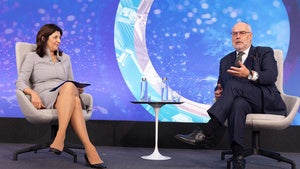
About This Event
Estonia has become a digital powerhouse, leading the world in online government services while positioned on NATO's strategically important eastern border. The country has shown how technology can strengthen democracy and security simultaneously. How did Estonia transform itself into a digital leader? What can other countries learn from its approach to both innovation and defense? And how can stronger US-Estonia cooperation help address today's evolving security challenges? Join President Karis as he discusses Estonia's experience navigating digital transformation and geopolitical pressures in an increasingly complex world.
This transcript was generated using automated transcription software and has been lightly edited for clarity and readability. While efforts have been made to ensure accuracy, it may contain errors or omissions. Please refer to the original recording for complete context.
LESLIE VINJAMURI: Good morning and welcome. Thank you for joining us today for today's discussion with President Alar Karis of Estonia. My name is Leslie Vinjamuri. I joined the Council on July 1st as president and CEO, and I must say this is my first time at the Chicago Council welcoming a sitting head of state. How tremendous that is. The president of Estonia.
Estonia is a country of just over 1.3 million people. Boy, it is a country that is punching above its weight and certainly pulling its weight, I would say for all of Europe and for the West and for the international community. It has built one of the world's most advanced digital societies, from e-residency to digital voting.
It has demonstrated how technology can enhance democratic governance, empower citizens, and drive economic innovation. But Estonia's story we know is about far more than technology. It's also shaped by geography and history. I had a look this morning. The border that Estonia shares with Russia is approximately 294 kilometers. Just pause to imagine that.
President Alar Karis has served as president of Estonia since October 2021. He brings a scientific background. He is a molecular geneticist and developmental biologist. He brings a unique blend of scientific rigor and public service to his role. He previously served as director of the Estonian National Museum, as rector of the University of Tartu and the Estonian University of Life Sciences, and as Auditor General of the Republic of Estonia.
From 2010 to 2021, he served as honorary consult to Chile in Estonia, and he has been recognized with honors from Belgium, Sweden, Finland, and Latvia. We are so deeply honored to have President Karis with us today to discuss Estonia its role in the world, technology, and of course national security. Before we begin, let me just say that the president is going to first address us.
I will join you in the audience. I am looking forward to that part. We will then have a conversation and then we will open it up to your questions afterwards. And we are on the record. We are live streamed and as I like to say, I really, in my role cannot say how much I sincerely appreciate the questions from each of you.
People from around the world not only watch our public events on the day [of the program], they watch them back. It's your moment to really ask an intelligent question to the president and I strongly encourage you to take advantage of it. Please join me in welcoming Estonian President Alar Karis.
ALAR KARIS: Thank you very much for having me here today and thank you very much for this introduction. I'm glad to be able to share with you Estonian experiences as a small country and as a country in the tough neighborhood on NATOs Eastern Flank.
I think three key lessons that we have learned that have helped us to get to where we are now.
The first, obviously, is that alliances are important. Working together with other freedom loving states is the key to prosperity as well as security. Our history before the Second World War showed us that being alone is a bad strategy. Isolation is a bad strategy. We do not have any luxury of going alone. We need alliances. Working together is a key in solving all regional and international problems.
Let's take energy independence from Russia, for example. Until 2022, Estonia was fully dependent on Russia's gas transit and electricity, but we cut it all off. It was not easy. It was quite difficult. But in our experience, the secret weapon in managing that difficult transition was regional cooperation among our partners and allies. For example, we benefit from the LNG terminals in Lithuania and Finland, and we had great cooperation with Poland.
But alliances are not only important for small states. We see authoritarian regimes worldwide challenging all the core western values and the international security order. The only way of countering this is by working together. Therefore, Estonia is firm believer of alliances. We constantly strive to make our alliances as strong as possible, be it NATO, EU or other regional alliances.
And the second thing that we have learned is the powerful impact a small nation can achieve when they lead by example. Let's take digitalization for example. Back in the 90s, we chose to leap directly into the digital age. We were the first country to start voting online, and we have done so for 20 years now. And since last year, 100% of our government services are online. As a next step, we have launched AI Leap. This year we want to be the first country to bring AI education to every high school to turn AI into a national advantage for our future generations.
And we also want to lead by example in matters of defense and security as well. We take our defense seriously. Starting next year, we will allocate almost 5.5% of our GDP to defense. We'll do so for at least the next four years, and through that, we encourage others to do the same because it is very clear that European countries have to do more in building up its defense spending capabilities and combat readiness. And of course, we want to lead by example in helping Ukraine defeat Russia's aggression.
Estonia was one of the very first to send weapons to Ukraine. Our missiles arrived in Ukraine in January 2022, and by now our military support to Ukraine amounts to almost 3% of our GDP. This commitment, obviously it's not big on the financial scale, but it shows that courage in policy can be as powerful as economic size.
But having said that, a word of caution is also advised as one should never get too comfortable with one's success, and therefore the third lesson is to learn from others as well. Because in terms of defense and digitalization, the most innovative country right now is probably Ukraine. For example, Ukraine's governments smartphone platform, Diia, takes our innovation even further and is now probably one of the most advanced examples of state level digital services anywhere in the world.
And of course. Our defense industry is increasingly cooperating with the Ukrainian defense industry, especially in UAV production. And our defense forces are trying to learn as much as we can from Ukraine's military tactics as fast as possible, as are our emergency services in matters of civilian defense. Let's learn from each other. Thank you very much for your attention.
LESLIE VINJAMURI: Thank you, President Karis. I appreciated the optimism about AI, the innovation, and the emphasis on the significance and importance of working together. Nobody knows it better than you do as president of Estonia in the current moment. Let's start with the question with your remarks on digital. It is an extraordinary achievement, 100% of your government services moving to digital. It's something that I think for those of us in the United States is still quite a long ways off. But the advantage of digital in terms of efficiency is undoubtedly quite remarkable.
But it presumably also brings some insecurities, some vulnerabilities. So, could you talk with us about how you have shielded yourself or attempted to from those vulnerabilities? Cybersecurity attacks? Disinformation, grey-zone warfare operates frequently through digital technologies. You know this better than anyone. How have you [handled this]? Presumably it is an ongoing work in progress.
ALAR KARIS: Yes, talking about digitalization is, as some say, it's a cold coffee vase, which means its in every place in our country. I mentioned it's 100% digitalized. Everything is online, all services. But I have to say, there’s one thing: To get married, you still have to show up. But the rest you can do. We also introduced actually e-divorce, so that means you do not use lawyers that much and you can really divorce online. But coming back to, we started in 90s and we had to start from scratch because everything was Soviet style when we regained our independence in the beginning of the 90s.
So when we realized we should do something differently and as we are, at least we think we are very innovative. So, we started to digitalize our country and the first thing we did was Tiger Leap. That means every school, every class could have internet connection and then computers and iPhones as well. This was a start in the 90s. As I said, we are so used to it that it's even difficult to explain what we actually did. But of course, there were challenges even with the digital ID of course we don't, or we didn't have this kind of emotional discussions like, like we see now in, let's say, Great Britain.
I just came from Great Britain recently, and it was a very hot topic. We managed to go through, of course we had discussions and so forth, but still it was a challenge. We didn't know how it was going to happen, but we built up a kind of trust, trust towards government and to banks and so forth. So, I guess, the main thing about digitalizing your country or any country is to build up trust, first of all. And what we managed to do, I'm not sure we could do it now, but in the 90s we used our window of opportunity.
Security of course is a concern. And we, probably all know in 2007, we had a cyber-attack from Russian side, and then it was a wakeup call, but we realized it's also part of this modern hybrid war. And we started to build up all the cybersecurity institutions. We also educated our people and now we have even NATO cybersecurity center. People all over the world come to our capital to work together and learn from each other. But this issue of security remains all the time. You can see how from different parts of the world, these cyber-attacks are going basically all the time, and you don't know who's behind that. But most of the time it's of course our big neighbor.
LESLIE VINJAMURI: Your big neighbor with a 294 kilometer shared border, who shall go name unnamed for at least a moment. Can you give us, as the audience a degree of perspective on this? If you look at the countries of Europe, where are you positioned relative to other countries on this question of digitization?
ALAR KARIS: It depends how you look at things . . . But of course, it's more difficult now in different countries. I might mention UK, but also Germany, France, and so forth. In that sense, they are lagging behind and they come over, ask questions, how did we manage to go digital outside our country? And one thing, of course, how it works is, it's very convenient. That means you don't have to go anywhere.
And the second important thing is government is allowed to ask only once for your data. That means people own the data. That means you can check who wants it. Let's say your general practitioner wants to get information, but there is a tech and I can see whether you are allowed to use the data or not.
And coming back to security, you have this X-Road. This is a backbone. That means we don't have a central data bank, but it's in different places and it connects with this backbone. So, this is also one security issue we have developed.
LESLIE VINJAMURI: So, it gives you, one could argue, a tremendous amount of soft power. Influence, soft power, an elevation to be so advanced on digital at the same time. And I do want to pivot to, I think what many of us are focused on when we think about Estonia and your geostrategic location, the security challenges that you face and the cooperation that's taking place in order to help you both prevent, but also deter future challenges.
On, I think it was September 19th, Russian fighter jets flew over Estonian airspace for 12 minutes. Were you in Estonia at the time?
ALAR KARIS: Actually, I wasn't.
LESLIE VINJAMURI: And did you find out immediately that it was happening?
ALAR KARIS: I was in New York.
LESLIE VINJAMURI: September, of course, United Nations Assembly.
ALAR KARIS: It's not the first time. Somebody has counted. From 2003, it has been more than 80 times Russian fighter jets are crossing our borders. In a way, we're used to that. But of course, 12 minutes is a bit longer than it was in previous times.
We are trying to make shortcuts and they are trying to test us. And we managed to defend ourselves because, I mentioned, alliances. So, we have fighters from different countries. There's a rotation and they went up to protect us. The same with Finland. Finland actually joined NATO quite recently. These things happen and now it's not only fighter jets, it's also balloons in Lithuania and also drones in Poland, some other places, Romania. There is a GPS jamming, and so that means we should get used to that.
And this proximity to Russian border is not that important anymore because even these missiles, they can target Brussels from Russia. That means everyone, we all have to be alert and to be prepared. This is what I'm trying to tell you. Also, when I visit different countries and give interviews, I understand when people ask me, are you scared or frightened, or so forth? It seems like the person who asks the question is more frightened than me. He wants to get the answer. We are not frightened at all because we know what to expect.
LESLIE VINJAMURI You're very stoic. And you say it could happen anywhere. But I think for an American audience, the idea that we would have two Russian fighter jets fly over our territory and to have it not be the first time is quite frankly not imaginable.
If you remember back to when we had a Chinese balloon across our territory, it created tremendous hysteria. It shut down relations between the US and China for quite some time. And yet where, because of where you are you've seen it, you, it is a daily reality. You live this. But trust me, it is.
The feeling that you bring to our audience is not one that I think most of us share or can imagine. Tell us about the commitment of NATO. Obviously, Estonia is part of NATO, but the commitment of NATO within Estonia right now, can you give us a sense? I was looking today, I think, and talking to your colleagues that have traveled with you, 900 to 1000 British troops, four or 500 American troops, a couple of hundred French troops. How many Estonian troops?
ALAR KARIS: All together are something like 40,000 Estonians who are ready to defend our country. And Estonia also has Estonian Defence League. It's a voluntary league and they have some exercise preparing yourself to defend.
Actually, the number is probably even bigger, but Estonia is a very small country. Not only have we got1.3 million people, but it's also only 45 square kilometers. That means even if we buy our own fighters, it's just too small to exercise or anything. But we rely on our neighbors as also Finland and Sweden, which joined quite recently to NATO because when I became a president in 2021, I visited both countries and they told me, no way we are going to join NATO because public opinion is completely different. Five months later, they asked for the membership.
This geo-vertical situation can change things quite quickly. Just a correction of mistakes. These jets, they didn't reach our country as such, but they were in our space, so that's a different—if they start flying over the country, it's completely different situation.
LESLIE VINJAMURI: And they were escorted out by the Italians.
ALAR KARIS: Yes.
LESLIE VINJAMURI: So, the level of confidence, there’s an ongoing conversation in the United States across much of Europe about NATO's future commitment collectively about the US commitment to NATO. I think people at the moment feel reassured that the US will stay in NATO. There's a question about whether it's troops will remain, we're looking forward to the force posture review and what that might mean for American troops within Europe. But, for us there's a level at which it's a, the, it's a very important, I don't wanna diminish the significance to many to many Americans. But it is a theoretical question.
The homeland in the United States I think most people don't feel that it's at risk daily. Which isn't to say that there aren't real security questions. But there is a question of, whether the US will remain active, whether troops remain deployed. And you must experience that debate very differently sitting where you sit.
ALAR KARIS: The presence of US troops in Europe and in Australia, I guess it's extremely important, not totally to Europe, but it's also important to us. Because this, even this war which was in now in which is now in, in Ukraine, it's not only war against Ukraine or maybe Europe. It's against Western values. And US is part of this Western values.
I have been talking also to the current president and he seem to understand that it's important But the same time, it's obvious I mentioned 5% of GDP, the defense. Not every country in Europe is willing to do not at this very moment, but it's necessary because we can't rely on in Europe, only on US troops. So that means we have to build up and very fast to build up our own capabilities. 'cause we get after the Cold War, most of the people, or most of the countries in Europe, also so forth, that it's all over now. No wars whatsoever. But it took only 30 years and this war started in, in Ukraine.
We have to build our capabilities, of course, but the US presence is as important. And yes, you, we've got British troops and others, and we, within NATO British troops are allocated to Estonia. One brigade is ready to come whenever, right away to Estonia.
LESLIE VINJAMURI: There is a question, and I think it's not only of whether the United States will stay in NATO at and at what level, but whether Europe, whether a NATO that is more European can rise to the challenge that the challenges that might face it.
What is your level of confidence? And tell us a little bit about the conversations that you have with your European counterparts to the extent that you can about Europe stepping up. We've seen increased spending. We know it's not. As you've just said, 5% across all NATO members within Europe.
But it is a considerable shift. It's also something that's going to take a very long time to hit, and it's not only, we tend to talk about the 5%, 3.5% and 1.5%, but it's not just how much you spend, it's ultimately what you can achieve with that money. How is your confidence and what are, what's the tenor of the conversations within Europe? You seem more stoic than many, I would say Western European leaders.
ALAR KARIS: Yes. Even with 5% what I mentioned, and you mentioned, it's just an, it's not a nice number. It comes from a NATO defense plans, and we have calculated that it's 5% and we need to put 5% to defense. But I mentioned Sweden and Finland, that things happen all of a sudden.
The same was with Germany. You see how fast they actually switched from one understanding to another. So now we are building also very military capabilities. Also a defense industry and so forth. Maybe, yeah, some country like Spain. I talked to a Spanish president quite recently.
I am also trying to explain it's needed, it's also for you, it's understandable. They do have another problem as well. It's a migration from South Africa. But nevertheless, we're willing to put more.
LESLIE VINJAMURI: As you move east within Europe, it feels like the conversation becomes more consolidated around this. But in the West, a lot of—and it's a distinction I know that isn't really state of the art anymore in Europe, but in the UK, in France ,and Spain, as you've mentioned—the conversation seems to be much more parochial, much more internal. It is about immigration, it's about stall growth, about questions of productivity.
Where is Estonia on these questions? Is it really just a singular focus on digital, on security and defense? Is the sort of sharpness of your geographical position one that just focuses the country in a very different way?
ALAR KARIS: Of course, the defense is number one at this very moment, but we can't we have something else as well? Otherwise there is nothing to defend. And also education and culture and these kind of things are extremely important. Me as a president, I'm a very fond of soft diplomacy. So wherever I go, I bring along also cultural delegation people. Now I do have two presidents of university with me.
So we are building up is, and we are, we're trying to lead by example. Because we are small and if I say we put 5%, why don't you? Because we managed. So we start thinking if this small country is able to do this and that be, then why not do we? But I understand it's difficult because it's also an internal issue and there are always elections going on and so forth. But nevertheless, just giving an example. We all have directions and our economy is not doing well at this very moment.
LESLIE VINJAMURI: You can be in a major security conference. You have tremendous universities. We did have a lovely breakfast upstairs where we met, many of us, two of your leaders of your universities.
It is very impressive soft power, I think is something that we all understand is important. It's hard to define. You know it when you see it, and I think you know it when you feel that it's been diminished or a little bit lost. But it is incredibly important, especially if it translates into hard military security defense commitments and contributions.
You mentioned that you spend a lot of time in diplomatic conversations. You mentioned speaking with, I assume you meant President Trump?
ALAR KARIS: Yes, I had an opportunity to talk to him when I was at an event in Vatican where it was a funeral of Pope. So yeah, according to the alphabet I was sitting next to him. Two and a half hours under the sun.
LESLIE VINJAMURI: Two and a half hours sitting next to President Trump. How was that?
ALAR KARIS: We had time to talk [about a] number of things. And I explained the situation also in Europe, so it wasn't a very good opportunity to it's probably much more, has more influence than let's say 10 minutes in Oval office. I'm trying to explain and give also historical background and so forth. So it was an interesting conversation.
LESLIE VINJAMURI: There isa feeling I think right now that personal diplomacy has, it's always mattered, but that it perhaps matters more than ever. You also gave a very, I was listening last night, very powerful set of remarks to the UN general Assembly and the aftermath of these Russian jets coming to your airspace. So you clearly spend a huge amount of time engaged.
I would like to ask you a question about Russia. Russia's sitting there in the background. We haven't actually directly talked about Russia, but as president, as part of the foreign policy community leading in your country with your colleagues, what is your assessment of Russia's intentions when it comes to the Baltics to Estonia?
Some people really do believe that Russia feels that Ukraine is very distinct, very unique, that it's part of Russia's rightful claim to its own sovereignty. But that the rest of Europe is safe and secure and others feel very different about that question. They believe that Russia's intentions are more expansionist and that they do directly threaten Estonia and Lavia and Lithuania and perhaps Poland and other states where, what is your assessment?
ALAR KARIS: As I said, we are member of the alliance called NATO, and of course we don't want to test this article five. That's why deterrence is extremely important and I actually don't like these headlines, “Is Estonia next?” We're not going to be next, and you don't want to be next. But the question is now to first of how to end this war in Ukraine.
Because see, all these attempts, diplomatic and any other kind of attempts didn't work because the only person or only country who doesn't want peace is actually Russia. That means you have to find this peace through the battlefield. That means you have to provide more resources, military and resources to Ukraine.
I even wrote an article about this, that Western countries should also provide long range missiles to Ukraine. Because you see what Russia does, he uses all these missiles to attack kindergarten schools, hospitals, critical infrastructure. Now, winter is coming. We are trying now to attack also these power plants and so forth. They were given missiles also from North Korea, people from North Korea, from China. So we should do the same, not attacking hospitals and kindergartens, but these critical infrastructures which actually provide weapons to Russian military.
But then again, just coming back to this alliance and NATO, we have an experience already from 1920 even, we have a peace treaty in 1920. It didn't work because we were invaded by Soviet Union in 1940. That means even with signature doesn't rule, it doesn't matter. That means we need also something else that means to Ukraine as well. Being a NATO member, at some point, this is a security guarantee and we realized it very quickly that we need security. NATO is the only institution who can provide.
LESLIE VINJAMURI: I'm not sure that the current US leadership or frankly the past US leadership was in agreement with you on the question of Ukraine's membership of NATO.
ALAR KARIS: It doesn’t happen overnight. That means in between different kinds of security guarantees. These talks are in Europe already, coalition willing and so forth. It doesn't happen overnight for sure. It took us 10 years.
LESLIE VINJAMURI: It doesn't happen overnight. I'm going to come to the audience, but here are a number of steps and in addition to the US leadership pushing Europe to spend more, to collaborate more, to invest more in leading within NATO, there is also, as we know a very significant conversation about what happens with repurposing Russia's frozen assets within Europe to contribute to the defense of Ukraine to the eventual, it seems like a very long ways out the reconstruction of Ukraine. Estonia is in support of this?
ALAR KARIS: Estonian government is in support, but most of his assets are actually in Belgium. So that means we should convince Belgium to agree with this, that idea. And they also need certain guarantees. But they are not going to be alone afterwards.

Related Content
 Geopolitics
Roughly six in 10 favor using US troops if Russia were to invade a NATO ally like Poland or Latvia, Lithuania and Estonia.
 Global Politics
Nikita Lalwani joins Deep Dish to unpack how US industrial policy, national security, and China's tech ambitions are shaping the AI chips competition.
 Public Opinion
While still forming their views on these technologies, more say they are concerned about the potential risks than excited about the opportunities.
 US Foreign Policy
Washington is already behind in the race to secure critical minerals and rare earth elements. This report presents a path forward.