The West Under Pressure: Inside Munich 2026
 Play Podcast
About This Episode
Ukraine, China, and Iran are shaking up the world—but at the Munich Security Conference, the West seemed to be worrying about itself. Amid simmering transatlantic tensions, US Secretary of State Marco Rubio got a standing ovation, but was it real reassurance or just the same talking points, dressed up? The Observer’s Giles Whittell and ECFR’s Dr. Jana Puglierin break down the conference’s most revealing moments and what Europe is really thinking.
This transcript has been edited for clarity.
Leslie Vinjamuri: At this year's Munich Security Conference, the question wasn't just how the world is changing, it was whether the West is still aligned enough to respond. Beneath the speeches, a quieter unease emerged. Tensions within the transatlantic relationship are starting to ripple outward. The war in Ukraine remains stalled. China is gaining ground, and in Iran, protestors continue to face repression. All of this is unfolding, but at Munich, the US and Europe were very much focused inwards on their own relationship, debating their roles, responsibilities, and priorities.
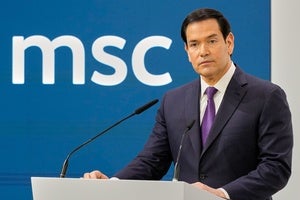
US Secretary of State Marco Rubio reaffirmed America's commitment to Europe.
How is this moment actually reshaping international security? As the West works through its differences, who's stepping in to fill the gaps?
To help us make sense of this, I am joined by Dr. Jana Puglierin, senior policy fellow at the European Council on Foreign Relations and head of its Berlin office, and Giles Whittell, deputy editor-in-chief at The Observer.
I'm Leslie Vinjamuri, president and CEO of the Chicago Council on Global Affairs, and welcome to Deep Dish.
It's been an extraordinary several weeks; frankly, it's been an extraordinary year for transatlantic relations and international order. Jana, let me start with you, since you're in Germany. Maybe we could start by getting your overall impressions of the conference. Did you come out of it with a very different sense of Europe's position with respect to the United States of the transatlantic relationship, or did you go in expecting one thing and come out with those expectations unchanged?
Dr. Jana Puglierin: The state of the transatlantic relationship was the theme during the Munich Security Conference. Everything else was secondary, including Ukraine, Russia, and China. It was really about how we feel about each other and what unites us or what drives us apart.
As you know, because you've been there as well, there were several reactions to the Rubio speech, ranging from, "Oh, this was really reassuring, and basically this is the end of the bullying," to, "Well, this was pretty much the same speech, just this time wrapped into a nice kind of offer."
For me, I think the speeches are completely alike. I notice the different tone. I notice the effort to reach out to Europeans to reassure them the US is not going anywhere, and that there is a continued interest in the transatlantic relationship. But I'm still digesting the 15 times the Secretary of State mentioned Western civilization. To me, this was the essence of the speech.
There was this offer to Europe: we can do great things together, but only if we agree on the principles. The principles are basically make Western civilization great again, and I'm not sure I think that is such an attractive offer to Europe.
LV: For those who were in the room, we saw there was a standing ovation. I'm curious what you make of that standing ovation that was given to Secretary Rubio right after his speech?
JP: After a lot of criticism, now German politicians who stood up after the speech and applauded are saying that it was an act of politeness. But I think that is not entirely true. Of course, it was to show respect to a very prestigious guest. Having the Secretary of State in Munich was something that the chair of the Munich Security Conference was very proud of. When he moderated a discussion with Rubio, he basically said there was a huge sigh of relief in the halls. That's because Europe is still trying to digest. There was a lot of anxiety in the room before the speech.
People were thinking about what he would say. What is the next thing that is coming to hurt us? At first sight, nothing that damaging happened to the transatlantic relationship. Many in that moment did not realize what Secretary Rubio actually just said. But in the overflow room where I was, the people were much less thrilled. I had a great colleague of ours, another think tanker working on Russia, who turned around and told me that he was very much reminded of Vladimir Putin.
So, make the past great again. That was the atmosphere in the room I was in. But when it comes to this speech, I think it's the most discussed item at the Munich Security Conference.
LV: I just spent 20 years in the UK, and I can tell you that you almost never get a standing ovation in the United Kingdom. For years, I would be the only person standing at the end of a West End performance, hoping that somebody would join me. It's just not done except for in very exceptional cases, and I assume Germany is not far off that mark.
I was also in the overflow room and would confirm the disconnect that you felt. Giles, you've been editing for one of the world's leading papers. What was your main takeaway from the Munich Security Conference?
Giles Whittell: Well, first I'd just like to come back on the, the ovation. I wasn't there, but we had a reporter in the room. I'm not at all surprised by the standing ovation. The tone was so markedly different. The syntax was conventional. It was at least a recognizable political speech, whereas Trump's 70 minutes in Davos, which I was in the room for, was, to put it politely, unhinged. The sole point of sanity there was his rollback on Greenland. But for about 1200 people in that room, this was a rare exposure to what he calls the weave. Referring to the teleprompter perhaps once every five minutes, and then going off on an unconnected and frankly embarrassing, and then eventually boring set of tangents.
So just because you had a senior politician looking and sounding conventional, I'm not surprised by the fact that he had a standing ovation. However, as an editor handling copy on Saturday afternoon, I have two points. One is, our correspondent completely agreed with Jana and many others that this was a different tone but a very similar message.
I scribbled down not unhinged, but unapologetic. That line, which in Germany must have really cut through, "don't be shackled by shame." I paraphrase slightly. This is a dog whistle to the AFD if ever there was one. And then, a prominent message to Europe, exactly similar to last year, to step up.
Which leads to my second point: after taking a step back and looking at the conference and the moment as a whole, I reached the conclusion that Europe is acutely aware of the need to step up, but it hasn't gotten there yet.
I thought, finally, one thing that was really striking was the big idea on European defense didn't come from Europe, it came from Elbridge Colby. He said we are still here for you, for the nuclear umbrella, for intelligence, reconnaissance, surveillance, all those things that the US is so good at. But step up within NATO. Let's call it NATO 3.0.
The framework for European security going forward came from the US, but I don't see the big, strategic thinking, bringing all strands of thought together that Europe needed.
LV: Jana, I wanna come to you on this. The AFD was there because of Vance's speech. The Americans are pushing the envelope on what Europe needs to do. I sat in on many conversations that I thought were brilliantly self-reflective on the part of Europeans, concrete in terms of proposals for reform, opening up the market more, that certainly didn't exist on the US side. What was your take on Europe within this?
JP: The AFD has been present at the Munich Security Conference before the former chair of the conference, Christoph Heusgen, decided not to invite them any longer. Not the AFD and also not another party called the BSW, which is more of a left-wing fringe party that's also very populist. So they are basically going back to where they've been before, but it was a heated discussion with a lot of different opinions in Germany and that political bubble.
LV: Can I ask you how many years they were crowded out?
JP: I think from 2022 to 2025. What I think is interesting, and I wanted to make this point, is that Rubio had to say on substance was dividing not only the Europeans, but also the Americans.
That is generally something that we need to take note of. This whole question of who we are, what the West is? What kind of civilizational values do we have, and how do we want to go forward? It divides audiences in Europe and the United States alike.
We are arguing with each other about our values, about what the United States stands for. That was very visible because there were also many Democrats there at the Munich Security Conference and not that many supporters of Rubio's approach, with the exception of the AFD and some Hungarian and Slovakian participants.
Keir Starmer spoke on a panel with Ursula von der Leyen, which I thought was a nice set because it was all about how the UK and the EU are moving closer together again. In December, we failed to bring the UK closer to the EU defense initiatives, and so there is no possibility for the UK to join SAFE, or there was no agreement on this.
What stayed with me was this disconnect between the big strategic speeches at the level of heads of state and government, and the events on the ground or the problems with a too-technocratic approach. Europeans have learned the lesson that they understand that the transatlantic relationship has changed and will most likely never go back to what it once was.
LV: On the way to Munich, I spent three days in meetings in London and talk about a dramatic time in UK politics. Starmer seems to have come through for now. There he is at Munich, sitting alongside von der Leyen.
How did you read this? Where does the UK fit in all of this right now, both with respect to Europe and the United States? How would you capture the current moment?
GW: If I knew the answer to your question, I'd have a very senior job in government or maybe in NATO. The whole point about the UK and its place in the world is we're still trying to figure that out 10 years after we voted to leave the EU.
I was listening back to one of your previous conversations, and to the idea that the special relationship has always been a third rail of UK politics. I was thinking, well, that's definitely the case. During the conservative administrations that have taken up over the past hundred years, for about three-quarters of the time, when Tony Blair was not in charge. There is a strong strain of skepticism on the left about that special relationship. And of course, within Keir Starmer's party, a lot of people voted to stay in the EU, including Starmer himself.
The two big questions in UK politics at the moment are whether Keir Starmer survives in office, because he's had a very inauspicious first year and a half. And whether whoever remains prime minister until 2029 actually achieves a closer relationship with Europe, which will probably involve biting the bullet on free movement to get closer to the single market.
I'm really struck by the way a year ago, defense was seen by Starmer and his team as a means to an end. Defense and security, that whole conversation is a means to an end, the end being that close relationship with the EU. Now, as the US pulls back from the security relationship, the war grinds on in Ukraine, and the Russian geostrategic threat remains. I don't think everything you hear about the possibility of further brinkmanship elsewhere up the eastern front in the Baltics, you've got to take that seriously.
Now, from the UK and the European perspective, that security relationship between the EU and the UK is not just a means to an end. It is a strategic challenge that has to be met, and hasn't so far. It was thought at the beginning of last year that the SAFE project would be a no-brainer, but we fell at the first hurdle. Maybe that was because of Macron's insistence that French military contractors have the first bite of the cherry. But, it just shows how very complex these avenues are now that we're out of the EU.
LV: I've just seen that Canada is joining SAFE, correct?
JP: Yes, Canada is only the third country. Ukraine has special access to the EU's new defense programs, but Canada is the only other country.
LV: There's supposed to be this idea of Europe returning to looking outward. The EU-India deal has just been agreed. Zelensky speaks, it runs over, unusual for Munich, and then everybody exits the main room just as the German foreign minister and the Indian Foreign Minister, Dr. Jaishankar, take the stage. So, days after the EU-India deal is signed, this is supposed to be a major partnership to help advance the broader ambition of diversifying partnerships in the face of a disruptive United States. But the room's kind of empty.
Jana, you started by saying the whole conference was really about us, meaning Europe and the transatlantic relationship. Could you say more about that?
JP: If I compare it with previous security conferences, I vividly recall the one in 2020, where it was basically all about China and the Indo-Pacific. China was the big challenge back then. There was this hope that one could work together, basically, to work on a joint US-EU-China strategy.
So it was really not front and center. As you said, there were all the side events, or the presence on the big stages. I bumped into a colleague yesterday who told me that she attended a side event on Japan with six people in the room.
It's very much going back to the roots of the Munich Security Conference. It started with a focus only on Europe and the US and the transatlantic relationship. Then in recent years, the focus has broadened a lot. But this year, every topic that was not us had a very tough time.
Ukraine was mentioned in all of the speeches. Secretary Rubio mentioned it in passing. But even here, the attention was not what it used to be in the past three years.
I listened to the Rubio speech, and I stayed seated for Wang Yi, the Chinese foreign minister. Rubio was all about how the United Nations has not produced any tangible action plan to solve one of the biggest problems in the world. We concentrate on us and the Western civilization and go back to our glorious past. Then Wang Yi entered the scene, basically starting with "Make the United Nations great again."
He talked a lot about global governance, using the very term "global governance," and if I had not known that China was supporting Russia's war of aggression—and was basically coercing all sorts of countries with economic pressure—I would have thought this is the nicest country in the world. The contrast was so stark.
LV: Giles, I want to hear from you on this. We've watched in recent weeks, leader after leader, including Keir Starmer, travel to China. Mark Carney went to China. Others are going to China. How did you capture this moment? Where in the world is Europe on China? And what has the Davos to Munich moment told us about that?
GW: Every European member state and the UK are, to a greater or lesser extent, still economically dependent on China. There's no growth. The economic arguments behind those trips that Starmer and others have been making are the most obvious ones. You can't unravel that sort of economic mutual dependency created over the course of three decades so quickly, nor does the UK government want to do that.
I am really preoccupied with a question for both of you guys, because you were there, which is to what extent Trump's actions in Venezuela and Greenland were seen in Munich as an invitation to China to do what it wants in Taiwan. That seems to me to be the geopolitical challenge heading towards us all.
If it goes badly wrong, it will make Ukraine seem like a tea party. Did China manage to put everyone's minds at rest on that, or was it just not discussed?
LV: I hate to say it, but the most attention that Taiwan seems to have gotten at the Munich Security Conference is a critique of AOC for not being able to answer the question of where America stands on Taiwan, whether it would put boots on the ground. That's captured a lot of headlines.
I've always personally been skeptical that the Chinese read their capabilities and abilities and their opportunity, with respect to Taiwan, based on what the US is doing in Ukraine or elsewhere. They consider it a separate strategic situation, as do the Americans. Jana, how would you answer that question?
JP: Discussions in Germany, the idea that there could be some coordinated actions between Putin and Xi and Ukraine and Taiwan is one that you hear quite often, recently. From a European perspective, what we fear most is that there is an incident in the Indo-Pacific and the US' attention is torn towards the Indo-Pacific. Everybody is engaged there, and this basically creates a window of opportunity for Vladimir Putin because we know that he's always looking for opportunities to exploit.
Although I think it is unlikely that she makes his decision dependent on Putin or vice versa. There could be some fallout after one of the two has made a decision, which could raise the stakes, and that is what we worry about.
You've seen that at the Munich Security Conference, Europe cannot defend itself for the foreseeable future without the United States. That is also something that led to this standing ovation and the many speeches where Europeans try to explain that they still believe in the transatlantic relationship, that they understood the need to step up, but that they don't want to fill in a divorce right now. That is because we are so aware of how crucial it is to have a true American presence in Europe, and to have access to the crucial capabilities like strategic enablers. Because without many of the American capabilities, we would be completely unable to defend Europe.
LV: As we come to a close, I want to ask one final question of each of you. It's about the United States. I was struck at the Munich Security Conference and in general, that within Europe there seems to be one narrative, which is that the US has changed. We kind of need to keep it in for the reasons that Jana has just described, and what do we do.
At Munich, we saw AOC there, as was Governor Newsom and Gretchen Whitmer. A lot of people were there.
Is there a more rigorous, nuanced conversation in the UK or in Europe beyond the headline of "America's not been coming back"? This could turn out in many different directions. There seems to be deep reflection in Europe on Europe, but not on the United States. Giles, let me start with you on this.
GW: I would contest that we're completely obsessed with the US and we talk about it all the time. Some of it is knee-jerk. Some of it is quite nuanced. Bill Clinton said in 1992, "I still believe in a place called hope." Well, in 2026, I still believe in a place called America.
You mentioned Newsom. I spoke with him briefly in Davos. He is guns blazing, using Trump tactics against Trump. He wants to be a contender in 2028. The midterms could go down to the wire, but the entire political situation could be overturned there.
It's a cliche, but it's true that trust lost is hard to regain. There are a lot of people in Europe who recognize how the system works in the states. We could very well have four to eight years of democratic government, or at least sane governance, after this.
But just as when Europe looks at Brexit, Britain, in principle, might welcome the idea of rejoining. But then what happens if you have a reform UK-style government wanting to unscramble the whole thing all over again? So the question is, with the transatlantic relationship, Europe looking across at the US, fully aware that the whole MAGA fever dream may pass, but it could come back again.
LV: Fascinating. And Jana, your thinking on this?
JP: I think Germany's obsessed as well. But sometimes the perception is not as nuanced as it should be. It's very much dominated by the Trump administration and what Trump does, and by the notion that there is a different America or that America is a very polarized, divided country. President Trump has not won the US election by a landslide, although he always claims otherwise.
Still, the perception of the United States has been deteriorating. We did a big poll just recently in November, and here you could really see that, for the majority in many European countries, the US is no longer a trusted ally, but more a necessary partner you need to work with.
The trust is not lost forever. There is also a broader sentiment here that there can be a more European-friendly government in the US. But it will not return to what it once was when it comes to burden sharing. This is now really about burden shifting, and I don't see an incoming, democratic president deploying a lot of troops to Europe once they are withdrawn.
This understanding that the US doesn't want to feel as responsible as it used to for Europe, for European affairs, is something that is bipartisan in a way. It's good for Europe not to think that the Trump years are always an aberration. Afterwards, we have a US president basically telling us the US is back and we can go back to our chairs. But to have a notion that the task for Europe to step up and to take its own destiny into its hands is here to stay. I think that is a healthy development.
LV: That was certainly one of the overarching themes, if not the theme of the Munich Security Conference. This has been a fascinating conversation. Giles Whittell, Jana Puglierin, I really sincerely appreciate your thoughts.
JP: Thank you very much.
GW: Thank you.
Leslie Vinjamuri: Thank you for listening to this episode of Deep Dish on Global Affairs. I'm your host, Leslie Vinjamuri. Talk to you next week.
Deep Dish is a production of the Chicago Council on Global Affairs. If you enjoyed today's episode, make sure to follow Deep Dish on Global Affairs wherever you get your podcasts. And if someone you know might find it interesting, send it their way.
As a reminder, the opinions you heard belonged to the people who expressed them, and not to the Chicago Council on Global Affairs. This episode is produced by Tria Raimundo and Jessica Brzeski, with support from Marty O'Connell and Lizzie Sokolich. Thank you for listening.



Related Content
 Geopolitics
The public supports deploying US troops to defend allies, particularly in Europe, but most oppose using them for territorial expansion.
 US Foreign Policy
The new strategy "suggests a very geographically grounded way of thinking about defense," former US Deputy Secretary of Defense Kathleen Hicks told the Council. She explains what it could mean for China, the war in Ukraine, and US alliances—and what comes next.
 Geopolitics
Ahead of Munich, Georgina Wright and Sophia Besch explain how Europe is rearming and diversifying its alliances.