The Trump Administration's New National Defense Strategy Expands the US 'Homeland'

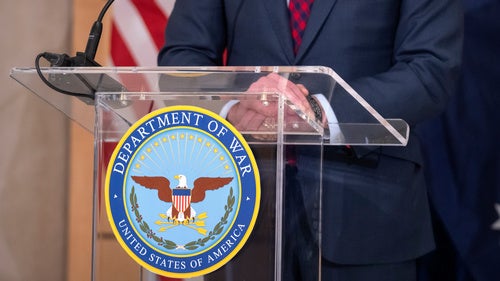
The new strategy "suggests a very geographically grounded way of thinking about defense," former US Deputy Secretary of Defense Kathleen Hicks told the Council. She explains what it could mean for China, the war in Ukraine, and US alliances—and what comes next.
As previewed by the recent US intervention in Venezuela and effort to control Greenland, the Trump administration’s 2026 National Defense Strategy calls for a US command of the Western Hemisphere “homeland.” While China remains a US defense priority, there is a marked shift in posture toward Europe and the Indo-Pacific and a new emphasis on the Arctic, the so-called ‘Gulf of America,’ and the Panama Canal. What does this signal about the future projection of US force abroad?
Council Distinguished Nonresident Fellow and former US Deputy Secretary of Defense Kathleen Hicks spoke with the Council’s Christina Colón about the new defense strategy’s geographic focus, its rhetoric toward longstanding allies, and the state of US President Donald Trump’s ‘Golden Dome.’
This interview has been lightly edited for length and clarity.
The Trump administration recently released the 2026 National Defense Strategy. What does it tell us about Washington’s priorities and how the administration sees the world?
The National Defense Strategy picks up the National Security Strategy’s emphasis on the United States’ so-called 'homeland,' but it really expands the use of 'homeland' to include the entire Western Hemisphere.
There are some other priorities in the document beyond that. Some are expected, and reinforce things that we've seen and heard from the president: certainly the treatment of allies and partners—the language is generally fairly negative about allies and partners—the very strong support for the industrialization of the United States, and the defense industrial base as a part of that, which has broad bipartisan support. That is a theme.
Finally, there is a continuation of the emphasis on China as the most concerning—in this case described as balance-of-power—actor for the United States and a desire to make sure that there is military capability to deny Chinese efforts to undermine US interests in the Indo-Pacific. But the language around China has changed, and I think we're going to have to wait to understand exactly how the Trump administration decides to pursue its China policy.
What is the purpose of the National Defense Strategy?
The National Defense Strategy is mandated by Congress, in statute, and it is to come out at least every four years. It is designed to provide Congress with an understanding of the priorities for the Defense Department and how those priorities translate into everything from the size of the force to where the force is positioned around the world to the kinds of capabilities that will be prioritized and other factors of that sort.
This strategy is light on the details for that second piece of how to connect the ends and the ways, so to speak, to the means. What are the resources required? What are the priorities for the force itself? The Defense Department has an annual budget release typically in February. I would suspect it will actually be a little later than that. A lot of us who follow defense, we're going to be interested to see those details.
China remains a central concern, but the strategy appears to reframe, and in some ways downgrade, its priority. What is driving that shift? And what does it signal for US strategy in the Indo-Pacific?
In the listing of the document, concerns are described as lines of effort. The second line of effort is China. That in and of itself is not really a downgrade. It is very common for national defense strategies to speak about homeland defense as the number one priority. The issue is the way the homeland defense is described as very expansive—including all of the Western Hemisphere. That I think is why China coming second seems to be a downgrade.
The language around maintaining military capability to deny Chinese military efforts is a good signal, I think, for those of us who worry a lot about China’s growing military strength. The language, however, has shifted from the first Trump administration and the Biden administration’s. The emphasis here is on strategic stability, which could be a good thing. It's a little hard to tell where that language is going to be headed. I think that's an area to watch. Public reporting suggests the language reflects Treasury Department edits on the Defense Department's language and it is trading off, not surprisingly, economic interests to work with China versus more military specific concerns.
The strategy repeatedly emphasizes securing specific geographic areas—Greenland, the 'Gulf of America,' and the Panama Canal. Why are these locations so prominent? And how does the approach differ from past defense strategies?
Those are 'strategic access points'—that's the language this defense strategy uses. I think that's accurate language; they're just not ones that I think most analysts would think are significantly challenged. There are some challenges in each region. The opening of the Arctic due to climate change certainly introduces new players—Russia and China, notably—into the Arctic region.
Chinese interests in the Panama Canal are something we've long watched, but not as much as a Defense Department priority. We, of course, want to make sure we can protect free access through the Panama Canal, but again, not a big driver of defense needs for the United States.
This Western Hemisphere frame of strategic access points suggests a very geographically grounded way of thinking about defense that does not quite match the types of risks and challenges that we face in a world where the defense capabilities of greatest concern can cross geography quite easily. And that is why we have not—for over a hundred years really—focused ourselves in this way on the geography.
This Western Hemisphere frame of strategic access points suggests a very geographically grounded way of thinking about defense that does not quite match the types of risks and challenges that we face in a world where the defense capabilities of greatest concern can cross geography quite easily.
February 24 marks four years since Russia launched its full-scale invasion of Ukraine. The defense strategy frames the war as "Europe’s responsibility, first and foremost." Can Europe realistically respond to this challenge? What will it take?
Let me first say that I think Europe would say it also believes that Ukraine is first and foremost a European challenge. And in fact, Europeans at this point have put more forward in terms of expenditure on Ukraine support—military, but also economic and other—than the United States alone. The United States is the single biggest country contributor, but if you take Europe as a whole, it's given more.
But the United States also has a strong interest in what happens in Ukraine. I mean, you can think about it in the most transactional sense: making sure that the European market is accessible to the United States, that we have strong trading partners, that these are trading partners who share our general interests and values—that leads to a kind of trade, an open trading, that is advantageous to us.
Of course, we in the United States—we have traditionally— believe very much in international law, which we believe protects sovereignty of nations, and that the invasion of Ukraine is a violation—obviously—that the Russians have undertaken. There's a lot up in the air I think right now, given President Trump's statements around Greenland, although he has backed off a bit.
This National Defense Strategy comes at a time when many questions are left open, including this idea of Europe as the primary interested party on Ukraine. You can interpret that benignly, or you could get quite worried about what the implication is with regard to the US withdrawing. And that gets to your question about Europe's ability to sustain Ukraine on its own.
I think that would be extraordinarily challenging in the near term on all counts. I think the United States is an interested party. There are countries throughout the world that aren't in Europe—for instance in Asia—that have also been engaged in strengthening Ukraine. I think all of that is to the benefit of the United States. And I'm hopeful that the National Defense Strategy provides a path for the United States to continue to substantially support while acknowledging that Europe, being proximate to Ukraine, bears a lot of interest and responsibility.
One noticeable shift from the first Trump administration is how allies are framed, from being described as “crucial to our strategy” to “dependents.” Historically, what role have alliances played in the US defense strategy? And what potential changes could follow from this new framing?
This is, again, a continuation of rhetoric that we've heard from the president, including during the first term. The fact that the language of the National Defense Strategy coming out of the then-Secretary James Mattis’ Defense Department came out so positively, I think, speaks to the strategic pushback around language like what we are now seeing. So, it's worrisome.
The United States has this major asymmetric advantage versus a China or a Russia or Iran, and that is that it can bring to bear a group of like-minded nations who have large market share and who have substantial military prowess among them. We know, for instance, that China views that power as more concerning than any particular military platform that the United States possesses or could possess. To take a transactional view in the immediate around allies really could harm that long-term focus on the strategic advantages that the United States has.
The United States has this major asymmetric advantage versus a China or a Russia or Iran, and that is that it can bring to bear a group of like-minded nations who have large market share and who have substantial military prowess among them.
I think there are real concerns now: the rhetoric around Greenland, the capture of Maduro, and more generally this language around the dependency of Europe. Europe takes it particularly on the chin in this document, but there’s also language around South Korea and Japan, and concerns that they need to step up more and have to take on some primary responsibility. Those are all suggestive that we may not be at the end of a period of just weathering rhetoric but in fact there may be some shifts in force posture and in investment as we refocus potentially around the Caribbean and Western Hemisphere—which is a much easier problem set from a military perspective—and kind of push over to allies much more of the responsibility in these other areas of the world.
Much is to be determined and that is why looking at these budget documents—I don't actually expect that they're going to shed a lot of light—but they are important to try to understand if we're going to see a little more clarity on where this is all headed.
The strategy outlines some expansive goals. Do the resources, force structure, and defense industrial base actually match these ambitions? Where are the biggest gaps?
The real answer is we don't know because it's not clear how these broad lines of effort fully translate into force posture (where are we putting the forces), force capabilities, what a Western Hemisphere focus could actually mean. I think this is all to be laid out.
The focus on industrialization and the defense industrial base is a very broad concern for the defense community. And that's a place where continued focus is necessary, but I don't think in the very near term we will be able to substantially shift the capabilities that we have today through that focus—and the same is true for our allies. So, when we look to shift burden, these allies face the same challenges with their industrial basis. These are multi-decade-long priorities that are important to invest in.
There are things we can do. When I was in the Defense Department, we had a major project called ‘Replicator’ that was really focused on what could we do in the next 24 months. They are continuing in the Defense Department to focus on areas like that. Those changes will be helpful, but you probably won't see a lot of that in the budget documents, and they're not actually the most expensive things by any margin that you could imagine. So, I don't think that the challenge there is really the spending.
Trump’s ‘Golden Dome’ is one of the costly projects highlighted in the defense strategy, which Trump has said will be built in three years. What is going on there?
The Golden Dome is highlighted as part of this ‘defending the homeland and Western Hemisphere’ priority. There's no doubt we need significant improvements from an air defense perspective. This could be better protection from everything from drones to cruise and ballistic missiles. So, the intent in general to have better air defense is a good idea.
There has not been—in the first eight to nine months since the Golden Dome was announced—enough progress to be confident in any way that the additional expenditures that have been given or that might be sought for defense will really return a comprehensive shield or dome across the United States. I do think we are at some risk of excess spending there.
I think Congress will be very interested in that issue set of Golden Dome spending when they see the budget documents. I would expect that the Golden Dome will be very much in the news as defense officials go up to defend what they seek for defense spending.
The Chicago Council on Global Affairs is an independent, nonpartisan organization and does not take institutional positions. The views and opinions expressed in this commentary are solely those of the author.

Related Content
 Geopolitics