Is the West Ready for an Asian Century?
 Play Podcast
About the Episode
As China and India rise, power in the Indo-Pacific is shifting fast, and the world is feeling it. Former Singaporean diplomat Kishore Mahbubani puts it bluntly: “the era of Western domination of world history is over.” Along with Avinash Paliwal of SOAS, they unpack how the region views this shift, whether President Trump’s second term has sped it up, and what it means for America’s place in the world.
This transcript has been edited for clarity.
Leslie Vinjamuri: The United States is no longer the undisputed power in the Indo-Pacific, but is it an Asian century? Shifts in trade, security, and the balance of power are changing the region and the international order.
This raises big questions: Who's rising? Who's falling? What does it mean for the US's role in the world?
To help us make sense of it, I'm joined by Kishore Mahbubani, a former Singaporean diplomat who can explain how China and India are quietly reshaping global power. And Avinash Paliwal from SOAS University of London, who can unpack why some countries are cozying up to each other and what it could mean to the US's influence.
I'm Leslie Vinjamuri, president and CEO of the Chicago Council on Global Affairs, and welcome to Deep Dish.
We're going to talk about Asia, obviously, but I think that in this moment, one of the things that our listeners are just fabulously interested in is how the rest of the world is seeing this moment in geopolitics.
Let's face it, we're all also very interested in how others across the world are responding to the second Trump administration. But before we get into the Trump questions, maybe we could start with you Kishore. You wrote a book, Living the Asian Century. So is it the Asian century? How do you see Asia, and how do you see it from the perspective of where you currently sit, which is in Singapore?
Kishore Mahbubani: Well, I think there's absolutely no question that the 21st century will be the Asian century, and let me just give you two statistics—one about China and one about India—to indicate how fundamentally the world is changing.
The 21st century began in the year 2000. The combined GNP of the European Union countries was eight times bigger in China in 2000. Today, they're about the same size. By 2050, the European Union will be half the size of China. If you look at India, I compared it with the United Kingdom because a hundred years ago, a hundred thousand Englishmen could effortlessly rule over 300 million Indians. But as recently as 2000, the UK's economy was still 3.5 times larger than India's. Today, India's economy is larger, and by 2050, it will be four times the size of the UK's.
We are returning to the normal world in which, for the first 1800 of the last 2000 years, the two largest economies were always China and India. We're coming back to the normal world, but Western minds cannot grasp the fact that the era of Western domination of world history is over.
LV: Let me come to you, Avinash, and bring you into the conversation. You've heard how Kishore set out an obvious case for the Asian century. How do you see this?
Avinash Paliwal: I do agree with Kishore. What I would add to Kishore's point is that this is happening, especially since the arrival of Trump 2.0 in Washington, DC, in parallel with the Western decline, and amid a huge dislocation in politics. We have seen how polarized the political and social situations in Europe have been. We have seen the kind of polarization that is playing out on the streets of Minneapolis. These are very, very significant tectonic political shifts happening in the West. Exactly when Asian countries, especially China and India, are becoming increasingly powerful, both in an economic sense and a military sense.
The final point I would add is that the economic growth story can mask certain elements of the distribution of per capita GDP incomes. In India, the country is both very poor and very rich, and inequality is quite high. But if you look at the capability set in terms of its technological development, the fact that the Indian government is quite determined now to become part of one of the semiconductor ecosystem choke points, and the fact that India found itself in recent crises with the Americans. Instead of getting bogged down, it used that crisis to completely usher in structural reforms. The trajectory these countries are already headed is reshaping the world order in real time.
LV: We've talked about Asia as if it were a coherent, cohesive region with two very large powers, China and India. But can we really talk about Asia as a coherent region? India and China don't exactly have the best relationship. From an outside perspective, it always feels like ASEAN member countries would prefer not to have to choose to align closely with China.
The region has forever been one that's hard to put coherence around. We talk about the West internally in decline, dividing across countries. That's from a very high baseline, which I'm not sure we've ever seen in Asia. Does that diminish its potential global influence?
KM: You are absolutely right. Asians make up 55% of the world's population across over 55 to 60 countries. So it's a very rich and diverse place. But the Asian century, it doesn't necessarily mean that all Asian countries have to get along. It does mean that the weight of economic power shifts to Asia.
And by the way, ASEAN is one-fifth the size of the European Union. During the 2010 to 2020 decade, ASEAN contributed more to global economic growth than the entire European Union. To add another statistic, at the end of World War II, the United States' share of global manufacturing was around 50%, when the century began; China's share was only 5% in 2000. Today, China has 30% of the global manufacturing capacity, and by 2030, it could hit 45%. Now, these structural shifts mean that real power, coming from the size of your economy, is going to shift to Asia.
While these trends continue, and I believe they will continue in one way or another, what happens in Asia will decide the course of world history. Of course, you have to make sure that some terrible things don't happen. If there's an all-out war between India and China, then of course, the Asian century will be hit very badly. But I don't see that happening.
There has been no major war in Asia since the Sino-Vietnamese War. That's 47 years already, almost five decades now, when wars haven't happened. It shows that there is a certain culture of pragmatism in the region that carries things along. People understand that what will derail them is war. I also want to emphasize that even though the West is reluctant to accept the Asian century...When I came out with my ninth book, the title was actually the "Asian 21st Centuries," an open-access book. I asked the publisher, what is our target? How many downloads should we try to get? He said, if you get 20,000 downloads, it's good. But instead of 20,000 downloads, there have been over 4.2 million downloads in 160 countries.
It's a small indication that the world is preparing for the Asian century. This is where the Western mind is so far behind the curve. He doesn't understand that the world is changing fundamentally.
LV: I want to challenge both of you, and I'll start with you, Avinash. The Asian century, it's India, it's China, and then it's sort of the rest. To be honest, it looks like it's basically China. Is it appropriate, and is it meaningful to talk about the Asian century rather than talking about the Chinese century? And where does India sit in all of this?
AP: There is absolutely no doubt that on every metric, whether it's the creation of a middle class, economic rise, GDP growth rate, macro/micro-economic indicators, population control, pollution, climate, or green energy, China is way ahead of India on almost every marker. If you start comparing, there is no doubt about that. It has a lot of military muscle, even when you compare it to India, which is the second-largest standing armed force in the world right now.
Coming from an Indian perspective, what I find interesting is the fact that in, let's say Washington DC, London, Brussels, Berlin, as well as in Beijing, there is a tendency to overlook the fact that here is a country which was just a few billion dollars worth of GDP in 1991, is now standing at over four trillion in 2026. It is growing at anywhere between six to 7% annually, and is the largest welfare state. It's a functioning democracy with, of course, many warts; It's not a liberal democracy. But India's story on its own right is so monumental, even if overshadowed by the China story.
India has the potential in the next 25 to 30 years to actually make the world tri-polar. It will be the third pole, and not just in terms of its capacities and its growth figures and its economic size, but in terms of its diplomacy, rule-shaping power, and how it shapes global institutions.
This is a country that wants to have an insider status in a world order that it has shaped itself. The current one, typified by the UN and other Western powers, is not something that India feels will give it the due respect and status that it truly deserves.
LV: Let's move on to the US and the US-Asia relationship. Let me first go right to the heart of the US under Trump's second administration. Kishore, you've talked about the Asian century. These are long-term structural trends that are independent of the United States, but here we have the return of President Trump, a very different administration than the first one was, with some similar themes. How is it being read in Singapore? How is it being read across Asia? How is it changing, if at all, these fundamental structural dynamics that you've pointed us to?
KM: To quote Mark Carney, from his Davos speech, "There has been a rupture." Clearly. The Trump administration has walked away from many of the rules and practices of an international order that was forged and that the world benefited from for over 80 years. But he's walking away from it.
Mark Carney only got the story half right, because the big story of 2025 is that there was a rupture, and then there was another R word. There was resilience. If there had been a real rupture, the global economy would have collapsed. Global trade would have gone down. Countries would have stopped growing economically. But what you saw instead was a very intelligent global system that did a lot of rewiring on its own. And amazingly, at the end of the year, the global economy had grown, global trade had grown, and countries were growing very fast.
Singapore is by far the most trade-dependent country in the world. Our total trade is three times our GNP. Now, that's unimaginable. If something has gone wrong in the international order, Singapore will be the first to be affected because we are the most globalized country in the world. We were praying for 1% or 2% growth.
When the year ended, we discovered that we had 4.8% growth in an economy whose per capita income is 92,000 US dollars, among the highest in the world, by the way. Malaysia grew by 6%. Taiwan grew by 8%. The Vietnamese grew probably by 8%. The world hasn't collapsed. So when people say everything is over, that's not true; there's actually been massive resilience. Even if you look at Donald Trump's various disruptive actions, all of a sudden, trade agreements that couldn't be completed were completed in a few months. EU-Mercosur was completed, EU-India was completed, and Indonesia-EU was completed. The rest of the world is saying, okay, if the United States wants to walk away from the global system, no other country is joining it. I'm actually surprisingly more optimistic about the future than many of the Western commentators are.
LV: Do you credit Donald Trump for this?
KM: I would say certainly the EU-India deal would never have happened if not for President Donald Trump.
LV: Avinash, how do you respond to this? How do you see the second Trump administration having affected the direction of travel? Has it accelerated growth and resilience? Maybe you could speak to India. You mentioned these six months of reforms that would perhaps not have been undertaken apart from the challenge that President Trump presented to India.
AP: Let me start with the significance or the element of shock that New Delhi felt with Trump 2.0. This was a country that welcomed Donald Trump's arrival. So the fact that after coming to power, he would impose 50% tariffs, 25% of which are punitive tariffs for purchasing and importing Russian crude, and will start to almost take a side in the India-Pakistan conflict (which flared up in April, May, 2025), and will try to play peacemaker in a dispute in which at least the Indians are unwilling and unaccustomed to having Americans do mediation, was a shock.
In terms of how India has dealt with it, I think there is confidence. It had options. It had the option of expediting its trade agreement with the United Kingdom, New Zealand, and the European Union.
It's ironic, as Kishore mentioned, that we must thank Trump for ultimately allowing the European Union and India to sign the agreement. The fact is, once the India-EU trade agreement was signed, that is exactly what triggered Trump to take India seriously and sign the trade deal, which was just announced a couple of days back, and reduce the tariffs from 50% to 18%.
So this is very clearly a sign of Indian resilience and exercising that confidence. But it was also a moment of humility that this is a country that is at such a fragile growth path that it cannot sustain 50% tariffs from one of the largest economies in the world for a prolonged period of time.
It did start to bite India's already limited manufacturing sector: people producing cars, people in the textile industry in South India. These people were going jobless; there was pain associated with these tariffs. A consensus has emerged in India that it's better to recognize that you are not the big point you thought you were. You are a significant middle point. You are rising, and you need to take your limitations more seriously than you did before.
This shock became that moment of learning, and that is what would trigger the reform. We cannot have a divided society along religious lines. We can't have that kind of polarization. We really need to focus on our growth story.
My last point would be the issue of trust. India and the US have signed the trade deal, but it's a deal, not a lasting agreement. This is how the Indians treat it. You never know when the big man in Washington, DC, will come and say, fine, 18% is not good enough. I'm increasing it for whatever reason. Rebuilding trust between the US and India is still going to take a lot more, given how much damage Trump has done in the past year.
LV: Kishore, we've had references to polarization and trust; we mentioned Minneapolis. We've been talking about Trump's disruption. How do people in your region see the United States in this current moment?
KM: There's no question that the standing of the United States has been damaged in many countries. Take India as an example. Avinash was saying it's going to take a long time for the trust to be reestablished between the United States and India. That's true. And certainly many other countries too.
Look at the European Union. A brutal experience with Ukraine and an equally traumatic experience with Greenland. But the world order is not crumbling. In fact, countries around the world, I predict, will continue with this world order. I would also say that most countries take a mature, long-term view of the United States. They believe that the United States will continue to play a major role on the world stage, and I agree with the old saying: never bet against the United States.
LV: Avinash, is it going to look the same? Is it going to be more culturally diverse in terms of the values? Especially if China's at the top of that Asian century. How do you see this future order?
AP: Value systems are really, really fluid systems. I do believe that India values democracy. It values participation. It values inclusivity. This does not mean that polarization does not exist. This does not mean that injustice or inequality does not exist in India. I really don't need to spell that out to anyone. There are a lot of concerns around India's political health, but still, the country has actually found its feet. It has found its balance.
This is likely to be the case in an Asian century where India is an important power, or the second largest power in Asia in that century after China, perhaps. These are countries that I doubt will be trying to impose their radiological value systems abroad. Even China. I'm open to being corrected, but it underwent an export revolution during the Maoist era, and I think it came out wiser, even if heavily bruised during the Cultural Revolution. These kind of domestic social churns must not be exported elsewhere because you will have blowbacks. This is the one learning that the Asians have had during the 20th-century European experience: you need to keep your ideas and values to yourself.
Interests, security, and strategic interests that you have in an economic or other sense, of course, need to be protected and projected. Having said all that, I do think this is an ongoing conversation, so I do not want to sound too confident to put one Indian value or the other Chinese value as being the value system in this kind of century. This is up for debate, and things can change.
I will not be surprised if the Chinese say, "Look, we do want to impose a particular kind of political ideal because that advances our interests." I'm not obviating that possibility at this point in time
LV: Looking ahead, we have three more years of President Trump leading the United States, in a fashion that is going to be inevitably disruptive and unpredictable. What are you anticipating? How is this moment going to unfold?
KM: There's no question that President Trump is unpredictable. Anybody who tells you that they can predict what President Trump is doing should have their head examined.
When I woke up this morning, I heard that there was a love affair between President Trump and the president of Colombia. They both were almost about to kill each other two weeks ago. So this is how unpredictable the world is. But at the same time, I've spoken to some leaders who have met privately with President Trump, and in private, he has proven to be a very good listener. He actually, surprisingly, makes an effort to understand the leader he's dealing with.
If you end up in a good conversation with him, you can actually get a good result. While countries are preparing for three years, they also realize that while he's unpredictable, he's not irrational. At the end of the day, when he hits a wall, he knows that you don't walk into a wall because you only break your head.
To me, the most interesting thing to watch in 2026 is that there'll be a major rebalancing of the US-China relationship, and let's be clear, that most important relationship in the world is always within the world's number one power and the world's number two power, especially when the world's number two power is growing faster than the world's number one power. That's the number one contest.
Here, paradoxically, if there's one thing you can be optimistic about in 2026, it's that there's a greater possibility of stabilizing the US-China relationship under President Trump, because he, in some ways, can also be pragmatic. There is a massive anti-China lobby in the United States. He's deeply embedded in the deep state. So there are people in the Pentagon, the State Department, and CIA who believe that American primacy is a religion and you cannot allow China to grow. But what's interesting is that President Trump doesn't share that view.
President Trump says, "Hey, these are big guys. I can work with them to get a deal that's good for me, but I'm not going to try and stop their growth." One thing I've learned, after studying geopolitics for 55 years, is that you can get surprises from all corners. And if indeed the US-China relationship stabilizes, they're not going to fall in love. Peace stabilizes and becomes predictable in what they're doing vis-à-vis each other. That, frankly, would definitely lead to a much more stable world order.
LV: Avinash, what are you looking for in 2026 and the next few years as Donald Trump sees through his second term in office?
AP: From an Indian vantage, there are two things that have become very clear. First, I think Indians struggle to find President Trump's ear in terms of shaping his worldview and shaping his approach towards India. The fact that they have now found their feet in terms of dealing with this entity, the first and foremost approach that India has adopted is that you manage and you get what you can in terms of positive equities out of a very mercurial White House.
This is not contingent on building trust. This is not contingent on your history. This is not contingent on the domestic politics of India and the fact that there is growing anti-Indian racism, thanks to a particular kind of brand of politics that has emerged in the United States over the past year. That's something which does affect Indians. It affects the government of India as well because it banks a lot on its diaspora equities to be able to have that kind of trust-building exercise with previous administrations, be they Democrats or Republicans.
The second step is to build your partnerships with other continents and countries in ways, means, and manner, which was unimaginable.
The monopoly on trade deals and trade agreements that India has signed—I cannot overstate what this means for a country that is so deeply protectionist to really overhaul itself in this moment. This is the two-part strategy that New Delhi has adopted: manage what you can in terms of the US seeing through the three years of the man. See where the United States goes. Hope for the best for the US. Hope that resilience within American society really does bring its politics back to an equilibrium that used to exist before Donald Trump 2.0 came into the picture. But do not wait for that to happen,
LV: That was Avinash Paliwal and Kishore Mahbubani. Thank you so much for listening.
Thank you for listening to this episode of Deep Dish on Global Affairs. I'm your host, Leslie Vinjamuri. Talk to you next week.
Deep Dish is a production of the Chicago Council on Global Affairs. If you enjoyed today's episode, make sure to follow Deep Dish on Global Affairs wherever you get your podcasts. And if someone you know might find it interesting, send it their way.
As a reminder, the opinions you heard belonged to the people who expressed them, and not to the Chicago Council on Global Affairs. This episode is produced by Tria Raimundo and Jessica Brzeski, with support from Marty O'Connell and Lizzie Sokolich. Thank you for listening.

Related Content
 Global Economy
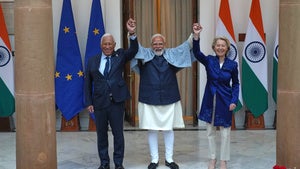
The free trade agreement between India and the European Union is a bold statement by middle powers, demonstrating to both the US and China that there could be better alternatives in a multipolar world.
 Global Politics
Canadian Prime Minister Mark Carney and Chinese President Xi Jinping are set to meet this week in Beijing, with bilateral trade high on the agenda. What does it mean for Trump’s efforts to exert control over the Western Hemisphere?
 Public Opinion
Unique parallel surveys find both publics agree trade and international engagement benefit their countries, but to different degrees.