What the EU-India Trade Deal Means for Middle-Power Networks

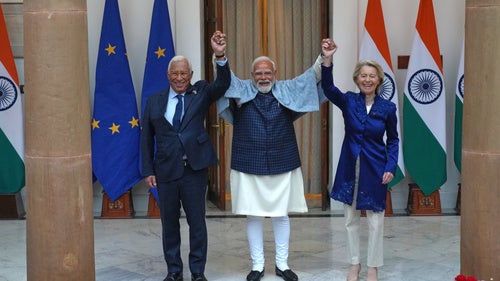
The free trade agreement between India and the European Union is a bold statement by middle powers, demonstrating to both the US and China that there could be better alternatives in a multipolar world.
Middle powers are feeling the pressure.
Canadian Prime Minister Mark Carney’s speech at the World Economic Forum was a powerful rallying call for middle powers to lead. Just days after the forum finished, the European Union and India agreed to a massive trade deal—no doubt spurred on by US President Donald Trump’s threat of tariffs against the two powerful economic players.
Longstanding US partners have been searching for alternative markets for some time. But can middle powers truly go it alone?
The EU-India agreement has the appearance of a swift rebuff to Trump’s “America First” economic agenda, but trade talks between India and the European Union predate Trump’s first administration, spanning nearly two decades. Multilateral trade deals have been stalled for some time—even as global trade continues to grow—and states have turned to bilateral deals as an alternative.
Former US President Barack Obama attempted to negotiate two major multilateral trade frameworks. The Trans-Pacific Partnership (TPP) succeeded, but in a blow to the former president’s ambitions, without the United States. The United Kingdom has since joined the successor agreement, now called the Comprehensive and Progressive Agreement for Trans-Pacific Partnership (CPTPP), and China would like to join. But the United States remains disinterested.
Obama also failed to push through the Transatlantic Trade and Investment Partnership (TTIP), despite trying for many years And key US partners’ frustration over an inability to secure greater access to US markets continued through the Biden administration, where a long hoped-for digital services trade agreement with Singapore failed to materialize.
An Uncomfortable Choice
With the United States abandoning its free trade orientation and China gaining in economic power, middle powers have had to work harder to avoid making an uncomfortable choice between the two dominant powers.
US President Joe Biden was able to force Europe’s hand, and it abandoned talks with China over a comprehensive investment agreement. COVID-19, China’s crackdown on Hong Kong, and security concerns surrounding rapidly developing 5G technologies created even more tension between China and the West. But Trump’s return—and his clear antipathy for the European Union—raised questions about whether Europe would return to its earlier efforts to deepen ties with China.
In what could be mistaken for a European ‘pivot to China,’ recent months have seen a flurry of European leaders traveling to Beijing. French President Emmanuel Macron met with Chinese President Xi Jinping in December, Carney traveled to China just days after the World Economic Forum drew to a close, and UK Prime Minister Keir Starmer (accompanied by a crew of UK business and cultural leaders) recently completed his trip to Beijing and Shanghai. At least five world leaders made trips to China in January alone.
But neither Canada nor Europe are naive about what a deeper reliance on China may entail. Following Carney’s trip to Beijing, Trump threatened to inflict a 100 percent tariff on Canadian exports if the county made a deal with China, which Carney said the country had “no intention” of doing.
Neither Canada nor Europe are naive about what a deeper reliance on China may entail.
Still, the potential for US retaliation may be the least of their concerns, and the recently published US National Defense Strategy hardly portrays China as a bogeyman. Instead, Starmer’s visit comes on the heels of a long and deliberate debate about the United Kingdom’s China policy, a China audit (the results of which have mostly been withheld), the obvious economic need for greater business opportunities abroad, and an intense domestic debate about the location of the Chinese Embassy in London.
This makes the EU-India deal even more interesting.
A Rising Determination Among Middle Powers
“What does it mean for middle powers to live the truth?” Carney asked in his speech at the World Economic Forum.
If the deal is ratified, it may mean two democratic blocs partnering to create opportunities that allow them greater autonomy and resilience in the face of a world of undesirable great-power alternatives.
Described as the “mother of all deals" by European Commission President Ursula von der Leyen, the deal pushes the 27-nation bloc and the world’s fastest-growing major economy—which together represent about 25 percent of the world’s GDP—into a deeper economic and political relationship. Ninety percent of tariffs are expected to be eliminated or reduced under the agreements, including Indian tariffs on European cars and EU tariffs on Indian textiles, the latter of which could lead to the creation of millions of jobs in the sector. A labor mobility clause has also been included, which should see high-skilled Indian workers spending more time working in the European Union and the same in reverse.
How much of this is a reaction to Trump’s policies? The European Union and India have both been hit with higher US tariffs in recent months, with Trump doubling tariffs on Indian goods in August as punishment for India purchasing Russian oil. While the European Union reached a trade agreement with the United States last July, Trump’s threats to tariff European nations that opposed his campaign to invade or otherwise acquire Greenland threatened a grave crisis between the United States and its NATO allies.
“Nostalgia will not bring back the old order. And playing for time—and hoping for things to revert soon—will not fix the structural dependencies we have,” von der Leyen said in Davos. She added that “Europe must speed up its push for independence—from security to economy, from defense to democracy.”
The EU-India deal signals a rising determination among middle powers, one born of necessity, to be bolder and create options.
The EU-India deal signals a rising determination among middle powers, one born of necessity, to be bolder and create options. The fact this deal is among democracies is a bold statement in a world where the great powers seem to have set liberal values to one side. Indian Prime Minister Narendra Modi told the press that the EU-India deal signals a “shared commitment to democracy and rule of law.”
Skepticism is of course warranted. For now, Europe’s ability to stand alone as a security power remains aspirational at best. With an aggressive Russia on its doorstep, and a strong partnership between Russia and China, the United States will continue to have a lasting material advantage if it wishes to return to its role as leader of the West. And if the current trend toward middle-power cooperation continues, the rest of the West may be a more attractive partner to the next US president.
The Chicago Council on Global Affairs is an independent, nonpartisan organization and does not take institutional positions. The views and opinions expressed in this commentary are solely those of the author.