Canadian PM Mark Carney's Trip to China Highlights the Cost of Trump's 'Donroe Doctrine'

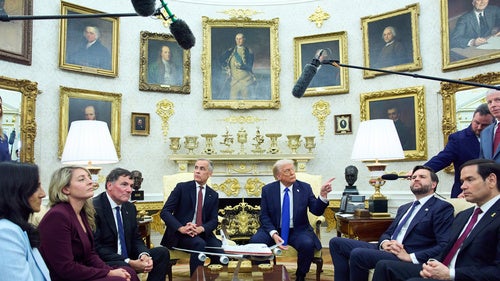
Canadian Prime Minister Mark Carney and Chinese President Xi Jinping are set to meet this week in Beijing, with bilateral trade high on the agenda. What does it mean for Trump’s efforts to exert control over the Western Hemisphere?
Canadian Prime Minister Mark Carney heads to China on Tuesday for a five-day state visit that will include meetings with Chinese President Xi Jinping and Premier Li Qiang. High on Carney’s agenda is bilateral trade, including diversifying Canadian energy exports away from the United States.
The contrast between US President Donald Trump’s pledge to "reassert and restore American preeminence in the Western Hemisphere” and Carney’s trip to China to strengthen bilateral relations is stark, highlighting very real tensions embedded in the “Trump Corollary” to the Monroe Doctrine outlined in the administration’s National Security Strategy. Carney said in a statement ahead of his visit that “Canada is focused on building a more competitive, sustainable, and independent economy.” He plans to use this trip to further the transition of Canada’s economy away “from one that has been reliant on a single trade partner.”
Canada is the fourth-largest oil producer globally. In 2024, it exported an average of 4.2 million barrels per day, with 93 percent flowing to the United States where Midwest refineries processed majority. Canada also maintains large stores of critical mineral deposits—including lithium, nickel, rare earths, and uranium—which are key to America’s energy future. Due to its shared geography and supply chains, Canada is important to American energy and economic security. A loosening of ties is at odds with a US strategy centered on hemispheric dominance.
A loosening of ties is at odds with a US strategy centered on hemispheric dominance.
To be sure, Canada’s interest in diversifying beyond the United States is not simply a response to Washington’s more muscular approach, though it has certainly accelerated such efforts. During the Obama administration, the force of US opposition to extending the Keystone Pipeline System—which was intended to bring Canadian oil through the United States to Gulf Coast refineries—caught Canadian energy officials by surprise. The Obama administration initially rejected the permits, only to have them revived by President Donald Trump in 2017 and then canceled again on President Joe Biden’s first day in office.
Since then, Canada has been looking for ways to diversify trade more broadly. A key pillar of Canada’s export credit agency’s first 10-year plan to reverse declining trade was heading into new markets, and the Canadian government’s 2025 budget included the launch of a “new Trade Diversification Strategy.”
But the timing and framing of this trip have been influenced by recent events. Trump’s repeated threat to make Canada the 51st state has been taken quite seriously by Canadians. In December, Ottawa announced it would be adding 100,000 reserve soldiers and 300,000 citizen soldiers to have at the ready should a need arise. The seizure of Venezuelan crude oil—which has similar characteristics to Canadian oil—is equally concerning to Canadians, as is the threat to Greenland, which is also strategically-located in the Western Hemisphere and has important mineral deposits, as well as deep, long-standing security ties to the United States.
Improving Canada-China relations will not be easy. Relations have been frosty since 2018, when Canadian police arrested a Chinese national at the behest of the United States and China responded by detaining two Canadians. Tensions further heightened when Canada charged China in 2021 with intervening in its domestic elections. Since 2024, China and Canada have gone back and forth inflicting punishing tariffs on each other’s exports. But this past does not necessarily dictate the future of China-Canada relations, and Canada’s position as a leader in clean energy technologies is an area of potential cooperation between Ottawa and Beijing.
Carney is a shrewd leader. After Beijing, he will make a diplomatic stop in Qatar on his way to the World Economic Forum in Switzerland, where he will have ample opportunity to further discuss diversifying Canada’s energy relationships and strategic approach. Trump’s pursuit of hemispheric control is also likely to be a point of conversation and concern among world leaders in attendance, especially given the administration’s use of the ‘Donroe Doctrine’ in framing their actions in in Venezuela. Carney’s China trip is an early test of its impact. If the strategic objective of consolidating America’s position in its own hemisphere results in key neighbors expanding their relationship beyond it, can the approach be said to be working?
The Chicago Council on Global Affairs is an independent, nonpartisan organization and does not take institutional positions. The views and opinions expressed in this commentary are solely those of the author.