Will Public Opinion Pressure Lawmakers to Vote on Iran?

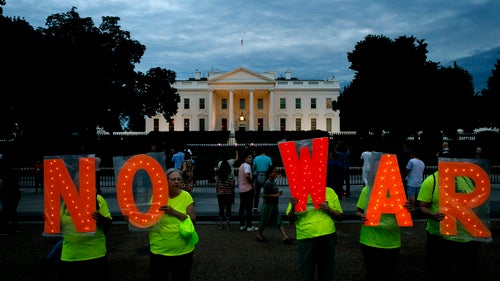
A 60-day period allowing Trump to wage war without congressional approval expires May 1. How legislators respond could influence the midterms.
Nine weeks into the Iran war, the United States is at a "key inflection point" as a 60-day period allowing US President Donald Trump to wage war without congressional approval expires May 1, granting legislators on Capitol Hill the authority to decide whether Trump can continue his military campaign in the Middle East.
Congressional Democrats have put forward several war power resolutions since the start of the conflict, which Republican leaders have repeatedly voted down. But with the war continuing to be unpopular, some GOP lawmakers including Senators Lisa Murkowski (Alaska), Thom Tillis (North Carolina), Susan Collins (Maine), and John Curtis (Utah) are now arguing that Congress should exercise its right to vote on the continuation of the conflict per the 1973 War Powers Resolution. Other Republicans, however, have appeared hesitant to engage in a vote ahead of the midterms, weighing the repercussions of voting in favor of continuing an unpopular war against their alignment with Trump.
Public opinion surveys conducted since the February 28 US-Israel attack on Iran and throughout the war have shown consistent majority opposition to US military action in the region. Recent polling finds about six in 10 Americans say they generally oppose the war. According to a March Pew survey, Americans are most concerned about how the war will directly affect them or fellow Americans, with 69 percent overall worried about higher gas and fuel prices, compared to 61 percent worried about the potential use of US ground troops in Iran and 59 percent worried about the possibility of large numbers of US military casualties.
Yet Americans also appear aware of the war's broader implications. A March Ipsos survey reported that 52 percent of Americans believe the conflict will worsen stability in the Middle East. Overall, two-thirds want the United States to end its involvement in the conflict (66%) even if US military objectives are not met.
A Partisan Divide
Republicans have remained largely supportive of the war, with between two-thirds and three-quarters faithfully backing the president's campaign, compared to about one in 10 Democrats. In an April Ipsos survey, 76 percent of Republicans said they approved of the US missile strikes against Iran compared to just 9 percent of Democrats and 24 percent of Independents. While Republican support for the Iran war is much lower than support for US President George W. Bush's 2003 initial invasion of Iraq—which 90 percent said they supported—at least two-thirds say they approve of Trump's handling of the situation, and a majority believe it will make the region more stable.
Still, the war is putting pressure on Republican leaders ahead of the midterm elections. GOP leadership has signaled a desire for Trump to turn to addressing affordability issues; a recent Gallup poll found 31 percent of Americans are concerned about inflation and high prices, and an increasing number are now citing energy costs as a financial problem. Americans voted for Trump in 2024 in large part due to concerns about the economy and inflation during the Biden years, as well as concerns about immigration. Now, with gas prices up more than 30 percent since the start of the war, they see Trump as going too far on his policies to reduce immigration and not far enough on addressing inflation.
A recent Economist/YouGov poll found that Americans' approval ratings on Trump's handling of inflation and prices have dropped to 29 percent, with his overall approval ratings on par with ratings for President Joe Biden following his 2024 debate performance. In fact, a Fox News poll conducted in April found that for the first time in 16 years, respondents said they think Democrats would do a better job than Republicans on the economy (52% Democrats, 48% Republicans).
How the war ends will also impact public opinion and the trajectory of US leadership. The Council on Foreign Relation's James M. Lindsay writes that "putting US ground troops on the ground would give Democrats a campaign issue and test the strong support that Trump's MAGA base has shown thus far for Operation Epic Fury." Indeed, very few Americans from either party say they would support sending US ground troops into Iran to complete the mission.
If the United States and Iran reach an agreement, public attitudes will depend on whether Americans see the deal as more effective than the 2015 Joint Comprehensive Plan of Action (JCPOA) at curtailing Iran's nuclear program. Chicago Council polling conducted last year found that 61 percent of Americans support US participation in an "agreement that lifts some international economic sanctions against Iran in exchange for strict limits on its nuclear program for at least the next decade." A recent Pew survey reveals that many Americans think Operation Epic Fury will make Iran's development of a nuclear weapon at least as likely (29%) if not more likely (27%) than before the war.
Lingering Effects
Even if the war were to end today, experts agree there will be lingering economic effects from the closure of the Strait of Hormuz. It could take several months or even years for oil supplies to recover to normal levels, and disruptions in fertilizer production and supply are likely to increase global food prices. The International Energy Agency (IEA) predicts that the conflict could impact global natural gas supplies for up to two years.
All of this suggests that the legislative and executive branches of government could face diverging incentives on how and when to end the war in Iran. Party leaders are surely reading the same poll results and are likely internally strategizing on how best to navigate the current storm of negative overall public opinion and expansive presidential powers on foreign policy. Republican leaders are also facing concerns over the GOP performance in midterm elections and a vindictive executive who might demean those who do not stand by his decisions. The situation is further complicated by the Republican base, which seems to back the Trump's positions on Iran while still expressing concern over rising costs.
Trump may decide to continue the war beyond the 60 days in the face of these headwinds through congressional approval, a 30-day presidential extension, or by choosing to fight the law. But how members of Congress respond in this moment could determine which party controls the House of Representatives come November. Of course, many things can happen between now and Election Day, and Americans are not known for their enduring attention spans. But if Congress authorizes an extension of Trump's war against Iran and the economic situation worsens as a result, public opinion suggests it could bolster Democrats' standing.
The Chicago Council on Global Affairs is an independent, nonpartisan organization and does not take institutional positions. The views and opinions expressed in this commentary are solely those of the author.