Why Trump Is Focused on Cuba

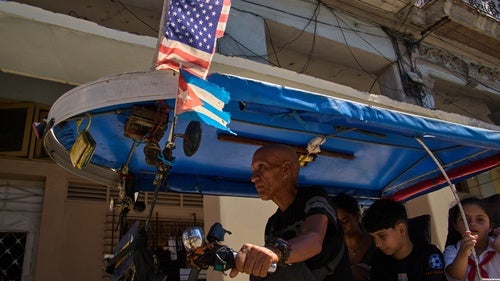
A US oil blockade has brought Cuba to the negotiating table. That gives Washington an “extraordinary opportunity” to influence the island’s trajectory and its relationship with the United States. Will Trump’s power play get in the way?
Cuba managed to restore power on Tuesday after a 29-hour outage plunged millions across the island into darkness. Blackouts have become increasingly common since the Trump administration cut off oil supply to the island in January, sparking an extreme fuel shortage and the nation’s worst economic crisis in decades.
The US blockade, which came on the heels of the US capture of Venezuelan President Nicolás Maduro and seizure of Venezuela’s oil reserves, has forced Cuba to the negotiating table. While Cuban President Miguel Díaz-Canel said his government is open to striking an economic deal with Washington, Trump indicated this week that he wants more from the island, telling reporters, “I think I can do anything I want with it.”
In an apparent response to Trump’s remarks, Díaz-Canel wrote on X that “in the face of the worst scenario, Cuba is accompanied by a certainty: any external aggressor will clash with an impregnable resistance.”
Council Senior Nonresident Fellow Cécile Shea spoke with the Council’s Libby Berry about the significance of this moment, the history of US-Cuba relations, and what the current talks signal about Trump’s view of the world.
This interview has been edited for length and clarity.
What is the nature of the current US-Cuba talks? And what led to this moment?
US-Cuba relations have been deeply strained for 65 or 67 years now. For most of that time, the leader of Cuba was Fidel Castro, who chose early on in his regime to align himself with the Soviet Union. That was the initial source of strain between our two countries.
As a client state of the Soviet Union, Cuba supported revolutions in Africa, terrorist groups in the Middle East, and problematic players in Latin America with arms sales and other expertise. In addition, they were active in the United States in terms of espionage and other matters. So, the stresses have been complex and varied, and the US response—a complete trade embargo on Cuba for most of that period—has been somewhat controversial. Cuba could not import cars from the United States. They could not import fuel, agriculture. Very often they could not import medicine. That led to decades of severe hardship for the Cuban people without a real change in their regime.
Things seemed to be changing during the Obama administration. The United States and Cuba sought to normalize relations. Trade routes opened. People could visit Cuba as tourists. But when President Trump came to power in 2016, he reversed most of those changes. And President Biden clamped down somewhat further.
When the United States arrested Nicolás Maduro in Venezuela, it stopped all Venezuelan oil exports to Cuba. In addition, Washington has threatened serious tariffs on any country that sells fuel to Cuba. This means that Cuba is running out of fuel. The situation is quite dire.
The talks are, from its perspective, to get fuel flowing again to the country, hopefully to remove some of the embargoes that were reinstated in 2016, and to ensure that the United States will not attempt to invade the country. From the US perspective, this is a chance to have some political prisoners released, to have concessions from Cuba to not operate its intelligence services in the United States, and to have some other reforms, such as allowing foreign investment by Cuban nationals into Cuba. What we're waiting to see now is if what Cuba has offered is going to be enough for the Trump administration to pull back on some of its threats.
How do you think Trump's vision for Cuba fits into his broader view of the world?
Trump was in high school during the Cuban Missile Crisis, when Cuba allowed the Soviet Union to place nuclear missiles 90 miles from the United States. It led to the 13 most dangerous days in human history. We almost went into World War III at that point. He and President Joe Biden were young men at the time. It's not ancient history to them: Cuba has been deeply troubling to them throughout their whole lives.
We can't have any more crises in the world. We have Iran. We have Gaza. We have a situation in Lebanon. We don't need a problem here.
Cuba is still not a perfect country, but it has been far less troubling to the United States since the fall of the Soviet Union. I personally hope that these negotiations work and that we're able to start moving toward the right track with Cuba in small part because we can't have any more crises in the world. We have Iran. We have Gaza. We have a situation in Lebanon. We don't need a problem here.
US military interventions in Venezuela and Iran have renewed debates about the United States’ involvement in regime change abroad. How does Cuba compare with these and past interventions?
There were press stories in early March that the Department of Justice was working on finding a reason to indict the president or the prime minister of Cuba, or other leaders in that country, the theory being that the United States could then do what we did in Venezuela: send a military unit into the country and kidnap Cuban leaders to face trial in the United States. But Maduro had been indicted five years ago, so there was an existing indictment that the United States chose to act on by going into the country.
The idea that we would go into a country and kidnap a leader and remove him in order to facilitate regime change is simply not the way the United States has ever operated. And it's certainly not the way the justice system is supposed to operate. You're not supposed to indict people because the president wants an indictment so that he has an excuse to kidnap them. You indict people because they've done something wrong, and then—if they're outside the country—you seek a legal way to bring them into the country.
It opens up a Pandora's box that I don't think we want open, because if we can do it, other countries will do it. What's to stop other countries from coming into our country and kidnapping leaders? What's to stop other countries from trying to assassinate whoever they happen to disagree with?
It's quite clear that the leadership in Cuba is willing to make some significant concessions to the United States at this point—including allowing foreign investment from Cuban nationals, increasing tourism, making it easier for Cubans to leave the country, and releasing political prisoners. The concession they are not willing to make is to step down from their high offices. If this is a demand from the Trump administration, this could be a major sticking point because—according to Cuba's leaders—that would amount to one government telling another government how to behave. And they are not willing to do that at this point.
How do you think US allies would respond if the United States were to press forward with efforts to force a regime change in Cuba?
The rest of the world has been very much opposed to US policy on Cuba for 60 years now. The United Nations almost every year votes to renounce the US embargo against Cuba. The agriculture and business sectors would love to be able to export to Cuba. The hospitality sector, of which President Trump is a member, would love to be able to build hotels in Cuba. The embargoes are unpopular, not just with most countries, but also inside the United States.
The rest of the world would, I think, have zero sympathy for the United States if it were to attempt regime change in Cuba. The situation with Cuba is very different than with Iran. A lot of our allies were somewhat, at least publicly, positive in the early days of our actions in Iran. They're a lot less positive now. I don't think they would be positive at all if we were to go into Cuba.
How do you think Russia and China would respond to any sort of US action against Cuba?
Russia historically has relations with Cuba, but less so since the fall of the Soviet Union. It's not clear to me how active China is. It would be a PR win for both countries. That's probably the biggest issue. They would be able to point to the United States as being an expansionist imperial regime and not respecting other countries and other governments.
What could regime change mean for Cuba? What role could it play on the world stage if a new government were to come into power?
The question of whether or not a new government would change Cuba's ability to operate in the world is actually somewhat less important than the question of whether the United States would end the embargo. Ending the embargo on Cuba is vital to Cuba's future because it will give them capital, will give them access to spare parts, and it will allow them to import from a country that's only 90 miles away. And it would be great for the United States. We could visit Cuba and we could invest in Cuba. There's an enormous Cuban American population, and they would like it to be easier for them to visit their families in Cuba.
Improving relations between Cuba and the United States would also lower the number of refugees coming into Florida because the economy would improve in Cuba and people would feel that they had a reason to stay. In addition, some of the significant number of Cubans who have left recently—as many as 2 million Cubans have left the country in the last five or 10 years—some of them might decide to go home, which would enable them to contribute to the Cuban economy. Ending the US embargo and enabling the country to move forward would clearly be to the US benefit at this point.
Whether or not installing some new type of US-friendly regime in Cuba would bring about the same change is difficult to know because the Cubans are a proud people and they like to feel that they have some say over their own future. Admittedly, it's not a democracy. They did not choose this government. But any country would not be fond of another country coming in and installing a new government or telling that country how to move forward. The Cuban people deserve the right to move toward democracy, and I think that the best way to ensure that is to improve relations between our two countries where we could have more real influence in Cuba and help it to move toward a more open society—as we've managed to do in many other countries over the last 50 years.
How are the Cuban people feeling in this moment? What do you think they are hoping for?
The Cuban people are desperate at this moment. They can't get gasoline. Food is very expensive. They can't go to work. If they are at work, there's no electricity. Tourism is down to a trickle because the hotels can't open because you can't run an elevator without electricity. And there's only electricity for two or three hours a day.
More broadly, I think they are desperate for a normalization of relations with the United States. They would like American tourists to be able to visit Cuba. They would like to be able to import American cars and car parts and American food and beverages. And they would like to be able to visit the United States themselves eventually.
The Cuban people are desperate at this moment. They can't get gasoline. Food is very expensive. They can't go to work. If they are at work, there's no electricity.
In the short term, they're just desperate for relief—for fuel, for food, and for things that they really need right now. In the long term, they want what they've wanted really for 65 years, which is an end to the embargo and a normalization of relations with the United States.
What about on the American side? How do you think the American public would respond to a potential conflict with Cuba, particularly the Cuban diaspora?
Up until the fall of the Soviet Union, the Cuban diaspora was really led by people who had fled Cuba in the early 1960s. Those people brought to this country a lot of scars. Their businesses were nationalized. They lost their life savings. They lost their homes. They lost relatives. They lost their country. And they had very strong anti-Castro feelings.
As they became successful in this country, they became politically powerful. They were major donors in a lot of congressional races. They built friendships with powerful people like President Trump, and they became extremely influential. And their children are even more influential. Secretary of State Marco Rubio is a Cuban American. Senator Ted Cruz from Texas is a Cuban American. There are five members of the House of Representatives who are Cuban Americans.
But—and this is an important but—the new generation has somewhat softer views toward Cuba than their parents did. Now, will there be people angry if President Trump opens all relations with Cuba without getting any concessions? Yes. Would it affect US politics the way it might have in the 80s or the early 90s? Probably not.
What's your take on the talks? Do you think they are heading in the direction of some sort of intervention, or do you think a deal seems more likely?
We have more information from the Cuban side than we do from our own government. From the Cuban side, they seem to have announced that they are willing to make some really important concessions—concessions that we would not have seen a year ago. So they are being very sincere. They are not willing to step down out of power at this point. If that is an absolute requirement from the US side, then it's not clear how things are going to move forward.
I'm hoping that the US negotiators will realize that this is an extraordinary opportunity to get promises for an election in two years. I would say, ‘OK, we have all these other promises from you regarding economic changes and the release of political prisoners (which is huge because if they're releasing political prisoners, it means there's going to be a political opposition in the country). Can we set a goal of free and fair elections two years from now or three years from now?’ That would be a huge win. It would be a feather in President Trump's cap, and it would be the best way to move forward. It would, frankly, make the United States popular in Cuba, which would be good because you want the people in a country 90 miles away to like you. You don't want them to resent you.
The Chicago Council on Global Affairs is an independent, nonpartisan organization and does not take institutional positions. The views and opinions expressed in this commentary are solely those of the author.

Related Content
 US Foreign Policy
"It appears that President Trump has decided that he's going to be the president that brings democracy to Cuba," Council Nonresident Senior Fellow Cécile Shea says. "It's a dangerous goal."
 US Foreign Policy
The US-led postwar international order is being tested in the waters of the Strait of Hormuz and in the shrewd calculations of governments from New Delhi to Helsinki.
 Global Politics
The US military captured Venezuelan President Nicolás Maduro during a large-scale strike. Experts assess what the unprecedented US intervention means for Venezuela, US foreign policy, and regional and global stability.
 US Foreign Policy
US sanctions on Latin American countries have exacerbated the worsening economic and political conditions behind the current migrant surge.