What International Law Experts are Watching in Iran

The laws of war were designed to protect civilians amid armed conflicts. Are they still fit for purpose?
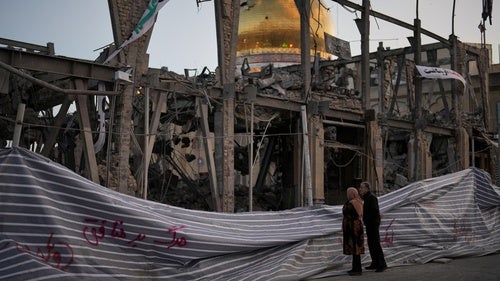
More than 100 legal experts recently signed an open letter expressing concern about potential violations of international humanitarian law during the Iran war, including the bombing of an Iranian girls’ school and threats by US officials to target Iran's civilian infrastructure.
“The laws of war and international humanitarian law came about in the post-World War II era with the goal of protecting civilians in armed conflict. They were based on the idea that even when wars happen, civilians are blameless parties and should not be treated in the same way as soldiers or fighters,” said Priyanka Motaparthy, who signed the letter. "That principle is still an incredibly important one and only grows more important as weapons have developed and military technologies have advanced.”
Motaparthy, director of the Center for International Human Rights and clinical professor at Northwestern University’s Pritzker School of Law, spoke with the Council’s Libby Berry about the legal justifications for going to war, what constitutes a war crime, and whether the existing laws of armed conflict are still fit for purpose.
This interview has been edited for length and clarity.
You joined a group of more than 100 international law experts in signing an open letter expressing concerns about the legality of the conflict in the Middle East. What motivated this response?
The letter came about because so many of us were so gravely concerned about the fact that the United States had gone to war under circumstances that are apparently illegal under the UN Charter in just such a seemingly haphazard way without congressional approval. It really just did not seem that any of the legalities around going to war and the circumstances under which the US should go to war had been followed.
We were equally if not more concerned about the conduct of the war and US-Israeli operations in Iran, seeing reports of severe civilian harm during the first days of the operation—most notably the strike on the Minab girls' school. All of this reporting from a variety of independent and reliable sources led to widespread and serious concern amongst international legal experts about how targeting was happening, how civilian harm was being assessed, and how the US administration was carrying out this war.
What international laws have been violated since the war broke out? And are there any circumstances under which such actions would be considered legal?
The United States should not go to war unless there is direct knowledge that there is an immediate attack that is going to happen either on US soil or against US forces or installations. There is just no indication that that was the case in Iran, and the administration has not really attempted to justify its actions by claiming that there was. These restrictions on the use of state force come from the UN Charter, Article 2.4, which restricts state force and considers it to be an act of aggression except for in very limited circumstances. If there was to be an imminent attack on the United States from Iran, then military action would have been justifiable and would have been legal.
There are also a lot of facts which seem to indicate that targeting may have been done in a way that would constitute a war crime given the number of civilians killed and the apparent targeting of civilian sites and civilian locations. There are also the threats to target civilian infrastructure like desalination plants and power plants upon which the civilian population depends to continue life. All of those things create a set of information which indicate very serious concerns about whether international law was being followed.
As an international law expert, what do you make of US President Donald Trump’s threat to destroy Iran’s “whole civilization” before the two sides reached a ceasefire agreement? Can rhetoric alone constitute a war crime?
A war crime is assessed by the action that is taken, but intent is a big part of that. What was the intention behind an attack? What was the military objective or the goal? And I think what was so extraordinary and prompted this outcry from international law experts was President Trump is the commander in chief of our armed forces. We also have the secretary of defense saying things like, we will give ‘no quarter’ and referring to the ‘stupid rules of engagement.’ These are the highest-level military commanders in our country, and they are making statements that go against basic principles of international humanitarian law and appear to be encouraging violations amongst our armed forces.
A war crime is assessed by the action that is taken, but intent is a big part of that. What was the intention behind an attack? What was the military objective or the goal?
Rhetoric cannot be in and of itself a violation. At the same time, rhetoric helps create what we call a command environment. What are the directions or orders people are getting? What are the incentives that are being created? What is the environment that is being created by this language and by this direction? That is a very important part of assessing whether violations and particularly war crimes have occurred. Official statements from US officials seem to indicate their impression that something is only a war crime if it is deliberate. That is just not true. Reckless targeting and grossly negligent targeting can also rise to that level.
President Trump has also compared the US action in Iran to the US operation in Venezuela. From an international law perspective, how do these two situations compare?
In both cases, we have what is an apparent violation of the UN Charter, the prohibition on what is called an act of aggression, just going to war against another country without that threat of an imminent attack. In the case of Venezuela, it was directed against what the administration has called narcoterrorists. There's a lot of murkiness around what that actually means and who is targetable under that definition. In the case of Iran, it was against an entire regime.
I think the key difference lies in just the nature and duration of the conflict. The Venezuela operation was much more discreet in terms of the time US forces were engaged on the ground and the number of bombings or attacks that happened. The Iran attack was a partner operation with Israel. There were a much larger number of targets hit in that operation. It went on for several weeks, not just a matter of days. There were much larger and wider reports of both civilian casualties and other civilian harm.
How does Maduro’s US indictment factor into the legal justification for the Venezuela operation?
An indictment is a criminal charge. The way to deal with a criminal charge is through a criminal justice proceeding, not through a military operation. And that is true whether it's the leader of a country or whether it is these attacks on boats that we're seeing in the Caribbean. In those attacks in particular, the individuals have been accused of trafficking drugs. That is a criminal offense. It's not an act of war.
How has international law evolved to respond to the rapidly shifting nature of modern warfare? Is the existing framework still fit for purpose?
The laws of war and international humanitarian law came about in the post-World War II era with the goal of protecting civilians in armed conflict. They were based on the idea that even when wars happen, civilians are blameless parties and should not be treated in the same way as soldiers or fighters who are actively participating are treated; They should be protected from risk to the greatest extent possible. That principle is still an incredibly important one and only grows more important.
I think that where the laws of armed conflict face a challenge is in two key areas. The first is around the use of artificial intelligence to scope and develop targets in situations of conflict. These systems can do that at scale and at a more rapid rate than humans can. There is a real danger that there will not be proper verification of these targets and that civilian harm will increase if these technologies are not used responsibly.
The second key area of concern is just the absolute decimation of norms around how conflicts are being fought and the imperative to protect civilians to the greatest extent possible.
What do accountability and justice look like in international law?
Those things operate at many different levels. We need to be holding our elected officials accountable for their role in either supporting or objecting to conflict when we believe it's not justified or not carried out under the right sort of procedures and under the right circumstances. Are they holding hearings? Are they demanding information? What are the actions that they're taking? We need to try and claw back some of those checks and balances that are meant to be in place.
At the international level, accountability can be extremely difficult to achieve and an extremely long road. I think one of the first priorities is to make sure that civilian deaths are properly investigated, that they are investigated to a criminal standard, that both governments and individuals where necessary are held to account for their actions, and that civilians are paid amends or redress if they have been harmed unjustly.
The Chicago Council on Global Affairs is an independent, nonpartisan organization and does not take institutional positions. The views and opinions expressed in this commentary are solely those of the author.

Related Content
 Global Politics
Is there any prospect for accountability when major powers ignore international law? Former UN High Commissioner for Human Rights and legal expert Louise Arbour answers.
 Global Politics
We need to think about an approach to international law's control of the use of force that is true to the moral and power political realities of today's world.
 US Foreign Policy
With distrust deepening and the Iranian regime still in place, can the United States and Iran reach a deal?