What China Wants and Why: Taiwan, North Korea, and Bipolarity

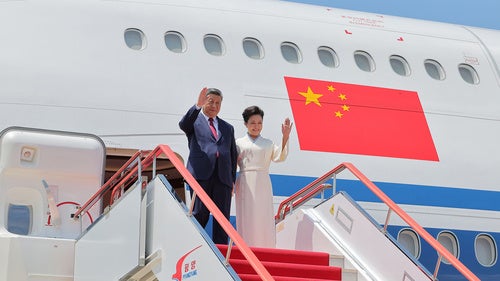
Trump called Xi his “friend” during a May summit in Beijing. But that doesn’t mean the two leaders see eye to eye.
Chinese President Xi Jinping made a surprising trip to Pyongyang this week for a summit with North Korean leader Kim Jong Un. The visit—Xi’s first to North Korea since 2019—came just weeks after the Chinese president hosted US President Donald Trump for talks in Beijing, which the US president described as “very successful” despite failing to secure any concrete agreements.
Meanwhile, the Iran war, tensions over Taiwan, and the competition for global influence continue to strain the relationship between the two great powers. Both leaders agreed to a framework of “constructive strategic stability” during their May meeting. But what does that mean? And what does China really want?
Distinguished Nonresident Fellow Evan Medeiros spoke with the Council's Christina Colón about why China is building up its nuclear capabilities, what Xi’s trip to North Korea signals, and how China’s ambivalence toward the idea of a G2 could inform the future world order.
This interview has been edited for length and clarity.
US President Donald Trump and Chinese President Xi Jinping settled on “constructive strategic stability” as the framework for the US-China relationship during their May summit in Beijing. What does that concept actually capture?
The concept of a constructive relationship of strategic stability is meant to capture the fact that both the United States and China want to ensure a stable relationship through the end of 2026—and perhaps through the end of Trump's second term. They want to avoid another disruptive trade war, for example.
The reason this concept was created by China is because the Chinese like to use these kinds of phrases to structure and discipline bilateral ties and, ultimately, to bind the United States. In other words, China articulates a term, and then it defines how you abide by that particular term. It is classic Chinese statecraft. But ultimately what it's about for both sides is trying to lock in a degree of predictability in US policymaking toward Beijing.
China is rapidly expanding its nuclear arsenal and, according to new satellite imagery, building out an extensive second-strike infrastructure in its northwestern desert. What's driving China's rapid military buildup, and what is it meant to signal?
China's rapid nuclear modernization is driven by two motivations. The first is status. The second is deterrence.
Status is the idea held by Xi and other Chinese leaders that large countries like China need to have nuclear capabilities that are commensurate with their status as a major power in the world. There’s been some very good research by Chinese scholars that point to Xi Jinping's conception of China’s position as a great power as commensurate with having a larger nuclear capability.
But it’s not just status. There's also deterrence. And the deterrence calculus is ensuring that China has a sufficient number of nuclear weapons so that the United States—which has a much larger arsenal than China—doesn't have the ability to coerce or intimidate China. The argument that several scholars make is that China is growing the size of its nuclear arsenal so it can eliminate or checkmate the US ability to coerce China with nuclear weapons if they ever got into a war or a crisis over an issue like Taiwan.
China has positioned itself as a champion of sovereignty, multipolarity, and noninterference. How are other nations interpreting China's role in the world order right now? And how much does that perception matter to Beijing?
China has long advocated these ideas to advance its interests as a rising power and to align itself with those of developing countries, especially the Global South. China is trying to position itself in solidarity with the latter. In other words, China portrays itself as part great power, part developing country. It's this dual identity that is at the heart of the way China presents itself to the rest of the world.
For many countries, they look at China as a country that is deeply invested in multilateralism, the United Nations system, and protecting sovereignty and territorial integrity. But at its core, what China's real value proposition is for many countries in the world is prosperity. China offers a market that they can sell into, a market that they can invest in. Then, of course, the Chinese present themselves to the rest of the world as a country that has enjoyed enormous prosperity in a short period of time—and might have some experiences that those countries can draw on.
What China's real value proposition is for many countries in the world is prosperity.
The challenge China faces internationally right now is that China is such an export juggernaut that it's starting to create pressures toward deindustrialization in many countries. In other words, it's simply putting industries out of business in both developed and developing countries alike. So, what used to be a massive strength for Chinese diplomacy—the fact that it represented extraordinary prosperity and that working with China could improve the economic fortunes of other countries—is now an economic threat as well.
Let's move now to Taiwan. Taiwan remains the most volatile issue in the relationship. Taipei is beefing up its anti-ship missile arsenal, US allies like Japan and the Philippines are stepping up their own deterrence posture, and China even banned New Zealand lawmakers from entering the country after they visited Taipei. What do all these developments tell us about the pressure points around Taiwan and where things might be headed?
Taiwan is by far the most critical and most sensitive issue in the US-China relationship. It's the issue that needs to be watched the most closely because it's the one that could precipitate war between the United States and China.
Right now, we're at a sensitive moment in the Taiwan question because it appears as if the Trump administration is making some accommodations to Beijing in tension with longstanding US policy. The Trump administration, and Trump himself, has suggested and is signaling that it may delay arms sales, delay high-level visits of Taiwan officials to the United States, in order to accommodate Beijing and bring about greater stability in the relationship. These actions are presumably being taken to create a positive environment for Xi Jinping’s upcoming September 24 visit to the US. Of course, Beijing will try to extend these beyond September.
It remains unclear how Taiwan’s leadership and policymakers in Asia will view these policy actions. The net result could be destabilizing for the entire region if the US actions are seen as accommodating Chinese power and its threats, implicit and explicit.
Earlier this week, Xi made his first visit to North Korea since 2019. What's the current state of China-North Korea relations?
For the past decade, China has had very tense relations with North Korea, due in part to the fact that Kim Jong Un and Xi Jinping don't have a good personal relationship which is key in relations between two highly personalistic authoritarian regimes. In addition, China has always been very careful about what technology it shares with North Korea (much to Pyongyang’s frustration), and of course, the issue of North Korea's nuclear weapons program is a longstanding issue of disagreement and dispute. Kim wants Xi to accept and acknowledge him as a nuclear weapon state.
Xi Jinping recent trip Pyongyang is a very clear indicator of a major and historic warming in relations between China and North Korea. Xi’s move is driven by a new strategic calculus on the part of Beijing. China wants to pull North Korea closer in order to have greater certainty and predictability about North Korea's future behavior. But there's a second, even more strategic rationale, which is for China to pull North Korea closer to ensure that it doesn't drift even more into Russia's orbit. Now, both China and Russia are courting North Korea to limit the other's influence in Pyongyang.
Both China and Russia are courting North Korea to limit the other's influence in Pyongyang.
About a year and a half ago, Russia and North Korea signed a mutual security treaty for the first time (making them allies!), and they started to engage in very substantial military cooperation. It’s well known that North Korean soldiers are serving in the Russia-Ukraine war, fighting on the front lines for Russia. I think the Chinese fear that Russia and North have become too close and this relationship could potentially pose some challenges to China So, I think that part of Xi Jinping's play by visiting is to ensure North Korea is at least equidistant between China and Russia and doesn't actually become a pawn or proxy of Moscow in a way that could give Moscow leverage over Beijing.
Trump has embraced the “G2” label, the idea that the US and China are co-managers of the global order. But Beijing has rejected it, arguing that the world shouldn't be run by one or two countries. What does that disagreement reveal about how each side sees the relationship? And what does it signal about the future of US-China relations?
I wouldn't say that Beijing has rejected the G2 concept. What I would say is that they're more ambivalent. They haven't embraced the idea, but they like that the idea is out there
The idea that they have embraced, at least implicitly, is the idea that the world is very rapidly becoming a bipolar in which Beijing and Washington are the two major power centers, the two countries at the center of resolving any major issue in international affairs. And that's exactly the kind of world Beijing wants to operate in, at least for now. The Chinese talk about advocating multipolarity, but what they're really saying is they want a world in which the United States and China are the two key strategic reference points, and then there's a big multipolar world around them.
My big, long-term concern is the Chinese see that as a way station—bipolarity as a half step toward what would ultimately become a world in which China is at the center of international politics and becomes the singular reference point.
The Chicago Council on Global Affairs is an independent, nonpartisan organization and does not take institutional positions. The views and opinions expressed in this commentary are solely those of the author.
Related Content
 US Foreign Policy