In Greenland, European Allies Push Back Against Trump's Pressure Campaign

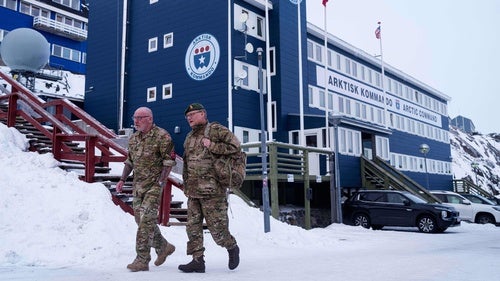
A joint European troop deployment underscores how US allies are navigating Greenland, NATO obligations, and a more coercive American approach.
The Issue
The United Kingdom, Germany, Sweden, France, Norway, the Netherlands, and Finland began sending troops to Greenland this week as part of a joint military exercise referred to as “Operation Arctic Endurance” following a tense meeting at the White House between US, Danish, and Greenlandic officials.
White House Press Secretary Karoline Leavitt told a group of reporters that she does not think the deployment of dozens of troops from the group of NATO countries will impact “the president's decision-making process or impact his goal of the acquisition of Greenland at all.”
Now, President Donald Trump is once again weaponizing tariffs to coerce state leaders to comply with US political and security objectives, saying he may impose them on countries that “don’t go along” with his plan for Greenland.
The threat comes amid a renewed push for peace in Ukraine, which has prompted European leaders to work carefully to remain aligned with the US president. Earlier this month, the United Kingdom agreed to put troops on the ground in Ukraine, pending parliamentary approval, if a peace deal is reached. France offered the same.
UK Defense Secretary John Healey referenced “the depth” of the US-UK defense relationship when speaking about the United Kingdom’s support of the United States in seizing a Russian-flagged oil tanker in violation of US sanctions.
The deployment of troops by NATO countries adds to the efforts by US allies to walk a careful line in the face of Trump’s attempts to subvert the core principles and practical arrangements that underpin the transatlantic partnership.
The deployment of troops by NATO countries adds to the efforts by US allies to walk a careful line in the face of Trump’s attempts to subvert the core principles and practical arrangements that underpin the transatlantic partnership.
Will Trump’s attempt to coerce US allies and take Greenland work?
US lawmakers—including members of Trump’s own party—have voiced their disapproval. Former Republican Senate Majority Leader Mitch McConnell said that a US seizure of Greenland would mean “incinerating the hard-won trust of loyal allies.” And on Friday, an 11-member bipartisan delegation traveled to Greenland to “highlight more than 200 years of friendship between the United States and the Kingdom of Denmark.”
There is also little to no popular support for such a move among the US public. Chicago Council-Ipsos polling conducted just last week finds that Americans overwhelmingly oppose a US invasion of Greenland, with 85 percent decisively against using military force to make Greenland part of the United States.
The Context
While Greenland’s status has been set under international law, the history of Greenland is not straightforward. It was settled by the Norse, colonized by the Danish, served as an outpost for US troops during World War II, and formally became a part of the Kingdom of Denmark in 1953. In 1979, Greenland gained limited autonomy and established its own parliament. A 2008 referendum granted the territory self-rule.
While the world had been happy with the existing arrangements until recently, Greenlanders were less so. A poll undertaken as recently as 2025 found that >84 percent of Greenlanders would like to see their home achieve full independence. Greenlandic Prime Minister Jens-Frederik Nielsen and four party leaders echoed the refrain earlier this month, saying they “want to be Greenlanders”—not Americans or Danes.
The history of Denmark’s relationship with Greenland is complex. A report released in the fall of 2025 documenting a forced contraception policy enacted on Greenlandic girls in the 1960s and 1970s added to tensions between the people of Greenland—the majority of whom are indigenous Inuit—and Danish leadership. Just before the release of the report, government officials in Greenland and Denmark attempted to acknowledge these historical injustices, offering a formal apology in September 2025. In December, the Danish health ministry announced that they would be financially compensating thousands of women as part of a deal reached. Denmark’s health minister Sophie Løhde said that while they “cannot remove the pain from the women,” the payout would help “acknowledge and apologize for the experiences they have gone through.”
Postcolonial narratives are not hard to surface in this context. If Trump’s ambition was to assert US hegemony over Greenland, he could have fostered the sentiments of those who prefer independence. A gradual or sequenced approach may have been more effective in achieving this goal.
But the president appears to prefer disruption, raising questions about his ultimate objective—and his dramatic rhetorical claims on Greenland appear to have led to solidarity between Greenland and Denmark.
The Response
Trump’s claim that the United States should own Greenland has put European nations in a uniquely challenging situation. Article 5 of NATO’s charter states that an attack on a NATO country is “considered an attack against them all.” But the charter does not explicitly outline what to do should the attacker be a member of the alliance.
In deploying troops to Greenland, Europeans are handing the president a gift: a pretense for backing down. Both sides could claim a victory; Europe is doing more this time and in concrete terms to safeguard Greenland and the Arctic, and the United States is responding by unwinding its threats.
In deploying troops to Greenland, Europeans are handing the president a gift: a pretense for backing down.
It does not need mentioning that Germany is sending a “reconnaissance team” of only 13 military personnel. The fact it is sending any at all is symbolically and politically significant.
Greenlanders appear unconvinced that they need the United States for protection in the face of Russian or Chinese moves in the Arctic. Ahead of this week’s White House meeting, Nielsen amended his earlier statement, saying, “We are now facing a geopolitical crisis, and if we have to choose between the United States and Denmark here and now, we choose Denmark."
Denmark’s move away from its long-standing partnership with the United States aligns with actions taken by many other US allies. Last year, Canada and Europe raised their defense spending goals in part to satisfy Trump’s demand, but also to reduce their security reliance on the United States. Just this week, Canadian Prime Minister Mark Carney traveled to China to further bilateral trade between the two countries, becoming the first Canadian prime minister to visit in nearly a decade following the near collapse of the relationship.
In Greenland, Canada and France announced that they would be opening consulates as a “political signal” amid Trump’s continued threats.
What’s Next
The largest-ever US delegation will arrive in Davos, Switzerland, next week for the World Economic Forum’s annual meeting, where Trump is set to deliver a speech.
The meeting is set to occur “against the most complex geopolitical backdrop since 1945,” the forum’s president and CEO Børge Brende said.
Trump’s middle-of-the-night capture of Venezuela's leader and his disturbing claims on Greenland will crowd out much of the more rigorous discussions among global economic leaders on vital issues from artificial intelligence and economic growth to international debt, productivity, and more. But Trump will undoubtedly seek to shock and disrupt European business and political leaders.
When it comes to Greenland, Trump and his top aides are said to prefer a diplomatic path to taking control of the island.
Danish officials said following Wednesday’s meeting that a working group would be formed to continue conversations and address Trump’s national security concerns.
The limited deployment of troops through “Operation Arctic Endurance” is said to be just the start of increased military presence on the island, with Denmark’s deputy prime minister saying the goal is “to establish a more permanent military presence with a larger Danish contribution.”
The Chicago Council on Global Affairs is an independent, nonpartisan organization and does not take institutional positions. The views and opinions expressed in this commentary are solely those of the author.