In Iran, Trump Abandons a US Strategy of Coercive Diplomacy

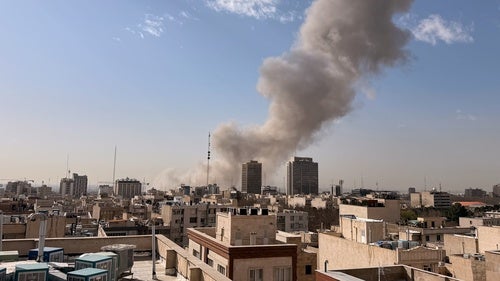
The United States and Israel attacked Iran, signaling a departure from nuclear negotiations.
Editor’s Note: This analysis has been updated to reflect new developments.
One day after talks between Iran and the United States in Geneva concluded with no agreement, the United States and Israel launched massive, coordinated strikes across Iran.
After days of US President Donald Trump signaling a limited focus on ridding Iran of its nuclear capabilities, the United States abandoned any pretense to a limited objective as Trump called for regime change. In a video announcing the launch of “major combat operations in Iran," he characterized the attack as “a massive and ongoing operation to prevent this very wicked, radical dictatorship from threatening America and our core national security interests" and called on the Iranian people to rise up and overthrow their leader.
Earlier in the week, during his State of the Union address, Trump had mostly avoided foreign policy. For a president currently attempting to negotiate an end to wars in Ukraine and Gaza, this came as a surprise. There was no direct mention of China, even with the president’s trip to Beijing on the horizon. But it was the president’s limited remarks on Iran that stood out—delivered amid the largest US military buildup in the Middle East in decades.
Iranian Foreign Minister Abbas Araghchi spoke positively of Thursday's round of indirect negotiations in Geneva, saying both nations were “showing greater seriousness in reaching a negotiated solution.” But US negotiators Steve Witkoff and Jared Kushner appeared to be far less confident in a successful negotiation. And Trump told reporters on Friday that he was “not happy” with Iran, reiterating that Iran cannot have nuclear weapons but adding that a final decision had not been made when it came to using military force. US Vice President JD Vance and other officials met with Omani Foreign Minister Badr al-Busaidi, who had been mediating the recent talks between Iran and the United States, in Washington on Friday to continue discussions.
The strikes come just weeks after a destructive and devastating crackdown on protesters by the Iranian regime resulted in thousands of deaths. The current context made narrowing the focus of the talks to a single diplomatic objective extremely difficult but essential. A weak Iranian regime determined to survive and a US administration that has multiple reasons to wish for a different Iran—and may be both undecided and internally divided on the optimal path forward—made the risk of escalation high for both sides.
Coercive diplomacy is notoriously difficult even in easy cases.
The Trump administration had appeared to be pursuing a difficult but conventional strategy of coercive diplomacy, which rests on a threat to use force if negotiations fail. But coercive diplomacy is notoriously difficult even in easy cases. Success depends on clear communication by the coercer of the objectives of diplomacy and a credible commitment to use force if diplomacy fails—and to deliver in its stated intentions, whether it be lifting sanctions or ceasing the threat to use force. In this case, the attempt to use coercive diplomacy to negotiate a deal appeared to face multiple barriers. Trump’s preferred diplomatic style is one of disruption and unpredictability. While his unpredictability may have delivered success in some cases, it runs contrary to best practice for a successful coercive strategy.
Trump had said he preferred a diplomatic solution that would keep Iran from having nuclear weapons and stop their enrichment of uranium. But US Secretary of State Marco Rubio continued to raise Iran’s ballistic-missile program as an issue that must be addressed, calling Iran’s reluctance to discuss its ballistic missiles a “big, big problem.” Further, Trump’s earlier rejection of the Joint Comprehensive Plan of Action (JCPOA) undercuts the ability of the United States to credibly commit to a deal that is limited to uranium enrichment. When Trump pulled out of the JCPOA in 2018, it was partly because the agreement included a sunset clause but also because the deal failed to address Iran’s ballistic missiles and regional activities. Even if the United States were to agree to a limited deal with Iran focused on uranium enrichment and nuclear weapons, it would not resolve either the United States’ or Israel’s security concerns with respect to ballistic missiles—a real and fundamental problem that impairs the search for a limited deal.
While the current US strategy takes advantage of a weakened Iranian regime, Iran still has the means to retaliate. On Saturday, it responded with its own wave of strikes against regional US targets. It may also attempt to shut down the Strait of Hormuz, cutting off access to one of the world’s most important oil chokepoints. Such a move could cause oil prices to spike, severely disrupting the global economy.
All of this is taking place at a time when Americans have little appetite for war, and as Democrats in Congress are pushing for oversight on matters of war and peace. Democratic leaders had recently announced intentions to force a vote on a war powers resolution next week related to Iran. For his part, US Vice President JD Vance has said there is “no chance” a strike on Iran would result in an extended regional war. But he may not be able to deliver on this promise.
The stakes are high for Americans, US allies, and regional and international stability. The European Union was once again sidelined but continued to support a diplomatic solution, resisting the president’s attempts to use the Diego Garcia base in the Chagos Islands as a launch point for any potential attack against Iran.
While Trump has held tight to his desire to be the “president of the peace,” he has now proved he is not only willing but inclined to use military force. But unlike the targeted intervention in Venezuela, the coordinated attacks on Iran are taking place in a complicated region, making the situation incomparably more complex. Israel's security concerns, Iran's retaliation, and a complex regional environment make the risk of escalation in this current moment considerable.
The Chicago Council on Global Affairs is an independent, nonpartisan organization and does not take institutional positions. The views and opinions expressed in this commentary are solely those of the author.